
Updated 12 November 2026 · Written by the Digital Calculators team · How we made this guide
Key takeaways
- The IRS set the 2027 brackets on 5 November 2026. The seven rates stay the same (10% to 37%); the income thresholds rise. For a single filer, the 22% bracket now starts above $52,025.
- The 2027 standard deduction is $16,600 for single filers, $33,200 for married couples filing jointly and $24,925 for heads of household.
- Your marginal rate is the rate on your last dollar. Your effective rate is your total tax divided by your income, and it is always lower.
- A single person earning $75,000 in 2027 is in the 22% bracket but pays about 9.9% of their income in federal income tax.
The 2027 tax brackets are out. On 5 November 2026 the IRS published its annual inflation adjustments in Revenue Procedure 2026-35, and they apply to income you earn from 1 January 2027 (the return you file in early 2028). The seven tax rates do not change, from 10% up to 37%, but every bracket threshold moves up, and so does the standard deduction.
That is the news. The more useful part is understanding what a bracket actually does to your pay, because it is one of the most misunderstood numbers in personal finance. Many people believe that crossing into a higher bracket means all of their income is taxed at the higher rate, so a raise could leave them worse off. It cannot. Below you will find the official 2027 tables, a clear explanation of marginal and effective tax rates, and worked examples calculated line by line, plus a tax bracket calculator you can use with your own numbers.
- The 2027 federal income tax brackets
- 2027 standard deduction
- Marginal vs effective tax rate
- Worked example: single, $75,000 salary
- Worked example: married couple, $150,000
- Can a raise push you into a higher bracket and lower your pay?
- What changed from 2026 to 2027?
- How to estimate your 2027 tax in four steps
- Frequently asked questions
- Sources
The 2027 federal income tax brackets
These are the taxable-income ranges for each rate in tax year 2027, taken from IRS Revenue Procedure 2026-35. “Taxable income” means income after deductions, not your salary (more on that below).
| Rate | Single | Married filing jointly | Head of household |
|---|---|---|---|
| 10% | up to $12,800 | up to $25,600 | up to $18,250 |
| 12% | $12,800 to $52,025 | $25,600 to $104,050 | $18,250 to $69,650 |
| 22% | $52,025 to $109,125 | $104,050 to $218,250 | $69,650 to $109,100 |
| 24% | $109,125 to $208,325 | $218,250 to $416,650 | $109,100 to $208,300 |
| 32% | $208,325 to $264,550 | $416,650 to $529,100 | $208,300 to $264,550 |
| 35% | $264,550 to $661,375 | $529,100 to $793,650 | $264,550 to $661,350 |
| 37% | over $661,375 | over $793,650 | over $661,350 |
Married people filing separately use the single thresholds up to the 35% bracket; for them, the 37% rate starts above $396,825.
The IRS table also shows the tax owed at the start of each bracket. For a single filer, the tax on the first $52,025 is exactly $5,987, which is 10% of the first $12,800 plus 12% of the next $39,225. We rebuilt every example on this page from the bracket edges and checked it against those IRS figures.
2027 standard deduction
Before the brackets are applied, most people subtract the standard deduction from their income. For 2027 it is:
| Filing status | 2026 | 2027 |
|---|---|---|
| Single | $16,100 | $16,600 |
| Married filing jointly | $32,200 | $33,200 |
| Head of household | $24,150 | $24,925 |
| Married filing separately | $16,100 | $16,600 |
If you are 65 or older or blind, you can add an extra $1,700, or $2,100 if you are unmarried and not a surviving spouse. Someone who is claimed as a dependent gets the greater of $1,400 or their earned income plus $500, up to the normal amount.
The standard deduction is why a single person can earn $16,600 in 2027 before any federal income tax applies at all. You only itemize instead (mortgage interest, state and local taxes, charitable gifts and so on) if those deductions add up to more than the standard amount.
Marginal vs effective tax rate
This is the idea that clears up almost every bracket myth. The US uses a progressive system: each rate applies only to the slice of income that falls inside its bracket. Think of your income being poured into a row of buckets. The first bucket is taxed at 10%; once it is full, the next dollars spill into the 12% bucket, and so on.
- Marginal tax rate: the rate on your next dollar of taxable income, which is the bracket your last dollar lands in. It tells you how much of a raise, a bonus or extra freelance income you will keep.
- Effective tax rate: your total income tax divided by your income. It tells you what share of your money actually goes to federal income tax.
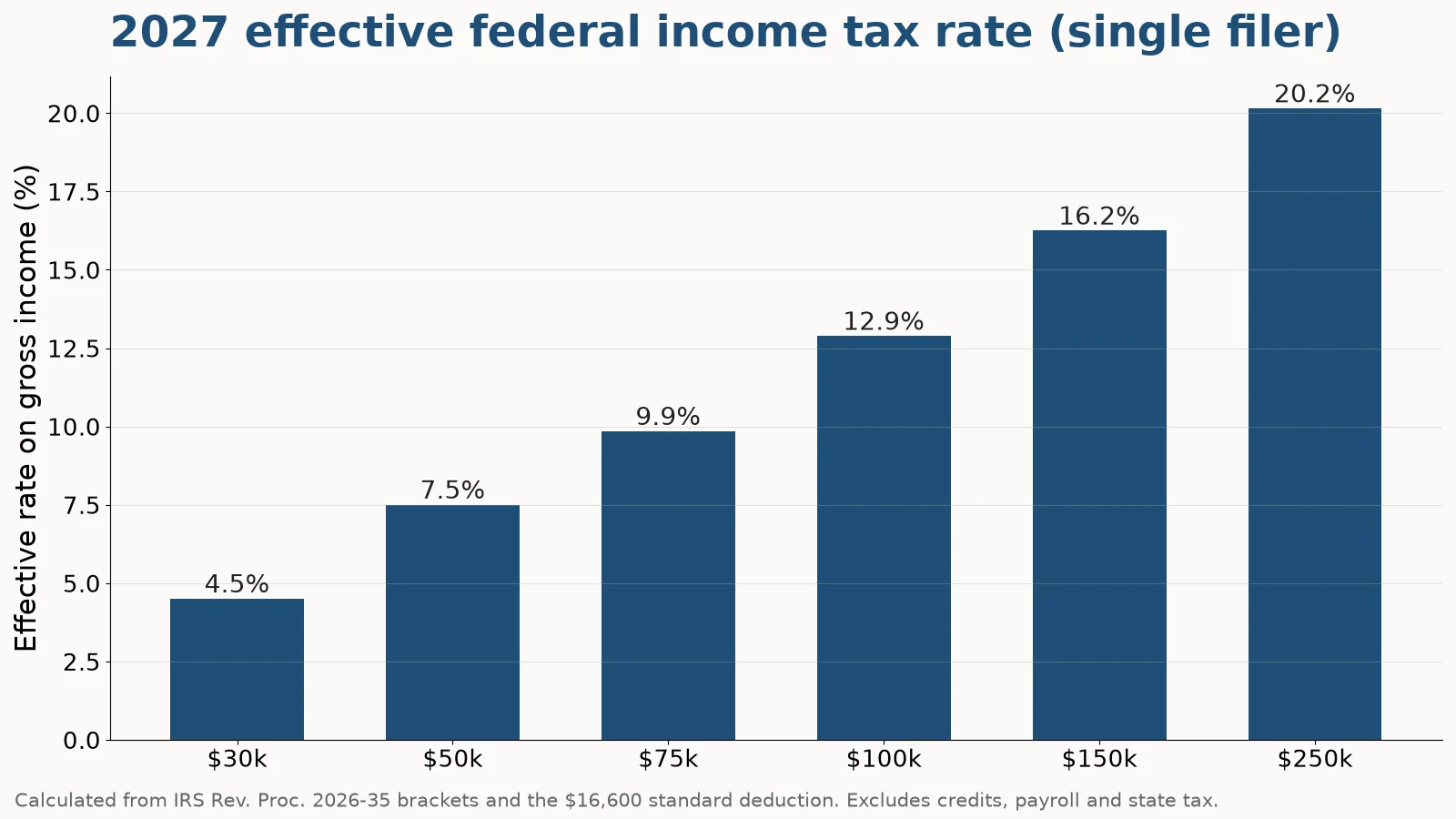
Because the lower slices are always taxed at the lower rates, your effective rate is always below your marginal rate. Here is how that looks across incomes for a single filer in 2027 who takes the standard deduction:
| Gross income | Taxable income | Federal income tax | Marginal rate | Effective rate |
|---|---|---|---|---|
| $30,000 | $13,400 | $1,352 | 12% | 4.5% |
| $50,000 | $33,400 | $3,752 | 12% | 7.5% |
| $75,000 | $58,400 | $7,390 | 22% | 9.9% |
| $100,000 | $83,400 | $12,890 | 22% | 12.9% |
| $150,000 | $133,400 | $24,375 | 24% | 16.2% |
| $250,000 | $233,400 | $50,381 | 32% | 20.2% |
Even at $250,000, where the last dollars are taxed at 32%, the effective rate on the whole income is about 20%. Try your own numbers in the calculator below.
Prefer a full page? Open the Tax Bracket Calculator.
Worked example: single, $75,000 salary
Take a single person with a $75,000 salary in 2027, no other income, who takes the standard deduction.
- Taxable income: $75,000 minus $16,600 = $58,400.
- Fill the brackets:
| Rate | Income in this bracket | Tax |
|---|---|---|
| 10% | $12,800 | $1,280 |
| 12% | $39,225 | $4,707 |
| 22% | $6,375 | $1,402 |
| Total | $58,400 | $7,390 |
The total federal income tax is $7,390. This person is “in the 22% bracket”, yet only $6,375 of their income is taxed at 22%. Their effective rate is 9.9% of their salary (12.7% of taxable income).
Keep in mind that income tax is not the only deduction from a paycheck. Social Security (6.2%) and Medicare (1.45%) are taken on top, and most states add their own income tax. Our paycheck calculator puts all of these together.
Worked example: married couple, $150,000
A married couple filing jointly with $150,000 of combined wages subtracts the $33,200 joint standard deduction, leaving $116,800 of taxable income. The joint brackets are twice as wide as the single ones for the lower rates, so:
- 10% on the first $25,600 = $2,560
- 12% on the next $78,450 = $9,414
- 22% on the remaining $12,750 = $2,805
The total is $14,779, an effective rate of 9.9% on their gross income. Their marginal rate is 22%, so each extra $1,000 of income would add $220 of federal income tax.
Can a raise push you into a higher bracket and lower your pay?
No. This is the most common bracket myth, and the bucket picture shows why. Moving into a higher bracket only changes the rate on the dollars above the threshold.
Say a single filer gets a raise from $67,000 to $70,000 in 2027. Their taxable income rises from $50,400 to $53,400, which crosses the start of the 22% bracket at $52,025. Their tax goes up by $498 on a $3,000 raise, so they keep $2,502 of it. Only the dollars above $52,025 are taxed at 22%; everything below is taxed exactly as before.
There are a few situations where extra income can cost more than the bracket suggests, such as losing eligibility for some credits or benefits that phase out with income, but the brackets themselves never make a raise lose you money.
What changed from 2026 to 2027?
Each year the IRS adjusts the thresholds for inflation so that people are not pushed into higher brackets just because prices and wages rose. For single filers, here is where each bracket starts:
| Rate | 2026 starts above | 2027 starts above | Change |
|---|---|---|---|
| 12% | $12,400 | $12,800 | +$400 |
| 22% | $50,400 | $52,025 | +$1,625 |
| 24% | $105,700 | $109,125 | +$3,425 |
| 32% | $201,775 | $208,325 | +$6,550 |
| 35% | $256,225 | $264,550 | +$8,325 |
| 37% | $640,600 | $661,375 | +$20,775 |
For the same $75,000 single salary, the 2026 rules give $7,670 of federal income tax and the 2027 rules give $7,390, about $280 less, because more income fits in the lower brackets and the standard deduction is $500 higher. If your pay rises roughly with inflation, your tax bill rises with it, but your effective rate stays about the same.
A few other 2027 figures from the same IRS release that often matter alongside the brackets:
- Long-term capital gains: 0% up to $51,050 of taxable income for single filers ($102,100 joint), 15% above that, and 20% above $563,200 single ($633,600 joint).
- Child tax credit: up to $2,300 per child, refundable up to $1,800.
- Annual gift tax exclusion: $20,000 per recipient.
- Health FSA contribution limit: $3,500.
How to estimate your 2027 tax in four steps
- Add up your income for the year: wages, self-employment profit, interest and taxable investment income.
- Subtract adjustments and deductions: pre-tax retirement contributions (traditional 401(k) and similar), then the standard deduction or your itemized deductions, whichever is bigger.
- Apply the brackets for your filing status to the taxable income that is left, slice by slice. The calculator on this page does this for you.
- Subtract credits such as the child tax credit. Credits reduce the tax itself, dollar for dollar, which makes them worth more than a deduction of the same size.
Two practical points. First, the 2027 brackets affect your 2027 paychecks through withholding, which follows IRS Publication 15-T for 2027. Employers usually update this early in January, so your take-home pay may change slightly with your first paycheck of the year. Second, if you are self-employed you pay self-employment tax (15.3% on most net earnings) on top of income tax; see our self-employment tax calculator.
Frequently asked questions
What are the 2027 federal tax brackets?
The rates are 10%, 12%, 22%, 24%, 32%, 35% and 37%. For single filers the brackets start above $0, $12,800, $52,025, $109,125, $208,325, $264,550 and $661,375 of taxable income (IRS Rev. Proc. 2026-35).
What is the 2027 standard deduction?
$16,600 for single filers and married filing separately, $33,200 for married couples filing jointly and $24,925 for heads of household.
When do the 2027 tax brackets apply?
To income earned from 1 January to 31 December 2027, reported on the tax return filed in early 2028. Your 2026 income still uses the 2026 brackets.
What is the difference between marginal and effective tax rate?
The marginal rate is the rate on your last dollar of taxable income (your bracket). The effective rate is total tax divided by income, and it is always lower because lower slices are taxed at lower rates.
Will a raise put me in a higher tax bracket and reduce my take-home pay?
No. Only the income above the bracket threshold is taxed at the higher rate, so you always keep most of a raise.
Is the 2027 tax brackets table based on gross income?
No. Brackets apply to taxable income, which is your income after the standard or itemized deduction and certain adjustments such as traditional 401(k) contributions.
How much federal tax will I pay on $75,000 in 2027?
A single filer with a $75,000 salary and the standard deduction has $58,400 of taxable income and owes about $7,390 in federal income tax, an effective rate of 9.9%, before credits.
Did the tax rates change for 2027?
No. The seven rates are the same as in 2026. Only the income thresholds and deductions were adjusted for inflation.
Related calculators
Sources
- IRS releases tax inflation adjustments for tax year 2027 (IR-2026-133), Internal Revenue Service, 5 Nov 2026. Summary of the 2027 brackets, standard deduction and other amounts.
- Revenue Procedure 2026-35, Internal Revenue Service. Official 2027 rate tables, base-tax amounts, standard deduction, capital gains thresholds, credits and limits.
- Revenue Procedure 2025-32, Internal Revenue Service. 2026 brackets and standard deduction used for the year-over-year comparison.
How we made this guide
This guide was drafted with the help of AI and checked by the Digital Calculators team. Every figure was taken from the sources listed above, which we read directly, and every worked example was calculated in code rather than by hand. The embedded calculator is our own tool. We update the guide when the sources change. This page is general information, not personal tax advice. Spotted a mistake? Tell us.