
Updated 13 November 2026 · Written by the Digital Calculators team
Key takeaways
- Write the digits after the decimal point over the place value of the last digit: 0.625 = 625/1000.
- Simplify by dividing top and bottom by their greatest common factor: 625/1000 ÷ 125 = 5/8.
- Numbers before the point become the whole part of a mixed number: 4.09 = 4 9/100.
- For a repeating decimal, multiply to shift the repeat and subtract: 0.2727… = 27/99 = 3/11.
- A fraction in lowest terms gives a terminating decimal only if its denominator has no prime factors other than 2 and 5.
Learning how to convert a decimal to a fraction comes down to one idea: a decimal already is a fraction, written in a different way. The digits after the point count tenths, hundredths, thousandths and so on, so 0.625 literally means 625 thousandths. Write that as 625/1000, simplify it, and you have 5/8.
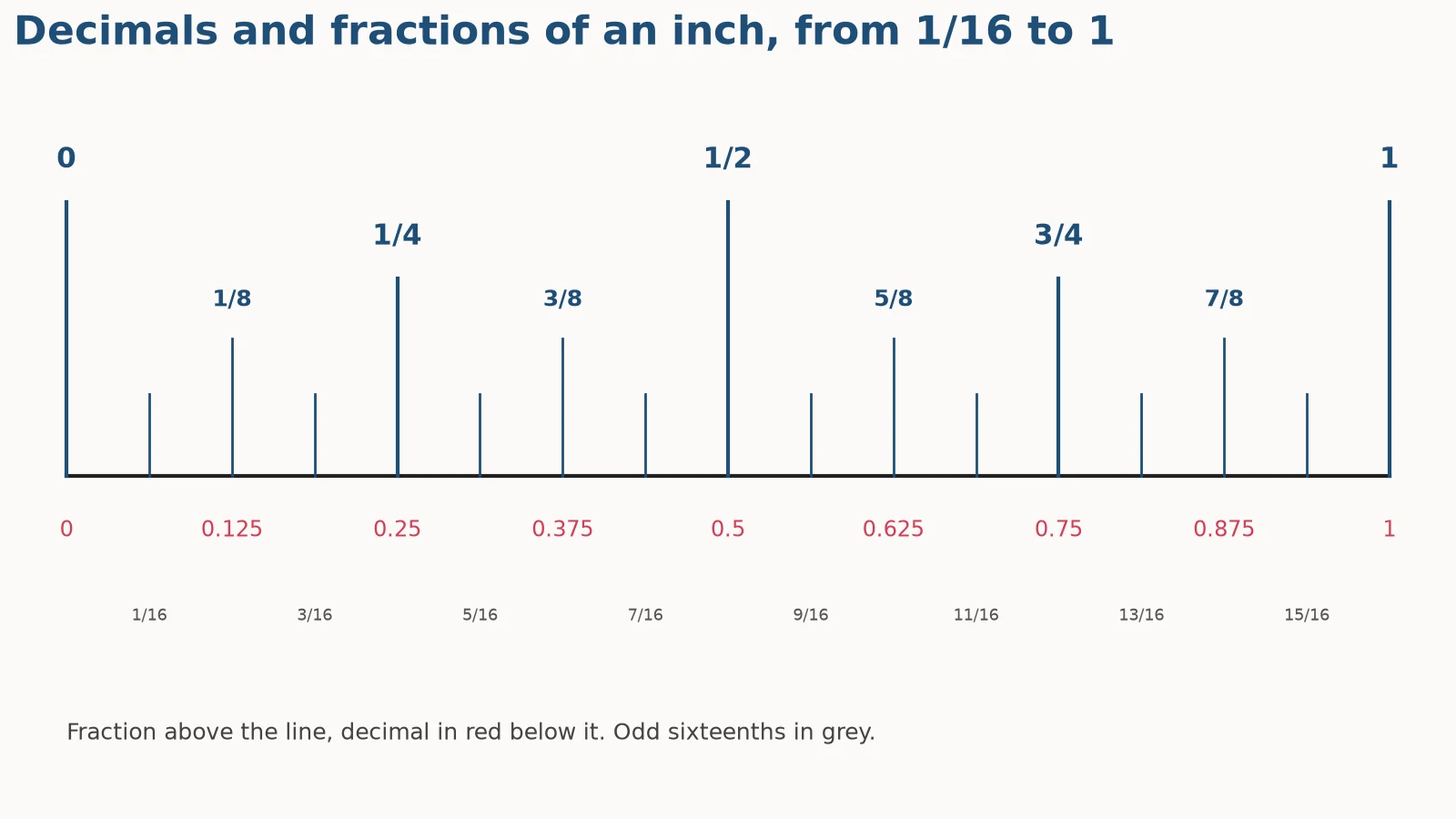
This guide follows the standard four-step method taught in schools, then goes further: how to simplify quickly with the greatest common factor, how to turn repeating decimals such as 0.333… and 0.2727… into exact fractions, why some fractions never stop as decimals, and how to find the nearest practical fraction for a measurement, such as the nearest sixteenth of an inch. There is a full inch-fraction chart and a table of common conversions, and our decimal to fraction calculator is built into the page.
The four-step method
The OpenStax Prealgebra textbook sets out the method in four steps:
- Look at the number to the left of the decimal point. If it is zero, the answer is a proper fraction. If not, it is a mixed number, so write the whole number first.
- Find the place value of the final digit. One digit after the point is tenths, two is hundredths, three is thousandths, and so on.
- Write the fraction. The numerator is the digits to the right of the point; the denominator is that place value.
- Simplify the fraction, if possible.
Here is the method applied to some typical decimals, including the three worked examples from the textbook:
| Decimal | Over place value | Divide by | Simplest form |
|---|---|---|---|
| 0.75 | 75/100 | 25 | 3/4 |
| 0.625 | 625/1000 | 125 | 5/8 |
| 4.09 | 409/100 | 1 | 4 9/100 |
| 3.7 | 37/10 | 1 | 3 7/10 |
| -0.286 | −286/1000 | 2 | −143/500 |
| 0.04 | 4/100 | 4 | 1/25 |
| 2.125 | 2125/1000 | 125 | 2 1/8 |
Notice that the number of zeros in the denominator always equals the number of digits after the decimal point. That is a quick way to check you have the right denominator: 0.04 has two decimal places, so it is 4/100, which simplifies to 1/25.
Negative decimals work exactly the same way; just keep the minus sign in front. So −0.286 is −286/1000, which simplifies to −143/500.
Try any decimal in the calculator below and it will show the steps.
Prefer a full page? Open the Decimal to Fraction Calculator.
How to simplify the fraction
Step 4 is where most of the work is. To simplify, divide the numerator and denominator by their greatest common factor (GCF), the largest number that divides both exactly.
Quick method: divide by small primes
Because place-value denominators are powers of 10, they only have the prime factors 2 and 5. So you only ever need to try dividing by 2 and 5:
- 625/1000: both end in 5 or 0, so divide by 5 → 125/200 → 25/40 → 5/8. 5 and 8 share no factors, so stop.
- 0.48 = 48/100: both even, so divide by 2 → 24/50 → 12/25.
Exact method: Euclid’s algorithm
For large numbers, Euclid’s algorithm finds the GCF in a few steps. Divide the larger number by the smaller, keep the remainder, and repeat until the remainder is zero. For 625/1000:
- 1000 = 1 × 625 + 375
- 625 = 1 × 375 + 250
- 375 = 1 × 250 + 125
- 250 = 2 × 125 + 0
The last non-zero remainder, 125, is the GCF. Dividing 625 and 1000 by 125 gives 5/8 in one go. Our greatest common factor calculator runs this for any pair of numbers.
Converting repeating decimals
A repeating decimal, as OpenStax defines it, is one in which the last digit or group of digits repeats endlessly. You will often see the repeating part written with a bar over it, so 1.333… is written as 1.3 with a line over the 3. These cannot be converted by place value, because there is no final digit. Instead, use a little algebra:
- Call the decimal x.
- Multiply x by 10 for each repeating digit (by 10 for one digit, 100 for two, 1,000 for three) so the repeat lines up.
- Subtract the original x. The endless tail cancels out.
- Solve for x and simplify.
For x = 0.2727…: 100x = 27.2727…. Subtract x and you get 99x = 27, so x = 27/99 = 3/11.
| Decimal | Working | Fraction |
|---|---|---|
| 0.333… | x = 0.333…, 10x = 3.333…, 10x − x = 3, so 9x = 3 | 1/3 |
| 0.272727… | x = 0.2727…, 100x = 27.2727…, 99x = 27 | 3/11 |
| 0.1666… | 10x = 1.666…, 100x = 16.666…, 90x = 15 | 1/6 |
| 0.142857 142857… | 1,000,000x − x = 142,857, so 999,999x = 142,857 | 1/7 |
| 0.999… | 10x = 9.999…, 9x = 9 | 1 |
Two shortcuts fall out of this. A block of repeating digits that starts straight after the point is simply that block over the same number of 9s: 0.454545… = 45/99 = 5/11. And 0.999… repeating is exactly equal to 1, which surprises many people, but the algebra leaves no room for doubt: 10x − x = 9, so x = 1.
If only some digits repeat, as in 0.1666…, multiply twice: once to move past the non-repeating part and once more to line up the repeat, then subtract the two.
Which fractions make terminating decimals?
Some fractions turn into tidy decimals (1/8 = 0.125) and others go on forever (1/3 = 0.333…). There is a simple rule that tells you which, before you do any division:
A fraction in lowest terms gives a terminating decimal only if its denominator’s prime factors are all 2s and 5s.
The reason is that a terminating decimal is a fraction over a power of 10, and 10 = 2 × 5. If the denominator can be scaled up to a power of 10, the decimal stops; if it contains any other prime, such as 3 or 7, it cannot be, and the decimal repeats.
Among the denominators from 2 to 20, only these give terminating decimals: 2, 4, 5, 8, 10, 16, 20. All the others (3, 6, 7, 9, 11, 12, 13, 14, 15, 17, 18, 19) give repeating decimals, unless the fraction simplifies first. For example, 3/12 looks like it should repeat, but it simplifies to 1/4 = 0.25.
This also explains why fractions of an inch are easy to work with as decimals. Halves, quarters, eighths and sixteenths all have denominators made only of 2s, so every one of them converts to an exact decimal.
When the decimal is rounded: finding the nearest fraction
Many decimals you meet in real life have already been rounded, so converting them exactly gives an awkward result. 0.33 is exactly 33/100, but whoever wrote it probably meant one third. Context matters: if a recipe or a calculator display shows 0.33 or 0.333, it is usually a rounded 1/3.
The best fraction with a small denominator
A more systematic approach is to ask for the closest fraction whose denominator is no bigger than a limit you choose. For 3.14159:
- with denominators up to 10, the closest is 3 1/7 (22/7);
- up to 100, it is 311/99 (3.14141);
- up to 1,000, it is 355/113, which matches 3.14159 to all five decimal places shown.
Measurements: nearest sixteenth of an inch
Tape measures in the US are usually marked in sixteenths of an inch, so a decimal measurement needs rounding to the nearest sixteenth. Multiply the decimal part by 16, round to a whole number, and put it over 16:
- 2.3 in: 0.3 × 16 = 4.8, which rounds to 5, so 2.3 in ≈ 2 5/16 in (2.3125 in, off by 0.0125 in).
- To the nearest eighth: 0.3 × 8 = 2.4, which rounds to 2, so 2.3 in ≈ 2 1/4 in.
- 0.6875 in is exactly 6,875/10,000, which simplifies to 11/16 in, so no rounding is needed.
Our rounding calculator and feet and inches calculator help with measurements like these.
Inch fractions to decimals and millimeters
Because an inch is defined as exactly 25.4 mm (a foot is exactly 0.3048 m), every sixteenth of an inch has an exact decimal and metric value. This chart is useful for drill bits, wrenches, woodworking and any job that mixes imperial and metric:
| Fraction | Decimal inch | Millimeters |
|---|---|---|
| 1/16 | 0.0625 | 1.5875 mm |
| 1/8 | 0.1250 | 3.175 mm |
| 3/16 | 0.1875 | 4.7625 mm |
| 1/4 | 0.2500 | 6.35 mm |
| 5/16 | 0.3125 | 7.9375 mm |
| 3/8 | 0.3750 | 9.525 mm |
| 7/16 | 0.4375 | 11.1125 mm |
| 1/2 | 0.5000 | 12.7 mm |
| 9/16 | 0.5625 | 14.2875 mm |
| 5/8 | 0.6250 | 15.875 mm |
| 11/16 | 0.6875 | 17.4625 mm |
| 3/4 | 0.7500 | 19.05 mm |
| 13/16 | 0.8125 | 20.6375 mm |
| 7/8 | 0.8750 | 22.225 mm |
| 15/16 | 0.9375 | 23.8125 mm |
| 1 | 1.0000 | 25.4 mm |
To convert any decimal inch to millimeters, multiply by 25.4. To convert millimeters to the nearest sixteenth, divide by 25.4 and then round the decimal part as shown above. Our mm to inches converter does both directions.
Common decimals and their fractions
These are the conversions that come up most often. The repeating ones are shown to four decimal places with “…” to mark that they continue.
| Fraction | Decimal | Type |
|---|---|---|
| 1/2 | 0.5 | Terminating |
| 1/3 | 0.3333… | Repeating |
| 2/3 | 0.6667… | Repeating |
| 1/4 | 0.25 | Terminating |
| 3/4 | 0.75 | Terminating |
| 1/5 | 0.2 | Terminating |
| 2/5 | 0.4 | Terminating |
| 1/6 | 0.1667… | Repeating |
| 1/8 | 0.125 | Terminating |
| 3/8 | 0.375 | Terminating |
| 5/8 | 0.625 | Terminating |
| 7/8 | 0.875 | Terminating |
| 1/9 | 0.1111… | Repeating |
| 1/10 | 0.1 | Terminating |
| 1/12 | 0.0833… | Repeating |
Going the other way: fraction to decimal
To turn a fraction back into a decimal, divide the numerator by the denominator. OpenStax shows this with 4/3: dividing 4 by 3 always leaves a remainder of 1, so the 3s in the answer go on forever, giving 1.333…. With a calculator, 5 ÷ 8 = 0.625 confirms the example we started with.
To turn a decimal into a percentage, multiply by 100: 0.625 = 62.5%. Our fraction calculator adds, subtracts, multiplies and divides fractions and shows the decimal result.
Frequently asked questions
How do you convert a decimal to a fraction?
Write the digits after the decimal point over the place value of the last digit (10, 100, 1,000…), then simplify. 0.75 = 75/100 = 3/4.
What is 0.625 as a fraction?
5/8. 0.625 is 625/1000, and dividing both by their greatest common factor, 125, gives 5/8.
What is 0.333 repeating as a fraction?
Exactly 1/3. If x = 0.333…, then 10x − x = 3, so 9x = 3 and x = 1/3.
How do I convert a decimal greater than 1 to a fraction?
Keep the whole number and convert the decimal part. 4.09 becomes 4 and 9/100, written 4 9/100, or 409/100 as an improper fraction.
Why do some fractions have repeating decimals?
In lowest terms, a fraction terminates only if its denominator’s prime factors are 2s and 5s. Any other prime factor, such as 3 or 7, makes the decimal repeat.
What is 0.2 as a fraction?
1/5. 0.2 is 2/10, which simplifies to 1/5.
What is 0.125 as a fraction?
1/8. 0.125 is 125/1000, and dividing both by 125 gives 1/8.
Is 0.999 repeating equal to 1?
Yes. If x = 0.999…, then 10x − x = 9, so 9x = 9 and x = 1 exactly.
Related calculators
Sources
- Prealgebra 2e, 5.1 Decimals, OpenStax, Rice University. The four-step method for converting decimals to fractions and mixed numbers.
- Prealgebra 2e, 5.3 Decimals and Fractions, OpenStax, Rice University. Definition and notation of repeating decimals; converting fractions to decimals.
- Handbook 44 (2026), Appendix C: General Tables of Units of Measurement, National Institute of Standards and Technology. The exact metric definition of the foot and inch used in the inch-fraction chart.