
Updated 13 November 2026 · Written by the Digital Calculators team
Key takeaways
- The National Academies’ Adequate Intake is 3.7 liters of total water a day for men and 2.7 liters for women, including the water in food.
- That means roughly 3.0 L (about 13 cups) of drinks a day for men and 2.2 L (about 9 cups) for women.
- About 80% of total water comes from drinks; the rest comes from food. Coffee, tea and milk count.
- For most healthy people, thirst and drinks with meals keep hydration normal; heat and long exercise raise needs.
- CDC survey data show US men averaged 3.46 L and women 2.75 L of total water a day.
“How much water should I drink a day?” is one of the most searched health questions, and the honest answer is less dramatic than most wellness advice. The official reference is the Dietary Reference Intakes for water from the Institute of Medicine (now part of the National Academies). It sets an Adequate Intake of about 3.7 liters of total water a day for adult men and 2.7 liters for adult women. Total water includes everything: plain water, other drinks and the water in your food.
Because roughly 80% of that comes from drinks, the practical figure is about 3 liters (13 cups) of fluids a day for men and 2.2 liters (9 cups) for women. This guide sets out the intakes for every age group, plus pregnancy and breastfeeding, explains what counts toward them, looks at the “8 glasses a day” and “half your body weight” rules, and compares the targets with how much Americans actually drink, according to CDC survey data. Our water intake calculator is built into the page. This is general information, not medical advice; people with heart, kidney or other conditions should follow their own doctor’s guidance.
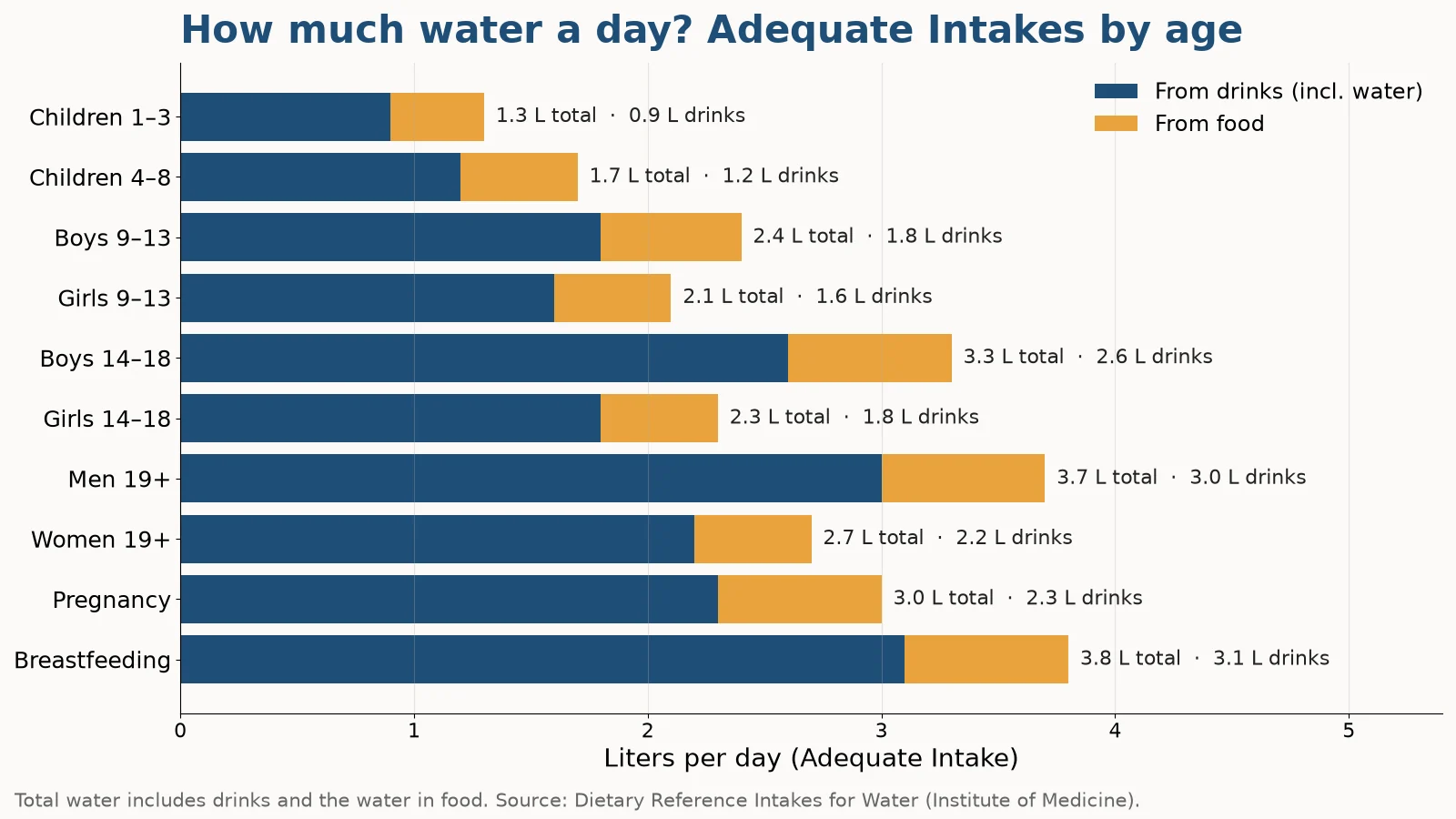
Daily water intake by age and sex
The Institute of Medicine set Adequate Intakes (AIs) for total water at every life stage. The table shows each one, with the approximate share from drinks that the report gives, and what is left to come from food. Ounces and cups use the report’s conversion of 1 liter = 33.8 fluid ounces and 1 cup = 8 fluid ounces.
| Group | Total water a day | From drinks | From food |
|---|---|---|---|
| Children 1–3 | 1.3 L (44 oz) | 0.9 L (about 4 cups) | 0.4 L |
| Children 4–8 | 1.7 L (57 oz) | 1.2 L (about 5 cups) | 0.5 L |
| Boys 9–13 | 2.4 L (81 oz) | 1.8 L (about 8 cups) | 0.6 L |
| Girls 9–13 | 2.1 L (71 oz) | 1.6 L (about 7 cups) | 0.5 L |
| Boys 14–18 | 3.3 L (112 oz) | 2.6 L (about 11 cups) | 0.7 L |
| Girls 14–18 | 2.3 L (78 oz) | 1.8 L (about 8 cups) | 0.5 L |
| Men 19+ | 3.7 L (125 oz) | 3.0 L (about 13 cups) | 0.7 L |
| Women 19+ | 2.7 L (91 oz) | 2.2 L (about 9 cups) | 0.5 L |
| Pregnancy | 3.0 L (101 oz) | 2.3 L (about 10 cups) | 0.7 L |
| Breastfeeding | 3.8 L (128 oz) | 3.1 L (about 13 cups) | 0.7 L |
Infants are covered separately: about 0.7 L a day from breast milk up to 6 months, and 0.8 L of total water from 7 to 12 months.
The adult values are the same at every age from 19 upward; the report does not lower them for older adults. Pregnancy raises the AI for total water to 3.0 L a day and breastfeeding raises it to 3.8 L.
Try the calculator below to adjust for your own weight, activity and climate.
Prefer a full page? Open the Water Intake Calculator.
What an Adequate Intake actually means
An Adequate Intake is not a minimum you must hit every day, and it is not the same as a Recommended Dietary Allowance (RDA). The report uses an AI when there is not enough evidence to set an average requirement. For water, the AIs are based on how much healthy, well-hydrated people in the US typically consume.
The report’s summary makes a reassuring point: except during prolonged physical activity or heat exposure, day-to-day fluid intake, driven by a combination of thirst and drinking at meals, keeps hydration and total body water at normal levels. In other words, most healthy people who drink when thirsty and have a drink with meals are already close to where they need to be.
Needs genuinely rise with:
- Heat: sweating in hot weather increases water losses.
- Long or hard exercise: extended activity raises losses well above everyday levels.
- Pregnancy and breastfeeding, as the table shows.
CDC’s analysis of national survey data also found that water intake rose with physical activity level for both men and women, which fits that picture.
What counts toward your daily water
All of it. The report is explicit that total water comes from the moisture in food, from drinks such as juice and milk, and from drinking water, and that no one source is essential for normal health. Some practical points:
- Food: about 20% of total water comes from food. Fruit, vegetables, soups and yogurt are mostly water.
- Coffee and tea: the report notes that caffeinated drinks have shown diuretic effects in some studies, but that the effect may be transient and that these drinks do contribute to total water intake.
- Milk and juice count, though juice adds sugar and calories.
- Plain water is the simplest choice, with no calories, but it is only part of most people’s intake. CDC data show plain water made up 30% of total water for men and 34% for women.
So someone who has two coffees, a glass of milk, soup at lunch and a couple of glasses of water with meals may be much closer to the target than they think. Our cups to mL converter and oz to mL converter help if your bottle is marked in different units.
The 8 glasses a day rule and other shortcuts
“Eight 8-ounce glasses a day”
Eight 8 oz glasses is 64 ounces, about 1.9 liters. That is less than the drinks portion of the AI for adult women (2.2 L) and men (3.0 L). But because food and every other drink also count, the 8 × 8 rule is neither a minimum nor a target; it is simply an easy-to-remember amount of plain water that many people will exceed once everything else is included.
“Drink half your body weight in ounces”
This popular rule does not come from the Dietary Reference Intakes, which give the same AI for every adult man or woman regardless of weight. Here is what it would suggest:
| Body weight | “Half your weight” rule |
|---|---|
| 120 lb | 60 oz (1.8 L) |
| 150 lb | 75 oz (2.2 L) |
| 180 lb | 90 oz (2.7 L) |
| 220 lb | 110 oz (3.3 L) |
For a 150 lb woman the rule gives 75 oz, close to the AI’s 2.2 L of drinks (about 74 oz). For a 220 lb man it gives 110 oz, a little above the 3.0 L drinks figure (about 101 oz). It is a rough guide at best. Size does affect needs, which is why our calculator lets you adjust for weight, but no single formula fits everyone.
How much water Americans actually drink
The CDC’s National Center for Health Statistics analyzed national survey data from 2009 to 2012. It found that:
- US men consumed an average of 3.46 liters (117 oz) of total water a day, and women 2.75 liters (93 oz).
- Intake fell with age: men aged 60 and over averaged 2.92 L, compared with 3.61 L for ages 20 to 39 and 3.63 L for 40 to 59. Women aged 60 and over averaged 2.51 L, against 2.78 L and 2.9 L for the younger groups.
- Intake rose with physical activity for both sexes.
- Plain water made up 30% of men’s total water and 34% of women’s, so roughly 1.0 L and 0.9 L a day respectively.
So on average, men were a little below the 3.7 L AI and women right around the 2.7 L AI. The same report notes that consuming too little water raises the risk of dehydration, kidney stones and poorer cognitive performance, which is a good reason to keep an eye on intake if you are often busy, outdoors or older.
A simple daily plan
If you want to check that you are getting enough drinks, here is one way an adult woman could reach about 74 oz (2.2 L) of fluids in an ordinary day, in line with the 2.2 L drinks figure:
| When | Drink | Amount |
|---|---|---|
| Breakfast | Coffee or tea, 1 cup | 8 oz |
| Mid-morning | Glass of water | 12 oz |
| Lunch | Glass of water or milk | 12 oz |
| Afternoon | Water bottle, half | 8 oz |
| Dinner | Glass of water | 12 oz |
| Evening | Herbal tea or water | 8 oz |
| Through the day | Small top-ups | 14 oz |
| Total | 74 oz |
An adult man aiming for about 3.0 L of drinks would add roughly 27 oz more, for example a larger bottle in the afternoon.
Practical tips
- Drink with meals. The report points to drinks at meals, together with thirst, as what normally keeps people hydrated.
- Keep water visible. A refillable bottle on your desk or in your bag makes it easy to top up.
- Plan for heat and exercise. Drink more on hot days and during long activity, when losses rise.
- Do not force it. Drinking large amounts far beyond thirst is not necessary for healthy people. If you have a medical condition that affects fluids, follow your doctor’s advice.
For hot days, our heat index calculator shows how hot it really feels.
Frequently asked questions
How much water should I drink a day?
The National Academies’ Adequate Intake is about 3.7 liters of total water a day for men and 2.7 liters for women, including food. That is roughly 13 cups of drinks for men and 9 cups for women.
How much water should a woman drink a day?
About 2.7 liters of total water, of which roughly 2.2 liters (about 9 cups) comes from drinks. Pregnancy raises this to 3.0 liters and breastfeeding to 3.8 liters.
How much water should a man drink a day?
About 3.7 liters of total water, of which roughly 3.0 liters (about 13 cups) comes from drinks.
Do coffee and tea count toward water intake?
Yes. The National Academies’ report says any diuretic effect of caffeine may be transient and that caffeinated drinks contribute to total water intake.
Is 8 glasses of water a day enough?
Eight 8-ounce glasses is about 1.9 liters. Together with food and other drinks, that may be enough for many people, but it is not an official target.
Does food count as water intake?
Yes. About 20% of total water comes from food, and fruit, vegetables and soups are especially high in water.
How much water do kids need?
The Adequate Intake is 1.3 liters of total water a day for ages 1 to 3 and 1.7 liters for ages 4 to 8, including food.
Do I need more water when exercising?
Yes. Prolonged physical activity and heat exposure increase water losses, so drink more on those days.
Related calculators
Sources
- Dietary Reference Intakes for Water, Potassium, Sodium, Chloride, and Sulfate, Chapter 4: Water, Institute of Medicine, National Academies Press (2005). Adequate Intakes for total water by life stage and the share from drinks.
- Dietary Reference Intakes for Water, Potassium, Sodium, Chloride, and Sulfate, Summary, Institute of Medicine, National Academies Press (2005). What an Adequate Intake means, thirst and meals, the 80% from drinks, caffeine and the sources of water.
- Daily Water Intake Among US Men and Women, 2009–2012 (NCHS Data Brief 242), Centers for Disease Control and Prevention. Average total water intake by sex and age, the plain-water share, and links with physical activity.