
Updated 13 November 2026 · Written by the Digital Calculators team
Key takeaways
- The RDA for adults is 46 g of protein a day for women and 56 g for men (Dietary Guidelines).
- That comes from about 0.8 g per kilogram of body weight for a reference adult (National Academies).
- Protein can supply 10% to 35% of an adult’s calories, which is 50 to 175 g on a 2,000-calorie diet.
- Pregnancy and breastfeeding raise the RDA to 71 g a day.
- One ounce of meat, fish or poultry, one egg, ¼ cup of tofu or ½ cup of cooked beans each gives about 7 g.
If you are wondering how much protein per day you need, the official answer may be less than you expect. The Recommended Dietary Allowance (RDA) in the Dietary Guidelines for Americans is 46 grams a day for adult women and 56 grams for adult men. Those figures come from the National Academies’ Dietary Reference Intakes, which base protein on about 0.8 grams per kilogram of body weight for a reference adult.
The RDA is the amount that covers the needs of nearly all healthy people, not a ceiling. Adults can get anywhere from 10% to 35% of their calories from protein within the accepted range. This guide shows how to work out your own figure from your weight, how the calorie-based range works, how needs change for children, teens, pregnancy and breastfeeding, and what a day of food looks like at the RDA, with and without meat. Our protein calculator is built into the page. This is general information; people with kidney disease or other conditions should follow their own clinician’s advice.
Protein needs by body weight
The National Academies’ Food and Nutrition Board expresses the adult protein RDA as about 0.8 g of protein per kilogram of body weight, based on reference body weights. To use it for yourself:
- Convert your weight to kilograms: pounds × 0.4536 (or pounds ÷ 2.2).
- Multiply by 0.8.
For example, a 180 lb person weighs 81.6 kg, so 0.8 × 81.6 = 65 g of protein a day. A shortcut in pounds is to multiply your weight by about 0.36.
| Body weight | Protein at 0.8 g/kg |
|---|---|
| 110 lb (50 kg) | 40 g |
| 130 lb (59 kg) | 47 g |
| 150 lb (68 kg) | 54 g |
| 170 lb (77 kg) | 62 g |
| 190 lb (86 kg) | 69 g |
| 210 lb (95 kg) | 76 g |
| 230 lb (104 kg) | 83 g |
| 250 lb (113 kg) | 91 g |
The Dietary Guidelines round this into the simple 46 g and 56 g figures for women and men. If you are much larger or smaller than average, the per-kilogram figure gives a more personal estimate. The calculator below does the conversion for you and also shows the calorie-based range.
Prefer a full page? Open the Protein Calculator.
The 10–35% of calories range
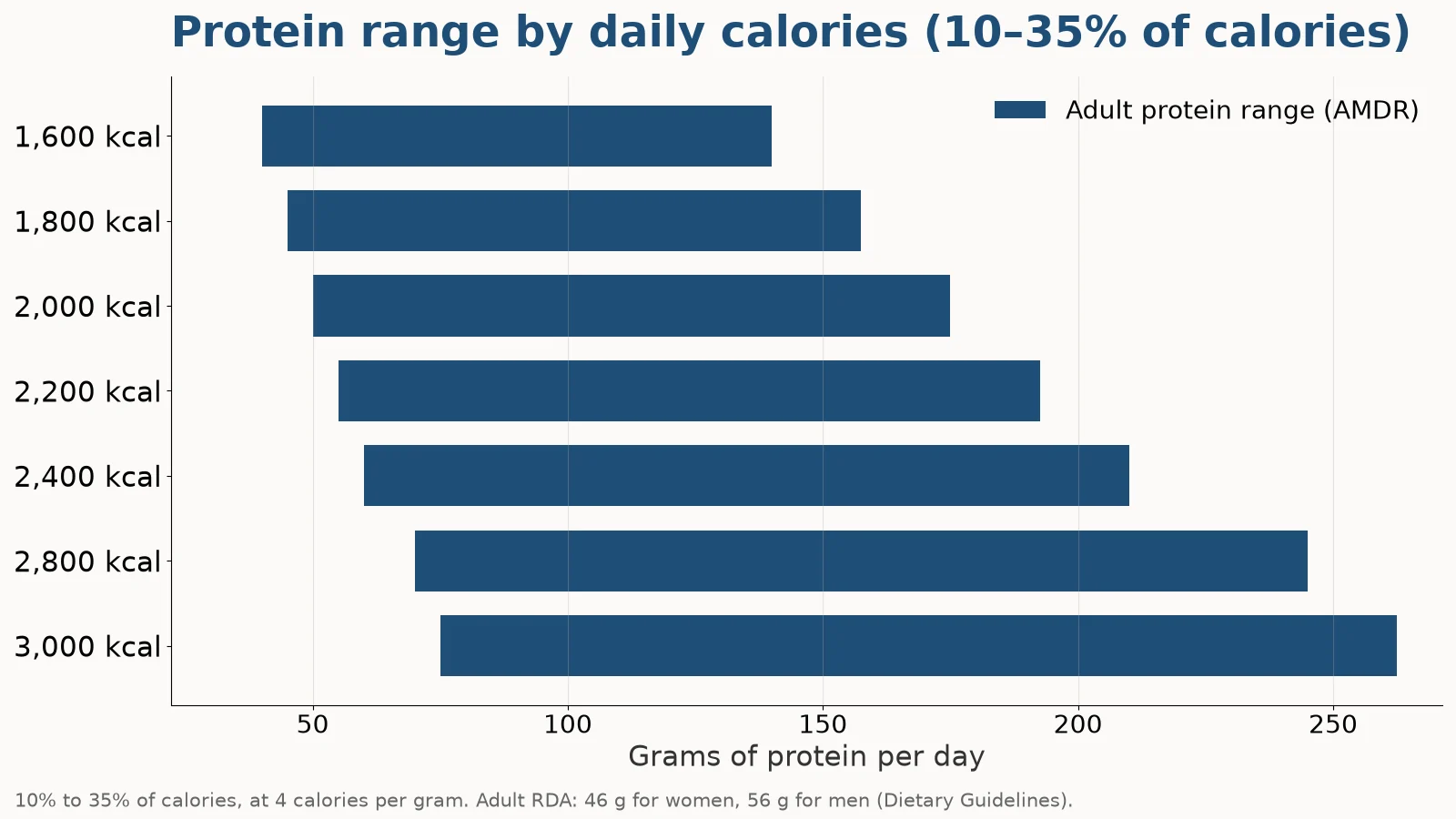
Besides the RDA, the Dietary Guidelines set an Acceptable Macronutrient Distribution Range (AMDR) for protein: 10% to 35% of calories for adults. MedlinePlus, from the National Library of Medicine, gives the same range and explains the arithmetic: each gram of protein supplies 4 calories, so a person eating 2,000 calories a day could eat 100 g of protein, which would supply 20% of their calories.
Here is the full range at different calorie levels:
| Calories a day | 10% of calories | 35% of calories |
|---|---|---|
| 1,600 | 40 g | 140 g |
| 1,800 | 45 g | 158 g |
| 2,000 | 50 g | 175 g |
| 2,200 | 55 g | 192 g |
| 2,400 | 60 g | 210 g |
| 2,800 | 70 g | 245 g |
| 3,000 | 75 g | 262 g |
The two measures fit together. The 56 g RDA for men provides 224 calories, which is about 9% of a 2,400-calorie day, just below the bottom of the range. That is a useful reminder that the RDA is a level to reach, not a target to stop at: a diet that gets even 10% of its calories from protein will usually exceed it. For our 180 lb example on 2,400 calories, the RDA of 65 g is 11% of calories, and the top of the range would be 210 g. So there is plenty of room to eat more protein than the RDA within accepted guidelines.
If you want to plan protein alongside carbohydrates and fat, our macro calculator splits your calories into all three.
Protein for children, teens, pregnancy and breastfeeding
Protein needs change across life. These are the RDAs and the protein share of calories from the Dietary Guidelines’ nutritional goals tables:
| Group | Protein RDA (g/day) | Protein share of calories |
|---|---|---|
| Ages 2–3 | 13 g | 5–20% |
| Ages 4–8 | 19 g | 10–30% |
| Ages 9–13 | 34 g | 10–30% |
| Girls 14–18 | 46 g | 10–30% |
| Boys 14–18 | 52 g | 10–30% |
| Women 19+ | 46 g | 10–35% |
| Men 19+ | 56 g | 10–35% |
| Pregnancy | 71 g | 10–35%* |
| Breastfeeding | 71 g | 10–35%* |
*The calorie range during pregnancy and breastfeeding is 10–30% for ages 14 to 18 and 10–35% for adults.
The adult RDAs stay the same from age 19 onward in these tables: 46 g for women and 56 g for men whether you are 25 or 65. Pregnancy and breastfeeding raise the RDA to 71 g a day at every stage. MedlinePlus notes that children and teens may need different amounts depending on their age, which the table reflects: a teenage boy’s RDA (52 g) is already close to an adult man’s.
What 7 grams of protein looks like
MedlinePlus offers a handy rule: one ounce (30 g) of most protein-rich foods contains about 7 grams of protein. Each of these counts as about one ounce:
- 1 ounce of meat, fish or poultry
- 1 large egg
- ¼ cup of tofu
- ½ cup of cooked beans or lentils
Using that rule, here is how an ordinary day reaches the RDA:
| Meal | Food | Protein |
|---|---|---|
| Breakfast | 2 large eggs | 2 × 7 g = 14 g |
| Lunch | 3 oz chicken in a salad | 3 × 7 g = 21 g |
| Snack | ½ cup cooked lentils in soup | 1 × 7 g = 7 g |
| Dinner | 3 oz salmon | 3 × 7 g = 21 g |
| Total | 63 g |
That is 63 g before counting the protein in bread, milk, yogurt, cereal or vegetables, so many people reach the RDA without trying. Low-fat dairy and whole grains also add protein; MedlinePlus notes that whole grains contain more protein than refined products.
Getting enough protein without meat
MedlinePlus is clear that you do not need to eat animal products to get all the protein you need. Plant sources include soy, beans, legumes, nut butters and some grains such as wheat germ and quinoa. Here is a meat-free day using the same 7-gram rule:
| Meal | Food | Protein |
|---|---|---|
| Breakfast | ¼ cup tofu scrambled ×2 (½ cup) | 2 × 7 g = 14 g |
| Lunch | 1 cup cooked beans in a burrito | 2 × 7 g = 14 g |
| Snack | ¼ cup tofu cubes | 1 × 7 g = 7 g |
| Dinner | 1 cup cooked lentils | 2 × 7 g = 14 g |
| Total | 49 g |
At 49 g, this day meets the women’s RDA and comes close to the men’s, before adding nuts, seeds, whole grains or soy milk. Plant proteins differ in their amino acid profiles, so eating a variety of them across the day is the simplest way to cover your needs.
Protein and the rest of your plate
Protein foods come packaged with other nutrients. MedlinePlus suggests healthy animal sources such as poultry without the skin, bison and lean cuts of beef or pork, alongside fish and low-fat dairy. Choosing a mix of animal and plant sources, or mostly plants, makes it easy to get enough protein while also getting fiber.
Reading protein on food labels
The Nutrition Facts label lists protein in grams per serving. For reference, the FDA’s labeling rules (21 CFR 101.9) set a Daily Reference Value for protein of 50 grams for adults and children aged 4 and older, based on a 2,000-calorie diet, and 13 grams for children aged 1 to 3. When a label shows a percent Daily Value for protein, it is measured against those figures.
Here is how servings with different amounts of protein compare with the 50 g reference. Check the label on the product you buy, because brands and serving sizes vary.
| Serving | Protein | Share of 50 g |
|---|---|---|
| A serving with 4 g | 4 g | 8% |
| A serving with 7 g | 7 g | 14% |
| A serving with 15 g | 15 g | 30% |
| A serving with 25 g | 25 g | 50% |
Notice that the 50 g label value sits between the RDAs for women (46 g) and men (56 g). It is a single number for comparing foods, not a personal target. Use your own figure from the body-weight table above, and use the label to see which foods do most of the work. Serving size matters: a label that shows 7 g of protein per two tablespoons tells you nothing about the four tablespoons you might actually spread on toast.
Do athletes and older adults need more?
The RDA is designed to meet the needs of nearly all healthy people, and it is the same for every adult age group in the Dietary Guidelines’ tables. It is not specifically set for people training hard or trying to build muscle, and you will see higher targets suggested in sports nutrition. The 10–35% calorie range leaves plenty of room for that: someone eating 2,800 calories could eat up to 245 g of protein a day within accepted guidelines.
A sensible approach for most active people is to:
- make sure you are at least meeting the RDA every day;
- spread protein across meals rather than eating most of it at dinner, so each meal includes a protein food;
- keep total protein within the 10–35% range of your calories;
- get advice from a registered dietitian if you are an athlete with specific goals, an older adult losing muscle or weight, or have a medical condition.
People with kidney disease are often advised to limit protein, so the guidance here does not apply to them. Our TDEE calculator estimates your calorie needs, which is the starting point for the percentage range, and the lean body mass calculator estimates how much of your weight is not fat.
Frequently asked questions
How much protein do I need per day?
The RDA is 46 g for adult women and 56 g for adult men. Based on body weight, it is about 0.8 g per kilogram.
How much protein per pound of body weight?
About 0.36 g per pound, which is 0.8 g per kilogram. A 150 lb person needs about 54 g a day.
How much protein is too much?
For adults, the accepted range is up to 35% of calories. On 2,000 calories that is 175 g a day. People with kidney disease should follow their clinician’s advice.
How much protein do I need during pregnancy?
The RDA rises to 71 g a day during pregnancy and breastfeeding, according to the Dietary Guidelines.
How much protein is in an egg?
About 7 g. MedlinePlus counts one large egg as one ounce-equivalent of protein food.
Can I get enough protein without meat?
Yes. Beans, lentils, tofu, soy, nut butters and some grains all provide protein. A day with tofu, beans and lentils can easily reach 49 g.
Do older adults need more protein?
In the Dietary Guidelines’ tables the RDA stays at 46 g for women and 56 g for men at every adult age. Older adults with specific concerns should ask a clinician or dietitian.
How many calories are in a gram of protein?
4 calories. So 56 g of protein provides 224 calories.
Related calculators
Sources
- Dietary Guidelines for Americans 2020–2025, Appendix 1 (Tables A1-2 to A1-4), U.S. Department of Agriculture and U.S. Department of Health and Human Services. Protein RDAs by age and sex, pregnancy and lactation, and the protein share of calories.
- Dietary Reference Intakes: RDAs and AIs, Total Water and Macronutrients, Food and Nutrition Board, National Academies of Sciences, Engineering, and Medicine. Protein RDA expressed as 0.8 g per kg of reference body weight for adults.
- 21 CFR 101.9, Nutrition labeling of food, U.S. Food and Drug Administration (eCFR). The 50 g Daily Reference Value for protein used on Nutrition Facts labels.
- Protein in diet, MedlinePlus, U.S. National Library of Medicine. 10–35% of calories, 4 calories per gram, the 7 g per ounce-equivalent rule and plant sources of protein.