
Updated 13 November 2026 · Written by the Digital Calculators team
Key takeaways
- The interest rate is the cost of borrowing the principal, with nothing else added.
- The APR (Annual Percentage Rate) adds certain lender fees to the interest rate, so it is usually higher, per the CFPB.
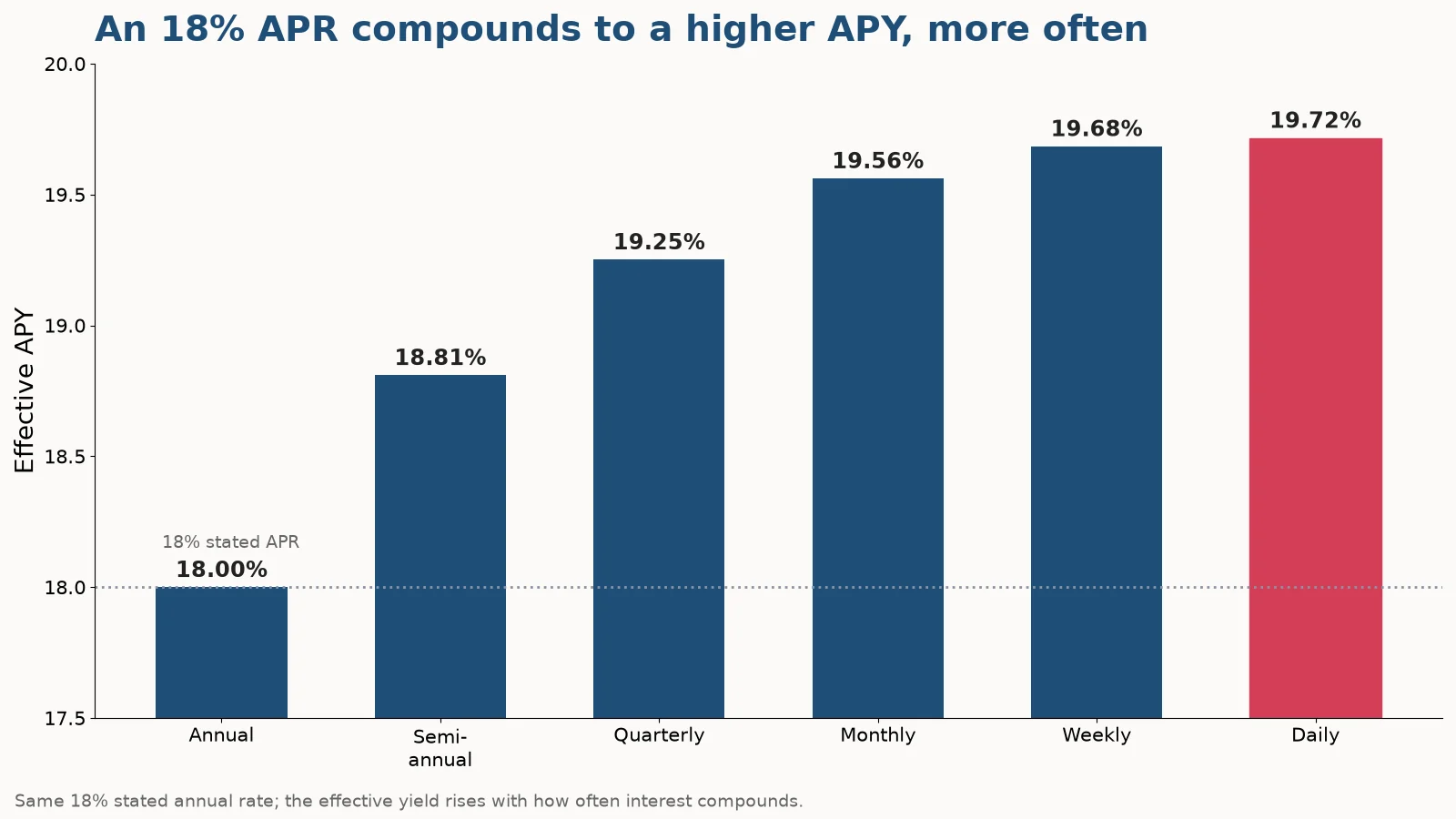
- The APY (Annual Percentage Yield) accounts for compounding: an 18% APR compounded monthly is actually a 19.56% APY.
- Compare loans using APR, since it is the standard, fee-inclusive figure required by the Truth in Lending Act.
- Compare savings accounts and CDs using APY, since it reflects the real annual return after compounding.
Weighing APR vs interest rate, and both against APY, matters because lenders and banks are required to show you specific numbers, and mixing them up leads to comparing the wrong things. This guide uses the Consumer Financial Protection Bureau’s definitions and the federal Truth in Savings formula to explain each term, with worked examples showing exactly how much they can differ. Our APR calculator and APY calculator run your own numbers.
Interest rate vs APR
The CFPB defines the interest rate simply: it is the cost you pay the lender for borrowing money, on top of the loan amount or principal. The APR is the interest rate plus certain additional charges the lender adds when the loan is made, such as origination fees, expressed as a yearly rate. Because it folds in more costs, the CFPB notes that your APR is usually higher than your interest rate.
For mortgages specifically, the CFPB says the APR also reflects points and mortgage broker fees paid to get the loan, which is why mortgage APRs tend to run noticeably above the quoted note rate. For credit cards, the CFPB’s own glossary treats the stated yearly rate as the APR directly, so the two figures are typically the same there.
A worked example shows the gap for a mortgage: a 30-year, $300,000 loan at a 6.50% note rate, with $3,000 in lender fees rolled into the cost, works out to about a 6.60% APR, even though the rate written on the note is 6.50%. The gap gets larger with more points or fees, and smaller on a loan with few or no fees. The CFPB’s bottom line: when shopping for a loan, compare APR to APR, never APR to a plain interest rate.
APR vs APY: what compounding changes
APR and APY measure different things entirely. APR is a stated yearly rate, including fees where relevant, but it does not account for how often interest compounds within the year. APY (Annual Percentage Yield) does: it is defined, under the Truth in Savings Act’s Regulation DD, as a rate reflecting the total interest earned based on the rate and how frequently it compounds over a 365-day period.
The regulation’s general formula is 100 × [(1 + Interest ÷ Principal)^(365 ÷ Days in term) − 1]. For ordinary compounding at a fixed frequency, this simplifies to the familiar form: APY = (1 + rate ÷ n)n − 1, where n is the number of compounding periods in a year.
Here is what an 18% stated annual rate becomes at different compounding frequencies:
| Compounding | Periods per year | Effective APY |
|---|---|---|
| Annually | 1 | 18.00% |
| Semi-annually | 2 | 18.81% |
| Quarterly | 4 | 19.25% |
| Monthly | 12 | 19.56% |
| Daily | 365 | 19.72% |
The more often interest compounds, the bigger the gap between the stated rate and the real annual cost or yield. A credit card advertised at 18% APR but compounding daily on unpaid balances effectively costs more than 18% a year; a savings account advertising 4% but crediting interest daily actually pays 4.08% a year, not 4%.
Why this matters for savings, not just debt
APY works in your favor when you are earning interest rather than paying it, which is the mirror image of the credit card example above. A savings account, money market account or CD stating a 4.00% rate compounded monthly actually yields 4.07% a year; compounded daily, it yields 4.08%. Banks are required to disclose the APY, specifically so savers can compare accounts that compound on different schedules without doing this math themselves.
This is also why a slightly lower stated rate with more frequent compounding can beat a slightly higher rate that compounds less often; the APY, not the stated rate, is the number that tells you which account actually pays more. Our compound interest calculator and APY calculator compare accounts by compounding frequency directly.
The gap between a stated rate and its APY grows with the rate itself, not just the compounding frequency. At low rates, such as the 1% many basic savings accounts paid for years, the difference between monthly and daily compounding is a few hundredths of a percentage point, barely worth factoring into a decision. At the higher rates seen on some high-yield savings accounts and promotional CDs, the same compounding gap becomes a meaningfully larger number in dollar terms on a sizeable balance, which is one reason APY disclosure matters more now than it did when rates across the banking system were uniformly low.
Simple interest vs compound interest
Underneath APR and APY is a more basic distinction the CFPB draws out in its credit card guidance: whether interest is calculated on the original principal only (simple interest) or on the principal plus any interest already added (compound interest). Credit cards generally compound, which is part of why carrying a balance gets expensive quickly: each billing cycle’s interest charge is added to the balance, and the next cycle’s interest is calculated on that larger amount.
A loan that compounds more often, or that carries a balance for longer before paying down, accrues more total interest than the simple arithmetic of “rate × principal × years” would suggest. This is the same mechanism that makes APY higher than a stated rate: compounding, working for you in a savings account and against you on revolving debt.
Most installment loans, including typical mortgages and auto loans, use amortized compound interest: each payment covers that period’s interest first, then reduces the principal, so the interest portion shrinks and the principal portion grows over the life of the loan even though the payment itself stays level. Revolving debt such as credit cards works differently, because the balance (and therefore the interest charged on it) changes every time you borrow more or pay some off, which is why a card’s effective cost depends heavily on how much of the statement balance you carry and for how long.
Which figure should you actually compare?
Use the right number for the decision in front of you:
- Shopping for a loan or mortgage: compare APR to APR across lenders. It is the figure the Truth in Lending Act requires, and it is designed specifically for this comparison.
- Shopping for a savings account or CD: compare APY to APY. It already accounts for compounding, so a higher APY always means a higher real return, regardless of how each bank compounds.
- Reading a credit card offer: the advertised APR is usually the number that compounds against you if you carry a balance; paying in full each month avoids the distinction entirely, since no interest accrues.
- Comparing a loan APR to a savings APY: these are not directly comparable without converting one to match the other’s compounding assumptions, so avoid eyeballing “6% APR” against “6% APY” as if they were the same kind of number.
A quick reference for what each term includes
It helps to keep a short mental checklist of what is and is not folded into each figure:
| Term | Includes | Leaves out | Used for |
|---|---|---|---|
| Interest rate | The raw cost of borrowing the principal | Fees, points, compounding | The number used inside amortization formulas |
| APR | Interest rate plus certain required fees, as a yearly rate | The effect of compounding frequency | Comparing loan offers (Truth in Lending Act) |
| APY | The real annual return or cost once compounding is applied | Fees that are not interest (for savings accounts, usually none apply) | Comparing savings accounts and CDs (Truth in Savings Act) |
None of the three is “wrong”; each is answering a different question, and lenders and regulators did not invent them arbitrarily — each term exists to make one specific kind of comparison fair and consistent across different providers. The interest rate tells you the headline cost of the money itself. The APR tells you the all-in yearly cost of a specific loan offer, fees included, which is why regulators require lenders to disclose it. The APY tells you the true annual return or cost once compounding is folded in, which is why regulators require banks to disclose it on deposit accounts. Confusing one for another is the most common way people misjudge whether an offer is actually good, especially when a lower headline interest rate is used to make a fee-heavy loan look cheaper than a fee-light competitor with a slightly higher rate but a lower APR.
Frequently asked questions
What is the difference between interest rate and APR?
The interest rate is the cost of borrowing the principal alone. The APR adds certain lender fees and charges to that rate, expressed as a yearly figure, so it is usually higher, per the CFPB.
Why is my mortgage APR higher than my interest rate?
Because mortgage APR also includes points, mortgage broker fees and other charges paid to get the loan, on top of the note rate itself.
What is APY?
Annual Percentage Yield: a rate, defined under Regulation DD, that reflects total interest earned based on the stated rate and how often it compounds over a year.
How do I convert APR to APY?
For standard compounding, APY = (1 + APR ÷ n)^n − 1, where n is the number of compounding periods per year. An 18% APR compounded monthly is about a 19.56% APY.
Should I compare loans using APR or interest rate?
APR. It is the standard, fee-inclusive figure required by the Truth in Lending Act, which makes it the right number for comparing offers from different lenders.
Should I compare savings accounts using APY or interest rate?
APY. It already accounts for each bank’s compounding frequency, so comparing APY to APY tells you which account truly pays more.
Are APR and APY ever the same number?
Only if interest compounds exactly once a year. Any more frequent compounding makes APY higher than the stated annual rate.
Does paying a credit card balance in full avoid APR entirely?
Generally yes for purchases, if the account has a grace period and the previous balance was paid in full; most issuers waive interest on new purchases paid off by the due date, though cash advances often accrue interest immediately.
Why do two loans with the same interest rate have different APRs?
Because APR also reflects lender fees and charges, which vary by lender even when the quoted interest rate is identical, so the all-in cost of otherwise similar loans can still differ.
Is a higher APY always better than a lower one?
For comparing deposit accounts of the same type and term, yes; APY already standardizes for compounding, so a higher APY means a genuinely higher annual return, all else being equal.
Related calculators
Sources
- What is the difference between a loan interest rate and the APR?, Consumer Financial Protection Bureau. CFPB's definitions of interest rate and APR, and guidance to compare APR to APR.
- Appendix A to Part 1030 — Annual Percentage Yield Calculation, Consumer Financial Protection Bureau (Regulation DD). The regulatory formula for APY and the rule that it reflects compounding over a 365-day period.