
Updated 13 November 2026 · Written by the Digital Calculators team
Key takeaways
- °F = °C × 1.8 + 32. So 20 °C = 68 °F and 180 °C = 356 °F.
- °C = (°F − 32) ÷ 1.8. So 350 °F = 176.7 °C, and 98.6 °F = 37 °C.
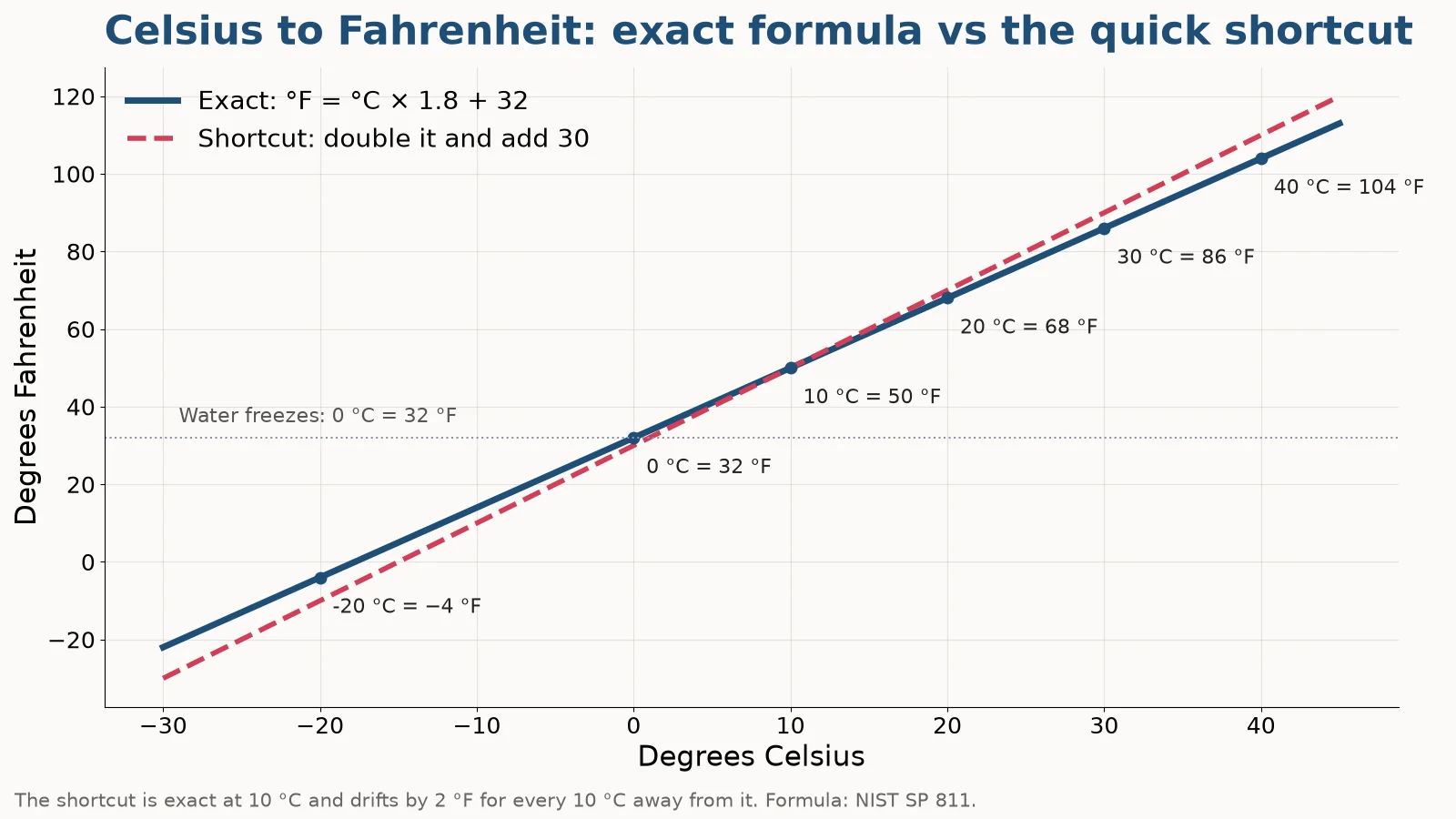
- Quick estimate for weather: double the Celsius and add 30. It is exact at 10 °C and 4 °F off at 30 °C.
- A temperature change converts without the 32: a rise of 10 °F is a rise of 5.6 °C.
- −40 is the same in both scales, and Kelvin is simply Celsius plus 273.15.
If you need to know how to convert Celsius to Fahrenheit, the formula is short: multiply by 1.8 and add 32. A 20 °C spring day is 20 × 1.8 + 32 = 68 °F. Going the other way, subtract 32 and divide by 1.8, so an oven set to 350 °F is running at about 176.7 °C. These are the exact relationships published by the National Institute of Standards and Technology (NIST), so they hold for any temperature.
The formula is easy to write down but awkward to do in your head, and it has a trap: temperature differences convert differently from temperatures. This guide covers both formulas, a mental shortcut and how accurate it is, how to convert a change in temperature, the Kelvin scale, and ready-made charts for weather, ovens, safe cooking temperatures and candy making, all from NIST. Our temperature converter is built into the page for any number not in the charts.
The formulas, both ways
NIST’s Guide for the Use of the International System of Units (Special Publication 811) gives the relationship between the two scales as:
°C = (°F − 32) ÷ 1.8
Rearranging gives the version for going from Celsius to Fahrenheit:
°F = °C × 1.8 + 32
You will often see 1.8 written as the fraction 9/5, which is the same number. So °F = °C × 9/5 + 32, and °C = (°F − 32) × 5/9.
Worked examples
- 25 °C to Fahrenheit: 25 × 1.8 = 45; 45 + 32 = 77 °F.
- −5 °C to Fahrenheit: −5 × 1.8 = −9; −9 + 32 = 23 °F.
- 350 °F to Celsius: 350 − 32 = 318; 318 ÷ 1.8 = 176.7 °C.
- 98.6 °F to Celsius: 98.6 − 32 = 66.6; 66.6 ÷ 1.8 = 37.0 °C.
Order matters. When going from Fahrenheit, subtract 32 first and then divide. Dividing first gives the wrong answer: 350 ÷ 1.8 − 32 would be 162.4, nowhere near the right value.
Prefer a full page? Open the Temperature Conversion Calculator.
Why 1.8 and 32?
The two numbers come from where each scale puts two fixed points of water. On the Celsius scale water freezes at 0 °C, and NIST notes in its kitchen measurement tips that water boils at 100 °C at sea level. Put those into the formula and you get 32 °F and 212 °F, the familiar Fahrenheit values.
- The 32 is the offset: the Fahrenheit scale starts counting 32 degrees below the freezing point of water.
- The 1.8 is the size ratio: between freezing and boiling, Fahrenheit counts 180 degrees while Celsius counts 100, and 180 ÷ 100 = 1.8. A Fahrenheit degree is smaller than a Celsius degree.
Because the scales have different zero points and different degree sizes, there is exactly one temperature where they agree. Setting °F equal to °C in the formula gives x = 1.8x + 32, so −0.8x = 32 and x = −40. At −40 it does not matter which scale you use.
A mental shortcut (and how accurate it is)
For weather, an estimate is usually all you need. The classic shortcut is double the Celsius and add 30. It replaces × 1.8 with × 2 and + 32 with + 30, and the two errors partly cancel. Here is how close it gets:
| Celsius | Exact | Shortcut | Error |
|---|---|---|---|
| −20 °C | −4 °F | −10 °F | −6 |
| −10 °C | 14 °F | 10 °F | −4 |
| 0 °C | 32 °F | 30 °F | −2 |
| 10 °C | 50 °F | 50 °F | 0 |
| 15 °C | 59 °F | 60 °F | +1 |
| 20 °C | 68 °F | 70 °F | +2 |
| 25 °C | 77 °F | 80 °F | +3 |
| 30 °C | 86 °F | 90 °F | +4 |
| 35 °C | 95 °F | 100 °F | +5 |
| 40 °C | 104 °F | 110 °F | +6 |
The shortcut is exact at 10 °C and drifts by 2 °F for every 10 °C away from that. Between 0 °C and 20 °C it is within 2 °F, which is fine for deciding on a jacket. At 30 °C it reads 4 °F too warm, and in the oven it is useless: 180 °C would come out as 390 °F instead of 356 °F.
An exact method you can still do in your head
Double it, take off a tenth, then add 32. Doubling and removing 10% is the same as multiplying by 1.8. For 23 °C: double is 46; a tenth of that is 4.6, so 46 − 4.6 = 41.4; add 32 to get 73.4 °F, which is exact.
The reverse shortcut, for Fahrenheit to Celsius, is to subtract 30 and halve. It is exact at 50 °F and has the same drift in the other direction.
Converting a temperature change
This is where most conversion mistakes happen. When you convert a difference between temperatures, such as “the temperature rose by 10 degrees” or “set the oven 25 degrees lower”, the 32 does not apply. Only the size of the degree matters.
NIST lists the factor for temperature intervals separately: a change of 1 °F equals a change of 0.5555556 °C, which is 1/1.8. So:
- A rise of 10 °F is a rise of 10 ÷ 1.8 = 5.6 °C.
- A rise of 5 °C is a rise of 5 × 1.8 = 9 °F.
Using the full formula on a change gives nonsense. Plugging 10 °F into (°F − 32) ÷ 1.8 gives −12.2 °C, which would turn a warming into a cooling. It is an easy slip with climate figures in particular: “1.5 °C of warming” is a change of 2.7 °F, not 34.7 °F.
The same rule applies in the kitchen. If a recipe says to lower the oven by 25 °F for a glass dish, that is a change of about 14 °C.
Celsius and Fahrenheit charts
Two quick-reference charts. The first goes from Celsius, the second from Fahrenheit. Values are rounded to one decimal place.
| Celsius | Fahrenheit |
|---|---|
| −40 °C | −40 °F |
| −30 °C | −22 °F |
| −20 °C | −4 °F |
| −18 °C | −0.4 °F |
| −10 °C | 14 °F |
| −5 °C | 23 °F |
| 0 °C | 32 °F |
| 4 °C | 39.2 °F |
| 5 °C | 41 °F |
| 10 °C | 50 °F |
| 15 °C | 59 °F |
| 20 °C | 68 °F |
| 21 °C | 69.8 °F |
| 22 °C | 71.6 °F |
| 25 °C | 77 °F |
| 30 °C | 86 °F |
| 35 °C | 95 °F |
| 37 °C | 98.6 °F |
| 40 °C | 104 °F |
| 45 °C | 113 °F |
| 50 °C | 122 °F |
| 100 °C | 212 °F |
| Fahrenheit | Celsius |
|---|---|
| 0 °F | −17.8 °C |
| 10 °F | −12.2 °C |
| 20 °F | −6.7 °C |
| 32 °F | 0.0 °C |
| 40 °F | 4.4 °C |
| 50 °F | 10.0 °C |
| 60 °F | 15.6 °C |
| 65 °F | 18.3 °C |
| 68 °F | 20.0 °C |
| 70 °F | 21.1 °C |
| 72 °F | 22.2 °C |
| 75 °F | 23.9 °C |
| 80 °F | 26.7 °C |
| 85 °F | 29.4 °C |
| 90 °F | 32.2 °C |
| 95 °F | 35.0 °C |
| 98.6 °F | 37.0 °C |
| 100 °F | 37.8 °C |
| 105 °F | 40.6 °C |
| 110 °F | 43.3 °C |
A few values are worth remembering as anchors: 0 °C = 32 °F, 10 °C = 50 °F, 20 °C = 68 °F, 30 °C = 86 °F and 37 °C = 98.6 °F. Anything in between can be estimated from the nearest anchor, using 1 °C ≈ 2 °F for small steps.
Oven temperatures in Celsius and Fahrenheit
Recipes from different countries give oven temperatures in different scales, and older recipes often use words instead of numbers. NIST’s Metric Kitchen publishes this table of approximate equivalents to translate those legacy descriptions:
| Description | Celsius | Fahrenheit |
|---|---|---|
| Cool | 90 °C | 200 °F |
| Very slow | 120 °C | 250 °F |
| Slow | 150 to 160 °C | 300 to 325 °F |
| Moderately slow | 160 to 180 °C | 325 to 350 °F |
| Moderate | 180 to 190 °C | 350 to 375 °F |
| Moderately hot | 190 to 200 °C | 375 to 400 °F |
| Hot | 200 to 230 °C | 400 to 450 °F |
| Very hot | 230 to 260 °C | 450 to 500 °F |
The pairs in this table are rounded to convenient oven settings, not exact conversions. 180 °C is exactly 356 °F, but recipes treat it as 350 °F, and 350 °F is exactly 176.7 °C. In practice the oven itself matters more: NIST notes that every oven, even of the same model, will have temperature differences, and suggests checking a thermometer in boiling water (100 °C at sea level) to find out how far off it reads.
NIST’s common cooking temperatures put cakes, cookies, brownies and banana bread at 180 °C, quick breads at 200 °C and pie crust at 220 °C, which convert to about 350 °F, 400 °F and 425 °F oven settings.
Safe cooking and candy temperatures
Food safety temperatures are usually published in Fahrenheit in the US, but NIST’s Metric Kitchen lists the same minimum internal temperatures in Celsius. Converting them back shows the familiar Fahrenheit numbers:
| Food | Celsius (NIST) | Fahrenheit |
|---|---|---|
| Beef, bison, veal, goat and lamb steaks, roasts and chops (rest 3 min) | 62.8 °C | 145 °F |
| Pork steaks, roasts and chops (rest 3 min) | 62.8 °C | 145 °F |
| Ground meats and sausage | 71.1 °C | 160 °F |
| Egg dishes | 71.1 °C | 160 °F |
| Chicken, turkey and other poultry | 73.9 °C | 165 °F |
| Casseroles | 73.9 °C | 165 °F |
| Leftovers | 73.9 °C | 165 °F |
Measure these with a food thermometer in the thickest part of the food. Our guide to how long to cook a turkey covers the poultry rule in detail.
Candy-making stages
Sugar syrup changes character at specific temperatures, and NIST lists the classic stages in Celsius. Here they are with Fahrenheit equivalents:
| Stage | Celsius (NIST) | Fahrenheit |
|---|---|---|
| Thread | 102 to 112 °C | 216 to 234 °F |
| Soft ball | 112 to 115 °C | 234 to 239 °F |
| Firm ball | 116 to 120 °C | 241 to 248 °F |
| Hard ball | 122 to 130 °C | 252 to 266 °F |
| Soft crack | 132 to 143 °C | 270 to 289 °F |
| Hard crack | 146 to 155 °C | 295 to 311 °F |
A candy thermometer that reads in one scale is all you need; convert the target once and write it on the recipe.
Kelvin, the scientific scale
Science uses the kelvin (K), the SI unit of temperature. It has the same size of degree as Celsius but starts at absolute zero, the coldest possible temperature. NIST gives the relationships as:
- K = °C + 273.15, so room temperature of 20 °C is 293.15 K.
- K = (°F + 459.67) ÷ 1.8, so 68 °F is also 293.15 K.
- °C = K − 273.15.
Kelvin is written without a degree sign: 293 K, not 293 °K. And because a kelvin and a Celsius degree are the same size, a temperature change of 5 °C is also a change of 5 K.
Our temperature conversion calculator handles all three scales, and the heat index calculator and wind chill calculator work in either Celsius or Fahrenheit.
Frequently asked questions
What is the formula to convert Celsius to Fahrenheit?
Multiply by 1.8 (or 9/5) and add 32: °F = °C × 1.8 + 32. For example, 30 °C × 1.8 + 32 = 86 °F.
How do I convert Fahrenheit to Celsius?
Subtract 32, then divide by 1.8: °C = (°F − 32) ÷ 1.8. For example, (77 − 32) ÷ 1.8 = 25 °C.
What is 180 °C in Fahrenheit?
Exactly 356 °F. Recipes round it to 350 °F, which NIST lists as a moderate oven.
What is 350 °F in Celsius?
About 176.7 °C. Recipes usually round it to 175 °C or 180 °C.
Is there an easy way to convert Celsius to Fahrenheit in your head?
Double the Celsius and add 30. It is exact at 10 °C and off by about 2 °F for every 10 °C away from that, so it suits weather, not cooking.
At what temperature are Celsius and Fahrenheit the same?
−40. Solving x = 1.8x + 32 gives x = −40.
How do I convert a change in temperature?
Leave out the 32. A change of 1 °C is a change of 1.8 °F, and a change of 1 °F is a change of about 0.56 °C.
What is 37 °C in Fahrenheit?
98.6 °F, because 37 × 1.8 + 32 = 98.6.
Related calculators
Sources
- NIST Guide to the SI, Appendix B.9: Factors for units listed by kind of quantity, National Institute of Standards and Technology (SP 811). The exact Celsius, Fahrenheit and kelvin formulas and the temperature interval factor.
- Metric Kitchen: Culinary Temperature, National Institute of Standards and Technology. Oven temperature descriptions, common cooking temperatures, candy stages and safe minimum internal temperatures in °C.
- Metric Kitchen: Culinary Measurement Tips, National Institute of Standards and Technology. Boiling water at 100 °C at sea level as a thermometer check.