
Updated 13 November 2026 · Written by the Digital Calculators team
Key takeaways
- The “multiply by 7” rule does not match how dogs age: they mature very fast in the first two years and more slowly after.
- A 2020 study of 104 Labrador retrievers found: human age ≈ 16 × ln(dog age) + 31.
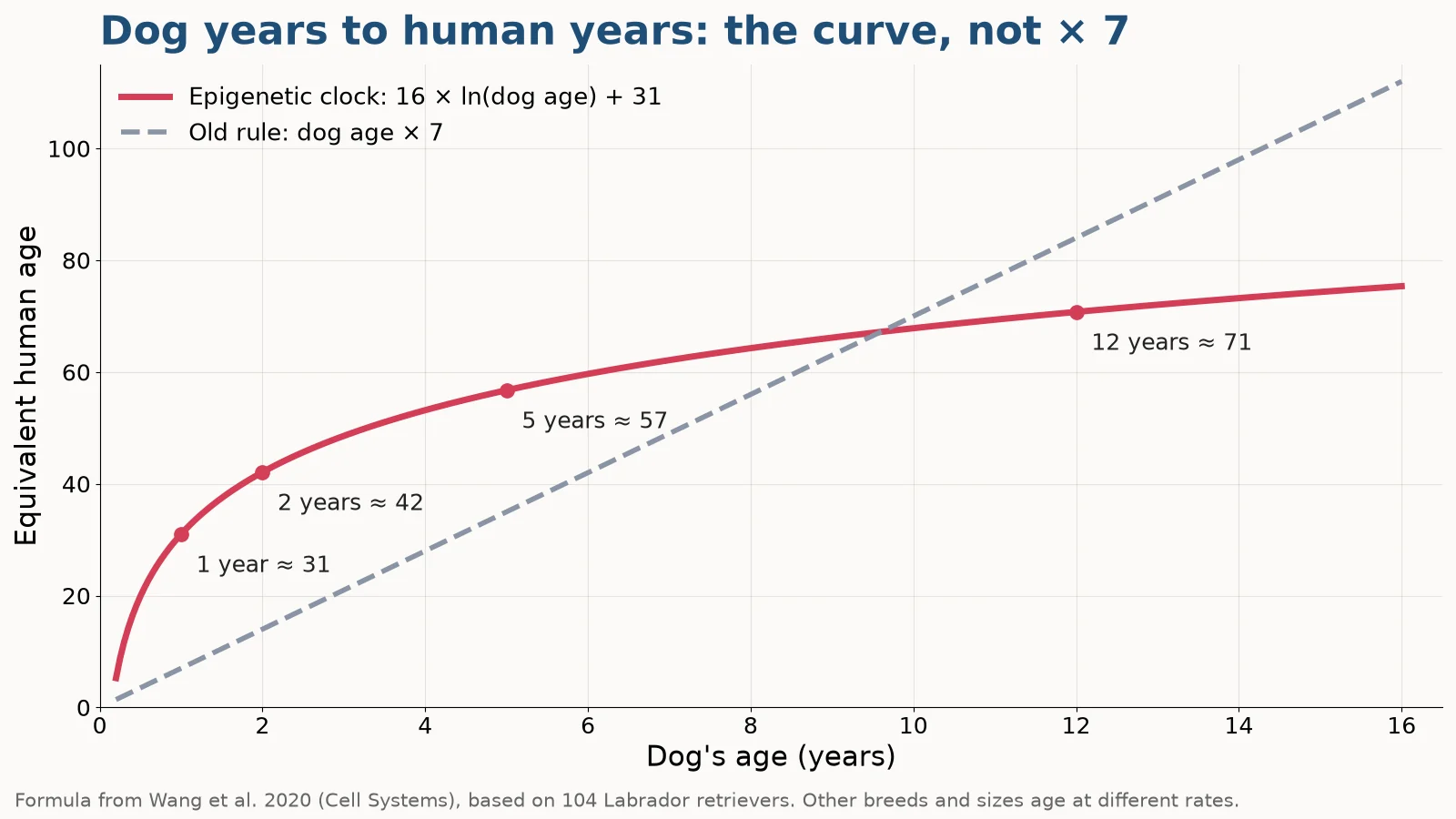
- By that formula a 1-year-old dog is about 31 in human terms, a 2-year-old about 42 and a 12-year-old about 71.
- The study looked at one breed. Size and breed change lifespan, so treat any conversion as an estimate.
- AAHA defines a senior dog as one in the last 25% of its estimated lifespan, not by a fixed age.
Converting dog years to human years by multiplying by 7 is one of the most widely repeated pet facts, and it is wrong in an important way. Dogs do not age at a steady seven-to-one rate. They race through puppyhood and adolescence in their first year or two, then age more slowly through adulthood.
A 2020 study in the journal Cell Systems offered a better formula based on how DNA changes with age in both species. Studying 104 Labrador retrievers, they found that a dog’s age translates to human age roughly as 16 × the natural log of the dog’s age, plus 31. That makes a 1-year-old dog more like a 31-year-old person than a 7-year-old. This guide explains the formula, gives a full conversion table, shows where it fits and where it does not, and covers the veterinary life stages that matter more for your dog’s care than any single number. Our dog age calculator is built into the page.
Why "× 7" does not work
The seven-year rule assumes dogs age at the same pace their whole life. Two simple checks show the problem:
- AAHA’s guidelines put the end of puppyhood at about 6 to 9 months, and most dogs are fully mature by 3 to 4 years. By the × 7 rule, a 9-month-old dog would be like a 5-year-old child, which does not fit at all.
- The dogs in the 2020 study ranged up to 16 years old. By the × 7 rule, a 16-year-old dog would be 112 in human terms.
Real aging is front-loaded. Dogs grow up very quickly, then the pace slows. Any accurate conversion has to be a curve, not a straight line, which is exactly what the 2020 study found.
Try your own dog’s age in the calculator below, then read on for how the newer formula works.
Prefer a full page? Open the Dog Age Calculator.
The epigenetic clock formula
The study, published in Cell Systems by Wang and colleagues in 2020, compared patterns of DNA methylation, chemical marks on DNA that change predictably with age, in dogs and humans. The researchers mapped the methylomes of 104 Labrador retrievers spanning a 16-year age range and compared them with human data.
They found a nonlinear relationship. Matching each dog to the most similar humans gave a fitted function of 17 ln(dog age) + 33, and matching each human to the most similar dogs gave 16 ln(dog age) + 30. They combined the two into a single formula:
Human age = 16 × ln(dog age) + 31
where ln is the natural logarithm and the dog’s age is in years. On a phone calculator, use the “ln” key: for a 5-year-old dog, ln(5) = 1.609; × 16 = 25.8; + 31 = 57.
How well it matches real milestones
The authors checked the formula against life stages the two species share, and found the agreement was particularly close for the earliest and latest stages:
- About 8 weeks in a dog translated to about 9 months in a human, the stage when baby teeth develop in both puppies and babies.
- The expected lifespan of a Labrador retriever, 12 years, translated to about 70 years, matching worldwide human life expectancy.
For the adolescent and mature adult stages, the paper notes the match was more approximate.
What an epigenetic clock measures
Your DNA sequence stays the same throughout life, but the chemical marks attached to it do not. One of these marks, methylation, builds up or disappears at particular sites in a fairly predictable way as an animal ages. Measure enough of those sites and you can estimate age from a blood sample, which is what scientists call an epigenetic clock.
The Cell Systems study used this idea across species. The researchers focused on stretches of DNA that dogs and humans share, called syntenic blocks, sequencing them deeply in the Labradors and comparing the patterns with human methylation data. According to the paper’s summary, the changes the two species have in common center on networks of developmental genes. Those shared changes were enough not only to translate age between dogs and humans, but also to extend the comparison to mice and to reflect the effects of anti-aging interventions in multiple mammals.
That is what makes the formula more than a curve fitted to life-expectancy tables. It is based on a biological process that ticks along in both species, and it lines up with physical milestones such as teething in infancy and typical lifespan at the end of life.
It is also consistent with the shape of the curve. If the shared changes center on developmental genes, the clock would be expected to move fastest while the body is developing and more slowly afterward. Dogs pack their development into a much shorter time than people do, so their clock runs very fast at first and more slowly later, giving the logarithmic shape in our chart.
Dog years to human years chart
Here is the formula applied to common ages, next to the old × 7 rule for comparison. Human ages are rounded to the nearest year.
| Dog’s age (years) | Human age (formula) | × 7 rule |
|---|---|---|
| 0.5 | 20 | 3.5 |
| 1 | 31 | 7 |
| 2 | 42 | 14 |
| 3 | 49 | 21 |
| 4 | 53 | 28 |
| 5 | 57 | 35 |
| 6 | 60 | 42 |
| 7 | 62 | 49 |
| 8 | 64 | 56 |
| 9 | 66 | 63 |
| 10 | 68 | 70 |
| 11 | 69 | 77 |
| 12 | 71 | 84 |
| 13 | 72 | 91 |
| 14 | 73 | 98 |
| 15 | 74 | 105 |
| 16 | 75 | 112 |
Two things stand out. First, the early years count for a lot: going from age 1 to age 2 adds about 11 human years, while going from 10 to 11 adds only about 1.5. Second, the two methods only agree around the middle of a dog’s life; the formula and × 7 cross at roughly 10 to 10 years. Before that, × 7 makes young dogs seem far younger than they are; after it, × 7 makes old dogs seem far older.
The formula is less meaningful for very young puppies, because the logarithm drops steeply below age 1. For puppies, the developmental milestones your vet tracks are a better guide than any conversion.
Breed and size matter
The biggest limitation of the formula is that it was built on a single breed. All 104 dogs in the study were Labrador retrievers. Dogs of different sizes and breeds have very different lifespans, so the same chronological age can mean a different stage of life.
The American Animal Hospital Association (AAHA) recognizes this in its 2019 Canine Life Stage Guidelines. It notes that the timing of the mature adult and senior stages is breed and size dependent, that variation increases in later years, and that the vet team’s estimate of an individual dog’s lifespan, generally predicted by breed lifespan, allows preventive care to be better targeted. For that reason, AAHA does not set fixed ages for mature adult and senior dogs.
In practice, treat the formula as a reasonable estimate for a dog similar to a Labrador and adjust in your head: a breed with a typically longer lifespan is probably “younger” than the formula suggests at the same age, and a breed with a shorter lifespan “older”.
Dog life stages: what your vet looks at
For your dog’s health, its life stage is more useful than a human-age equivalent. The AAHA guidelines define five stages:
| Stage | AAHA definition |
|---|---|
| Puppy | Birth to the end of rapid growth (about 6 to 9 months, varying with breed and size) |
| Young adult | End of rapid growth until physical and social maturity, which most dogs reach by 3 to 4 years |
| Mature adult | Maturity until the last 25% of estimated lifespan (breed and size dependent) |
| Senior | The last 25% of estimated lifespan through end of life |
| End of life | Terminal stage, depending on the specific illness |
Because “senior” is defined by the last quarter of expected lifespan, the age it starts varies by dog:
| Estimated lifespan | Senior stage begins at about | Human age (formula) |
|---|---|---|
| 10 years | 7.5 years | 63 |
| 12 years | 9 years | 66 |
| 14 years | 10.5 years | 69 |
| 16 years | 12 years | 71 |
A dog expected to live 10 years is a senior at about 7.5, while one expected to live 16 years is not a senior until about 12. Ask your vet what lifespan they would estimate for your dog; it shapes when to start senior health checks.
Using the conversion sensibly
Human-age equivalents are a fun and useful way to picture a dog’s stage of life, as long as you remember what they are and are not.
Good uses
- Understanding behavior. Knowing that a 1-year-old dog is roughly a young adult in human terms explains a lot about energy and testing boundaries.
- Planning care. Seeing that a 10-year-old dog is about 68 in human terms is a reminder that regular senior checkups make sense.
- Talking with children about why an older dog is slowing down.
Limits to remember
- The formula comes from one breed and one study. It is a population average, not a measure of your dog’s health.
- Small, medium, large and giant dogs age at different rates.
- Very young puppies do not convert well; use developmental milestones instead.
- Your vet’s assessment of body condition, mobility, teeth and blood work tells you far more about how your dog is aging than any calculation.
If you have a cat, our cat age calculator gives the feline equivalent, and the dog food calculator helps adjust portions as your dog’s needs change with age.
Frequently asked questions
How do you convert dog years to human years?
A 2020 study proposed human age ≈ 16 × ln(dog age) + 31. A 5-year-old dog works out at about 57 human years.
Is one dog year equal to seven human years?
No. Dogs mature very quickly in the first two years and more slowly after that, so a straight × 7 rule makes young dogs seem too young and old dogs too old.
How old is a 1-year-old dog in human years?
About 31 by the epigenetic formula, roughly a young adult.
How old is a 10-year-old dog in human years?
About 68 by the formula, compared with 70 by the × 7 rule.
Does the formula work for all breeds?
It was based on 104 Labrador retrievers. Breed and size affect lifespan, so for very small or giant breeds it is only a rough guide.
When is a dog considered a senior?
AAHA defines a senior dog as one in the last 25% of its estimated lifespan, so the age depends on breed and size.
Why do dogs age faster than humans early in life?
Dogs grow and mature much faster: puppyhood lasts about 6 to 9 months and most dogs are fully mature by 3 to 4 years.
What is the oldest a dog can be?
It varies a lot by breed and size. Ask your vet for an estimated lifespan for your dog’s breed and size.
Related calculators
Sources
- Quantitative Translation of Dog-to-Human Aging by Conserved Remodeling of the DNA Methylome (Wang et al., Cell Systems, 2020), PubMed Central, U.S. National Library of Medicine. The 16 × ln(dog age) + 31 formula, the 104 Labrador retrievers and the milestone comparisons.
- 2019 AAHA Canine Life Stage Guidelines, American Animal Hospital Association. Definitions of the five canine life stages and the role of breed and size.