
Updated 12 November 2026 · Written by the Digital Calculators team · How we made this guide
Key takeaways
- Lenders mainly judge affordability by your debt-to-income ratio (DTI): all monthly debt payments, including the new mortgage, divided by gross monthly income.
- Fannie Mae’s maximum total DTI is 36% for manually underwritten loans, up to 45% with strong credit and reserves, and up to 50% through its automated system.
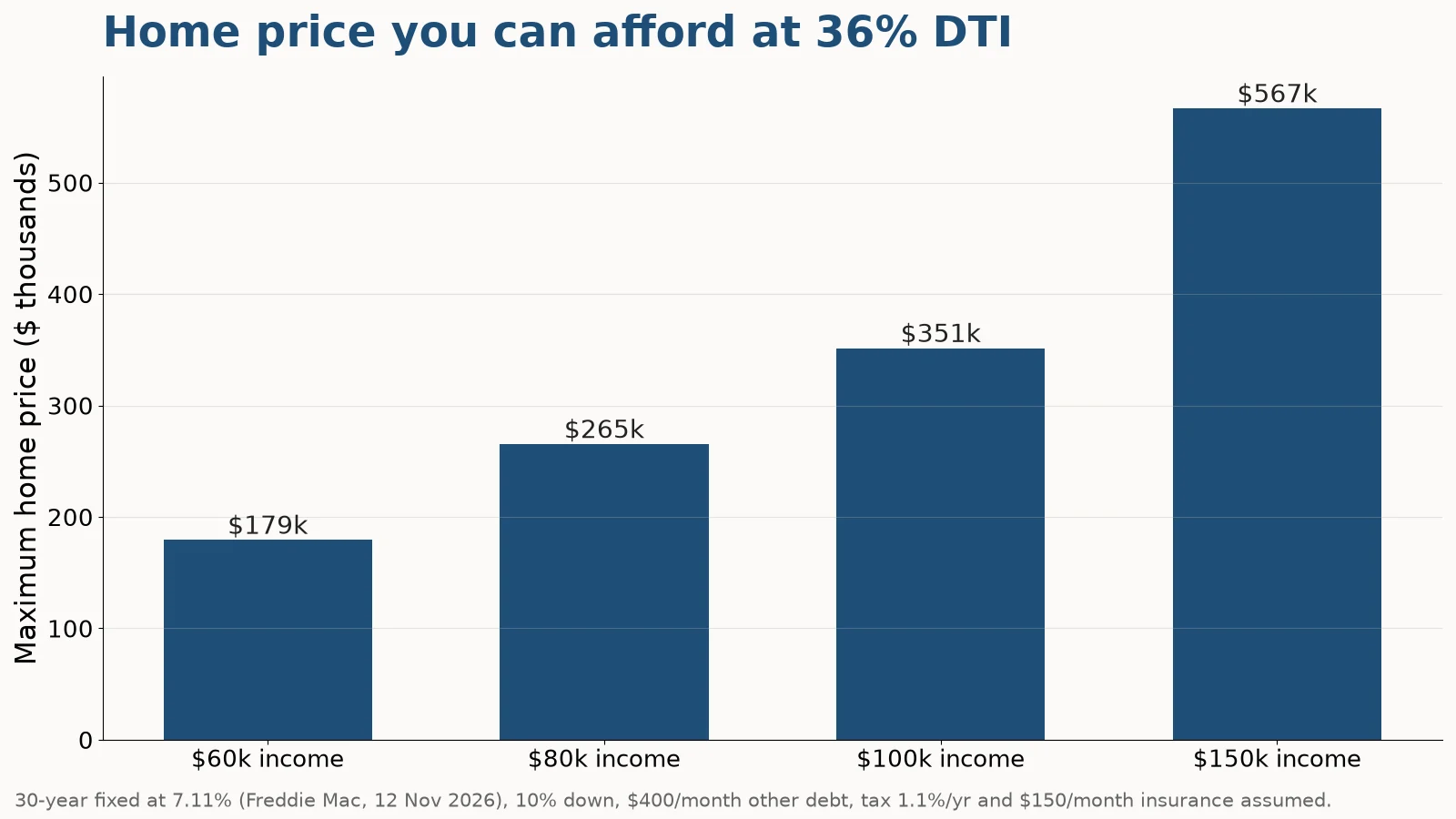
- At a 7.11% 30-year rate, a household earning $100,000 with a $400 car payment can afford about $351,000 with 10% down at 36% DTI.
- Every $100 of other monthly debt cuts your price range by roughly $14,000, and a 1-point lower rate raises it by about $33,000 in this example.
How much house can I afford? The honest answer is not a single multiple of your salary. Lenders work it out from your monthly numbers: how much you earn before tax, what you already owe each month, the mortgage rate, and how much you put down. The key figure is your debt-to-income ratio, and once you understand it you can work out your own price range in a few minutes.
In this guide we explain how DTI works, what limits the big mortgage investors actually set, and how the interest rate, property tax, insurance and your down payment change the result. Every example uses this week’s average 30-year rate of 7.11% from Freddie Mac’s survey and is calculated line by line, so you can follow it. Our house affordability calculator is built in below for your own figures.
- What lenders look at: your debt-to-income ratio
- How much house can you afford on your salary?
- Worked example: $100,000 income
- How much house can I afford on $60,000?
- How the interest rate changes what you can afford
- Down payment: 20% or less?
- Lender maximum vs what feels comfortable
- Five steps to find your own price range
- Frequently asked questions
- Sources
What lenders look at: your debt-to-income ratio
The Consumer Financial Protection Bureau defines your debt-to-income ratio as all your monthly debt payments divided by your gross monthly income, meaning income before taxes and other deductions. Its own example: a $1,500 mortgage payment, a $100 car loan and $400 of other debts make $2,000 a month. With a gross income of $6,000 a month, the DTI is 33%.
For a home purchase, the “mortgage payment” in that sum is the full housing cost the lender will count: principal and interest, property tax, homeowners insurance, and mortgage insurance or HOA dues where they apply. “Other debts” are things like car loans, student loans, minimum credit card payments and personal loans. Everyday bills such as groceries, utilities and phone plans are not part of DTI, which is one reason a lender’s maximum can be more than you are comfortable paying.
The limits that actually apply
Most US mortgages are sold to Fannie Mae or Freddie Mac, so their rules set the practical ceiling for conventional loans. Fannie Mae’s Selling Guide says:
- 36% is the maximum total DTI for manually underwritten loans.
- That can go up to 45% if the borrower meets credit score and cash reserve requirements.
- Loans run through its automated Desktop Underwriter system can be approved up to 50%.
A higher limit is not a target. At 45% or 50%, nearly half of your gross pay goes to debt before taxes, retirement saving and living costs. That is why we use 36% as the main planning figure in this guide and show 45% as the “stretch” case.
How much house can you afford on your salary?
The table below shows the highest home price where the full monthly housing cost plus $400 of other debt equals the DTI limit. It assumes a 30-year fixed mortgage at 7.11%, property tax of 1.1% of the price a year and homeowners insurance of $150 a month. Those last two are example assumptions: tax rates vary hugely by state and county, so swap in your own in the calculator.
| Gross income | Per month | 36% DTI, 10% down | 36% DTI, 20% down | 45% DTI, 10% down |
|---|---|---|---|---|
| $60,000 | $5,000 | $179,000 | $198,000 | $244,000 |
| $80,000 | $6,667 | $265,000 | $294,000 | $351,000 |
| $100,000 | $8,333 | $351,000 | $389,000 | $459,000 |
| $150,000 | $12,500 | $567,000 | $627,000 | $728,000 |
A few patterns are worth noticing. The price range rises faster than income, because the fixed $400 of other debt takes a smaller share of a larger budget. A bigger down payment raises the price you can reach, because less of the price is borrowed. And moving from 36% to 45% DTI adds a lot of buying power, but also a lot of monthly strain.
These figures leave out mortgage insurance. With less than 20% down on a conventional loan you will usually pay it, which lowers the price you can afford slightly, so treat the 10%-down columns as an upper bound.
Prefer a full page? Open the House Affordability Calculator.
Worked example: $100,000 income
Here is the full calculation for one household: $100,000 gross income, a $400 car payment, 10% down, and a 36% DTI target.
- Monthly income: $100,000 ÷ 12 = $8,333.
- Total debt allowed at 36%: $8,333 × 0.36 = $3,000 a month.
- Left for housing: $3,000 − $400 car payment = $2,600.
- Solve for the price whose payment fits: about $351,000.
| Monthly cost at $351,455 | Amount |
|---|---|
| Principal and interest ($316,309 loan, 30 years, 7.11%) | $2,128 |
| Property tax (1.1% a year) | $322 |
| Homeowners insurance | $150 |
| Car payment | $400 |
| Total debt payments | $3,000 (36% of gross income) |
You would also need about $35,145 for the 10% down payment, plus closing costs and a cash cushion. If the same household paid off the car first, its price range would rise to about $409,000: the $400 a month is worth roughly $57,000 of house.
How much house can I afford on $60,000?
On a $60,000 salary, gross monthly income is $5,000. At 36% DTI that allows $1,800 a month of total debt. With a $400 car payment and 10% down, the same assumptions give a price of about $179,000. With no other debt it rises to about $237,000.
That is lower than many people expect, and the reason is the rate. At 7.11%, every $100,000 borrowed over 30 years costs $673 a month in principal and interest alone. On a lower income, the fixed costs (tax, insurance and existing debt) also take up a bigger share of the budget.
Ways buyers on this income usually widen their options: paying down a car loan or card balance before applying, saving a larger down payment, buying with a co-borrower whose income counts too, or looking at areas with lower property taxes. Government-backed loans such as FHA and VA have their own rules; see our FHA loan calculator and VA loan calculator.
How the interest rate changes what you can afford
The rate is the single biggest lever outside your control. In our $100,000 example, a rate one percentage point lower (6.11% instead of 7.11%) raises the affordable price from about $351,000 to $384,000, with the same monthly budget.
The loan term matters too. Freddie Mac’s average 15-year rate this week is 6.45%. On the same $316,309 loan, a 15-year mortgage costs $2,747 a month instead of $2,128, so it fits far fewer budgets. But it saves a great deal of interest: about $178,098 over 15 years against $449,711 over 30 years. If you can afford the 30-year payment comfortably, our mortgage payoff calculator shows how extra payments get you part of that saving with less risk.
Because rates move every week, check the current figure before you rely on any price range, including the ones in this guide. Freddie Mac publishes its survey every Thursday.
Down payment: 20% or less?
You do not need 20% down to buy a home, but the amount changes three things:
- Price range: in our $100,000 example, going from 10% to 20% down raises the affordable price from $351,000 to $389,000, because the same payment supports a bigger home when you borrow less of it.
- Mortgage insurance: conventional loans with less than 20% down usually carry private mortgage insurance, which adds to the monthly cost until enough equity builds up.
- Cash needed: 20% of a $389,000 home is $78,000, before closing costs. Waiting years to save that can cost more than mortgage insurance would, if prices rise in the meantime.
Our down payment calculator shows how long it takes to reach a target, and the closing cost calculator estimates the cash you need on closing day.
Lender maximum vs what feels comfortable
A lender’s approval tells you the most you can borrow, not the most you should. DTI ignores several costs that come with owning a home:
- Maintenance and repairs: roofs, boilers and appliances wear out, and there is no landlord to call.
- Utilities: a bigger home usually costs more to heat, cool and power.
- Savings: retirement contributions, an emergency fund and other goals all come out of what DTI leaves over.
- Taxes on your pay: DTI uses gross income, but you pay the mortgage from take-home pay.
A practical check is to run your budget on take-home pay. Take the full housing payment for the home you are considering, add your other debts and normal monthly spending, and see what is left for savings. If the answer is close to zero, aim lower than the lender’s number. Our budget calculator makes this quick.
Five steps to find your own price range
- Add up your gross monthly income from all borrowers on the loan.
- List your monthly debt payments: car, student and personal loans, and minimum card payments. Check your ratio with the debt-to-income ratio calculator.
- Pick a DTI target. 36% is the conservative standard; above 43% to 45% leaves little room for anything else.
- Get real local costs: the property tax rate and an insurance quote for the area you are looking at, and today’s mortgage rate.
- Run the numbers in the affordability calculator above, then test the result against your take-home budget before you talk to a lender.
Frequently asked questions
How much house can I afford with a $100,000 salary?
With $400 of other monthly debt, 10% down, a 7.11% 30-year rate and a 36% DTI, about $351,000. With no other debt, about $409,000. Local property tax and insurance can move this a lot.
How much house can I afford on $60,000 a year?
About $179,000 with a $400 car payment, or about $237,000 with no other debt, at a 7.11% rate, 10% down and 36% DTI, using our example tax and insurance assumptions.
What debt-to-income ratio do I need for a mortgage?
Fannie Mae’s limit is 36% for manually underwritten loans, up to 45% with strong credit and reserves, and up to 50% through its automated underwriting system. Lower is better for approval and for your budget.
How do I calculate my debt-to-income ratio?
Add all monthly debt payments, including the new housing payment, and divide by gross monthly income. $2,000 of payments on $6,000 of income is a 33% DTI.
Does DTI include utilities and groceries?
No. DTI counts debt payments and housing costs such as the mortgage, property tax and insurance. Everyday living costs are not included, so budget for them separately.
Do I need 20% down to buy a house?
No. Many loans allow much less, but conventional loans with under 20% down usually require private mortgage insurance, which raises the monthly cost.
How much does a 1% lower mortgage rate increase what I can afford?
In our $100,000-income example, a rate 1 point lower raises the affordable price by about $33,000 with the same monthly budget.
Is the 28/36 rule still used?
It is a common rule of thumb: about 28% of gross income for housing and 36% for all debts. Actual lender limits are set by the loan program, such as Fannie Mae’s 36% to 50% total DTI.
Related calculators
Sources
- What is a debt-to-income ratio?, Consumer Financial Protection Bureau. DTI definition and the worked example.
- Selling Guide B3-6-02, Debt-to-Income Ratios, Fannie Mae. Maximum DTI of 36%, 45% and 50%.
- Primary Mortgage Market Survey, Freddie Mac, rates as of 12 Nov 2026. 30-year (7.11%) and 15-year (6.45%) average rates used in every example.
How we made this guide
This guide was drafted with the help of AI and checked by the Digital Calculators team. Every figure was taken from the sources listed above, which we read directly, and every worked example was calculated in code rather than by hand. The embedded calculator is our own tool. We update the guide when the sources change. This page is general information, not personal financial advice. Spotted a mistake? Tell us.