
Updated 13 November 2026 · Written by the Digital Calculators team
Key takeaways
- On the common 4.0 scale, A = 4, B = 3, C = 2, D = 1 and F = 0 (College Board).
- High school GPA is often a simple average of grade points; college GPA weights each grade by credit hours.
- Quality points = grade points × credit hours. GPA = total quality points ÷ total credit hours.
- Cumulative GPA divides all quality points by all credit hours, so the more credits you have, the less one semester moves it.
- College Board puts the average GPA at 3.0 across US high schools and 3.1 across US colleges.
If you want to know how to calculate GPA, the idea is simple: turn each grade into points, then average them. The details are where students get tripped up. Colleges weight grades by credit hours, many schools use plus and minus grades worth fractions of a point, some high schools add extra points for honors and AP classes, and pass/fail courses usually do not count at all.
This guide walks through each method with worked examples: the simple 4.0 average from College Board, the credit-hour method that university registrars use, cumulative GPA across semesters, weighted versus unweighted GPA, and how to work out what grades you need to reach a target. Use our GPA calculator for your own grades, and always check your school’s official grading policy, because scales differ.
- The 4.0 scale and the simple GPA
- College GPA: credit hours and quality points
- Plus and minus grades
- Cumulative GPA across semesters
- Weighted vs unweighted GPA
- Pass/fail, withdrawals and other grades
- Converting a percentage average to GPA
- What grades do you need to reach a target GPA?
- Frequently asked questions
- Sources
The 4.0 scale and the simple GPA
College Board’s BigFuture guide shows one commonly used way grades map to the 4.0 scale:
| Letter grade | Percent range | GPA points |
|---|---|---|
| A | 90–100 | 4.0 |
| B | 80–89 | 3.0 |
| C | 70–79 | 2.0 |
| D | 66–69 | 1.0 |
| E/F | Below 65 | 0.0 |
To find a simple GPA, add up the GPA points for all your classes and divide by the number of classes. College Board’s example: three A’s (4.0 each), one B (3.0) and one C (2.0) gives (4.0 + 4.0 + 4.0 + 3.0 + 2.0) ÷ 5 = 3.4.
College Board stresses that this table is a general guide, not necessarily the formula for your true GPA: some schools do not use pluses and minuses, and others use different cutoffs. It also gives context for the numbers: the average GPA is about 3.0 across US high schools and 3.1 across US colleges, though this varies a lot between districts and colleges.
Our GPA calculator, linked below, handles letter grades, plus and minus grades and credit hours.
College GPA: credit hours and quality points
In college, a 4-credit course counts more than a 1-credit course, so registrars use quality points. The University of Notre Dame’s registrar explains it this way: multiply the points for the letter grade by the course’s credit hours to get quality points. An A in a 3-credit course is 4.000 × 3 = 12.000 quality points. Then:
Semester GPA = total quality points ÷ total credit hours attempted
Here is a full semester, using the plus/minus grade values published by the University of Toledo’s registrar:
| Course | Grade | Credits | Quality points |
|---|---|---|---|
| English Composition | A− | 3 | 3.67 × 3 = 11.01 |
| Calculus I | B | 4 | 3.00 × 4 = 12.00 |
| Biology + lab | B+ | 4 | 3.33 × 4 = 13.32 |
| Intro to Psychology | A | 3 | 4.00 × 3 = 12.00 |
| PE: Swimming | A | 1 | 4.00 × 1 = 4.00 |
| Total | 15 | 52.33 |
Semester GPA = 52.33 ÷ 15 = 3.49.
A simple average of the five grades would give 3.60, higher than the true figure, because the 1-credit PE class counts as much as the 4-credit courses in a simple average. Always weight by credits for college GPA.
Plus and minus grades
Many colleges add pluses and minuses. The University of Toledo publishes these values:
| Grade | Grade value |
|---|---|
| A | 4.00 |
| A− | 3.67 |
| B+ | 3.33 |
| B | 3.00 |
| B− | 2.67 |
| C+ | 2.33 |
| C | 2.00 |
| C− | 1.67 |
| D+ | 1.33 |
| D | 1.00 |
| D− | 0.67 |
| F | 0.00 |
Each step is one third of a point, so an A− is worth 3.67 and a B+ 3.33. Other schools round these to one decimal place, and some do not use an A+, or give it 4.0 rather than more. These small differences can change a GPA in the second decimal place, so use your own school’s values when it matters, for example for scholarship cutoffs.
Note also that schools differ on rounding: some round a GPA to two decimal places, others truncate it. A 2.996 could appear as 3.00 at one school and 2.99 at another.
Cumulative GPA across semesters
Your cumulative GPA covers everything you have taken. Notre Dame’s registrar gives the formula:
Cumulative GPA = total quality points from all terms ÷ total credit hours attempted from all terms
The key is to combine the quality points and the credit hours, not to average the semester GPAs. Suppose a student had a 2.85 GPA over their first 30 credits (85.5 quality points) and then earned the 3.49 semester above (52.33 quality points over 15 credits):
(85.5 + 52.33) ÷ (30 + 15) = 3.06
Averaging the two GPAs, (2.85 + 3.49) ÷ 2, would give 3.17, which is wrong because the first period had twice as many credits.
How much can one semester change it?
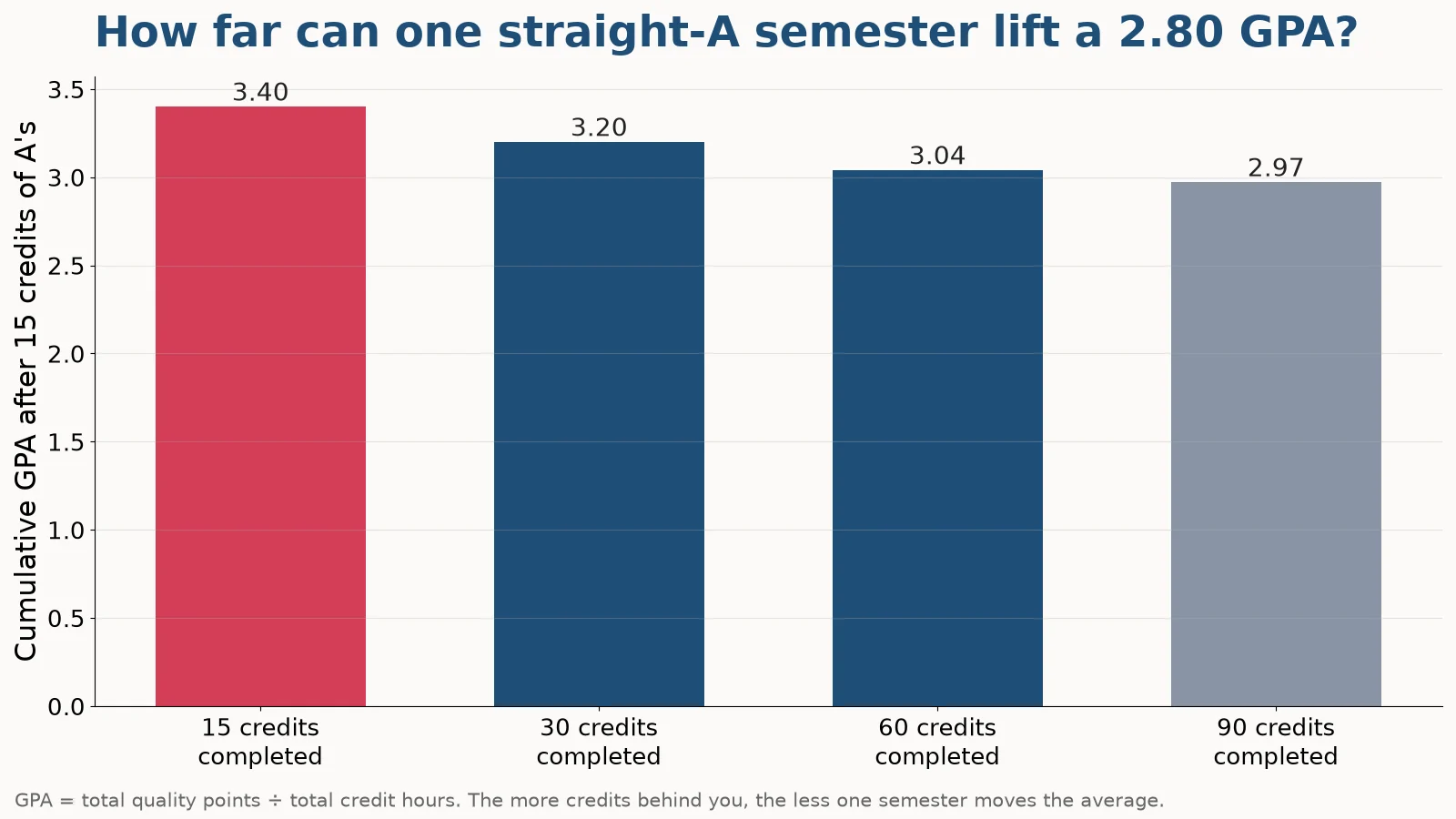
Because the cumulative GPA is weighted by credits, every semester counts for a little less than the one before. Here is what 15 credits of straight A’s would do to a 2.80 GPA, depending on how many credits are already on the record:
| Credits already completed | New cumulative GPA | Change |
|---|---|---|
| 15 | 3.40 | +0.60 |
| 30 | 3.20 | +0.40 |
| 60 | 3.04 | +0.24 |
| 90 | 2.97 | +0.17 |
A strong semester early in college can lift a GPA a long way; the same semester in the final year moves it much less. That is why the first year matters so much.
Weighted vs unweighted GPA
Many high schools report two GPAs. College Board explains that in a weighted GPA system, courses such as AP and honors classes are assigned higher GPA points. A common approach, used here as an example, adds one point for those courses, so an A in an AP class counts as 5.0 instead of 4.0. Schools vary in the exact scheme.
For these five classes:
- AP Biology: A (advanced)
- Honors English: B (advanced)
- Algebra II: B
- Spanish III: A
- Art: A
The unweighted GPA is 3.60. With one extra point for the two advanced classes, the weighted GPA is 4.00.
How colleges look at it
Because every high school weights differently, College Board notes that colleges may recalculate GPAs using their own criteria. Some remove noncore courses such as physical education or electives, focus on core subjects (math, science, English, social studies and world languages), and adjust or remove the weighting given to AP and honors classes. That is why many applications ask for your actual grades. It is worth asking each college’s admissions office how it evaluates GPA.
Pass/fail, withdrawals and other grades
Not every grade counts toward GPA. Policies vary, but the University of Toledo’s rules are typical:
- Grades such as incomplete, withdrawal and no credit (in Toledo’s case IN, IW, NC, PR, W and Z) are not used in the GPA calculation.
- A pass grade (PS) adds to the credit hours you have earned, but not to the hours or quality points used for GPA.
Toledo’s own example: a student with a B in a 3-credit course, a pass in a 3-credit course and an A in a 3-credit course has earned 9 hours, but only 6 count for GPA. The GPA is (3 × 3.00 + 3 × 4.00) ÷ 6 = 21 ÷ 6 = 3.50.
This has a practical consequence: taking a course pass/fail protects your GPA from a low grade, but a good grade in that course will not help it either. Check your school’s limits on pass/fail courses, especially for major requirements.
Converting a percentage average to GPA
Some schools report percentages or number grades rather than letters. To estimate a 4.0-scale GPA, convert each class grade to points first, then average the points, rather than averaging the percentages and converting once at the end.
The order matters because the scale is made of steps. Using the College Board table, grades of 89%, 91% and 79% average to 86.3%, which is a B (3.0). But converted class by class they are a B (3.0), an A (4.0) and a C (2.0), which also average to 3.0 in this case. Change the grades to 90%, 90% and 79%, though, and the percentage average (86.3%) is still a B, while the class-by-class GPA is (4.0 + 4.0 + 2.0) ÷ 3 = 3.33. A single percentage point at a cutoff can move a class a whole grade point.
College Board itself cautions that its table gives a general sense of how grades relate to the 4.0 scale and is not necessarily the formula for your true GPA. If your school publishes its own conversion, use that. When you report grades on an application, give the GPA exactly as it appears on your transcript, and use any recalculation only for your own planning.
What grades do you need to reach a target GPA?
You can work backward from a goal. The formula is:
GPA needed next term = (target × total credits after the term − current GPA × current credits) ÷ credits next term
For example, a student with a 2.80 GPA over 45 credits who wants a 3.0 after taking 15 more credits needs:
(3.0 × 60 − 2.80 × 45) ÷ 15 = 3.60 for the coming term.
That is achievable, roughly a B+ to A− average. If the answer comes out above 4.0, the target is not reachable in one term and you would need to spread it over two or more.
Practical ways to raise a GPA
- Focus effort on high-credit courses, since they carry the most quality points.
- Check whether your school allows grade replacement when a course is retaken; policies differ.
- Use office hours and tutoring early in the term, before grades are set.
- Keep a running tally each term so there are no surprises.
Our grade calculator shows what you need on a final exam, and the weighted average calculator handles any weighting scheme. For the maths behind weighted averages, see our guide to mean, median, mode and weighted averages.
Frequently asked questions
How do you calculate GPA?
Convert each grade to points (A = 4, B = 3, C = 2, D = 1, F = 0), multiply by the course’s credit hours, add them up and divide by the total credit hours.
What is a 3.5 GPA in letter grades?
On the 4.0 scale it is halfway between a B (3.0) and an A (4.0), roughly an A−/B+ average.
How do I calculate my cumulative GPA?
Divide the total quality points from all terms by the total credit hours attempted in all terms. Do not average the semester GPAs.
What is the difference between weighted and unweighted GPA?
Unweighted GPA uses the standard 4.0 scale for every class. Weighted GPA gives extra points for advanced classes such as AP and honors.
Do pass/fail classes affect GPA?
Usually not. At the University of Toledo, for example, pass credits count toward hours earned but not toward GPA.
What is the average GPA?
College Board puts it at about 3.0 across US high schools and 3.1 across US colleges.
How much is an A− worth?
At schools that use thirds of a point, such as the University of Toledo, an A− is 3.67. Some schools use 3.7.
Can I raise my GPA in one semester?
Yes, but less as you earn more credits. With 15 credits done, 15 credits of A’s can lift a 2.80 GPA to 3.40; with 90 credits done, only to about 2.97.
Related calculators
Sources
- How to Calculate Your GPA on a 4.0 Scale, College Board, BigFuture. The 4.0 scale table, the simple GPA example, average GPAs, weighted GPA and how colleges recalculate.
- Calculate GPA, Office of the Registrar, University of Notre Dame. Quality points and the semester and cumulative GPA formulas.
- Calculating Your GPA, Office of the Registrar, University of Toledo. Plus/minus grade values and how pass and other grades are treated.