
Updated 13 November 2026 · Written by the Digital Calculators team
Key takeaways
- Percentage of a number: divide the percent by 100 and multiply. 18% of $64.50 = 0.18 × 64.50 = $11.61.
- What percent X is of Y: divide the part by the whole and multiply by 100. 42 out of 50 = 84%.
- Percent change: (new − old) ÷ old × 100, the method the Bureau of Labor Statistics uses for the CPI.
- To undo a percentage, divide, do not subtract: a $64 sale price after 20% off came from $64 ÷ 0.80 = $80.
- A move from 4% to 5% is a rise of 1 percentage point, but a 25% increase in the rate.
If you want to know how to calculate percentage values quickly and correctly, you only need three formulas, and they are all variations on one idea: a percent is a number out of 100. “Per cent” literally means per hundred, so 18% is 18 per 100, or 0.18. Once you can turn a percentage into a decimal and back, every percentage question becomes a single multiplication or division.
This guide walks through each type of question you are likely to meet: working out a tip or a discount, turning a test score into a percentage, measuring how much a price or salary has changed, working backward from a sale price to the original price, and the classic traps, such as why a 10% rise followed by a 10% fall leaves you worse off. Every example is worked step by step, and our percentage calculator is built into the page so you can check your own numbers as you go.
- The three percentage formulas
- How to find a percentage of a number
- What percent is one number of another?
- Percent increase and decrease
- Reverse percentages: finding the original number
- Why +10% then −10% does not get you back
- Percent vs percentage points (and percent difference)
- Common fractions as percentages
- Frequently asked questions
- Sources
The three percentage formulas
Almost every percentage problem is one of these three. The trick is spotting which one the question is asking.
| Question | Formula | Example |
|---|---|---|
| What is P% of X? | P ÷ 100 × X | 18% of $64.50 = 0.18 × 64.50 = $11.61 |
| What percent is A of B? | A ÷ B × 100 | 42 of 50 = 42 ÷ 50 × 100 = 84% |
| What is the percent change from old to new? | (new − old) ÷ old × 100 | $80 to $92 = 12 ÷ 80 × 100 = 15% |
The first formula gives you an amount. The second and third give you a percentage. If your answer is in the wrong form, you probably picked the wrong formula.
A useful habit is to say the question out loud with the word “of” in it. “Eighteen percent of the bill” means multiply. “Forty-two out of fifty” means divide. “From eighty to ninety-two” means percent change, which always divides by the starting value.
The calculator below handles all three. Enter any two values and it fills in the third.
Prefer a full page? Open the Percentage Calculator.
How to find a percentage of a number
To find a percentage of a number, convert the percentage to a decimal by dividing by 100 (move the decimal point two places to the left), then multiply.
- 18% → 0.18, so 18% of $64.50 = 0.18 × 64.50 = $11.61.
- 7.5% → 0.075, so 7.5% of $240 = $18.
- 150% → 1.5, so 150% of 40 = 60. Percentages over 100 simply give more than the original.
Mental shortcuts
You can do most everyday percentages in your head by building from 10% and 1%:
- 10%: move the decimal one place left. 10% of $64.50 is $6.45.
- 1%: move it two places left. 1% of $64.50 is about $0.65.
- 5%: half of 10%. 20%: double 10%. 15%: 10% plus 5%. 25%: divide by 4.
For a restaurant bill of $64.50, that gives:
| Tip | Amount |
|---|---|
| 15% | $9.68 |
| 18% | $11.61 |
| 20% | $12.90 |
| 25% | $16.13 |
The swap trick
Percentages can be flipped: P% of X is always the same as X% of P, because both are P × X ÷ 100. So 8% of 25 is hard, but 25% of 8 is easy: a quarter of 8 is 2. And 8% of 25 is also 2. Try it on 4% of 75 (75% of 4 = 3) or 16% of 50 (50% of 16 = 8).
For tips specifically, our tip calculator also splits the bill between people.
What percent is one number of another?
To find what percent one number is of another, divide the part by the whole and multiply by 100.
Part ÷ whole × 100 = percent
- A test score of 42 out of 50: 42 ÷ 50 = 0.84, × 100 = 84%.
- Rent of $1,450 out of a $5,200 monthly income: 1,450 ÷ 5,200 = 0.2788, × 100 = 27.9% of income.
- A team that won 27 of 40 games won 67.5% of them.
The most common mistake is dividing the wrong way round. The “whole” is whatever you are taking a share of: the total marks, the full income, all the games. If your answer comes out above 100% when the part is smaller than the whole, you have flipped them.
Percentages above 100% are perfectly valid when the part really is bigger. If you budgeted $400 for groceries and spent $460, you spent 115% of the budget, which is the same as saying you went 15% over.
For grades in particular, our grade calculator converts points to a percentage and a letter grade.
Percent increase and decrease
Percent change measures how much something has grown or shrunk relative to where it started. The U.S. Bureau of Labor Statistics, which publishes the Consumer Price Index, describes the method in three steps: subtract the earlier value from the later one, divide that difference by the earlier value, and multiply by 100.
(new − old) ÷ old × 100 = percent change
A positive answer is an increase and a negative one a decrease.
- A price rises from $80 to $92: (92 − 80) ÷ 80 × 100 = +15%.
- Rent falls from $1,500 to $1,380: (1,380 − 1,500) ÷ 1,500 × 100 = -8%.
- A salary of $58,000 rises by 3.5%: the new salary is 58,000 × 1.035 = $60,030.
That last example shows the shortcut for applying a change: multiply by (1 + the change as a decimal). An increase of 3.5% means multiply by 1.035; a decrease of 8% means multiply by 0.92.
BLS also explains why it reports price movements as percent changes rather than raw index points: the size of a point change depends on how high the index already is, while a percent change does not. The same logic applies to your own numbers. A $5 rise on a $20 item is a big deal (25%); a $5 rise on a $500 item is not (1%).
To compare two values in either direction, use our percentage change calculator.
Reverse percentages: finding the original number
Reverse percentage questions give you the result after a percentage was applied and ask for the starting value. They catch a lot of people out, because the instinct is to add or subtract the percentage again, which gives the wrong answer.
Original price before a discount
You paid $64 for a jacket that was 20% off. What was the full price? Paying 20% less means you paid 80% of the original, so:
original = sale price ÷ (1 − discount) = 64 ÷ 0.80 = $80
Adding 20% to $64 would give $76.80, which is wrong, because the 20% was taken off $80, not off $64.
Price before sales tax
A receipt shows $54.00 including 8% sales tax. The total is 108% of the pre-tax price:
pre-tax = total ÷ (1 + tax rate) = 54 ÷ 1.08 = $50, so the tax was $4.
Salary before a raise
If your new salary of $60,030 includes a 3.5% raise, your old salary was $60,030 ÷ 1.035 = $58,000.
The rule in every case: divide by the multiplier that was applied. Our discount calculator and sales tax calculator work in both directions.
Why +10% then −10% does not get you back
Percentage changes do not cancel out, because each one is measured from a different starting value.
Take $100. A 10% rise takes it to $110. A 10% fall from $110 takes off $11, leaving $99. Overall you are down 1%. In multiplier form: 1.10 × 0.90 = 0.99, a change of -1%.
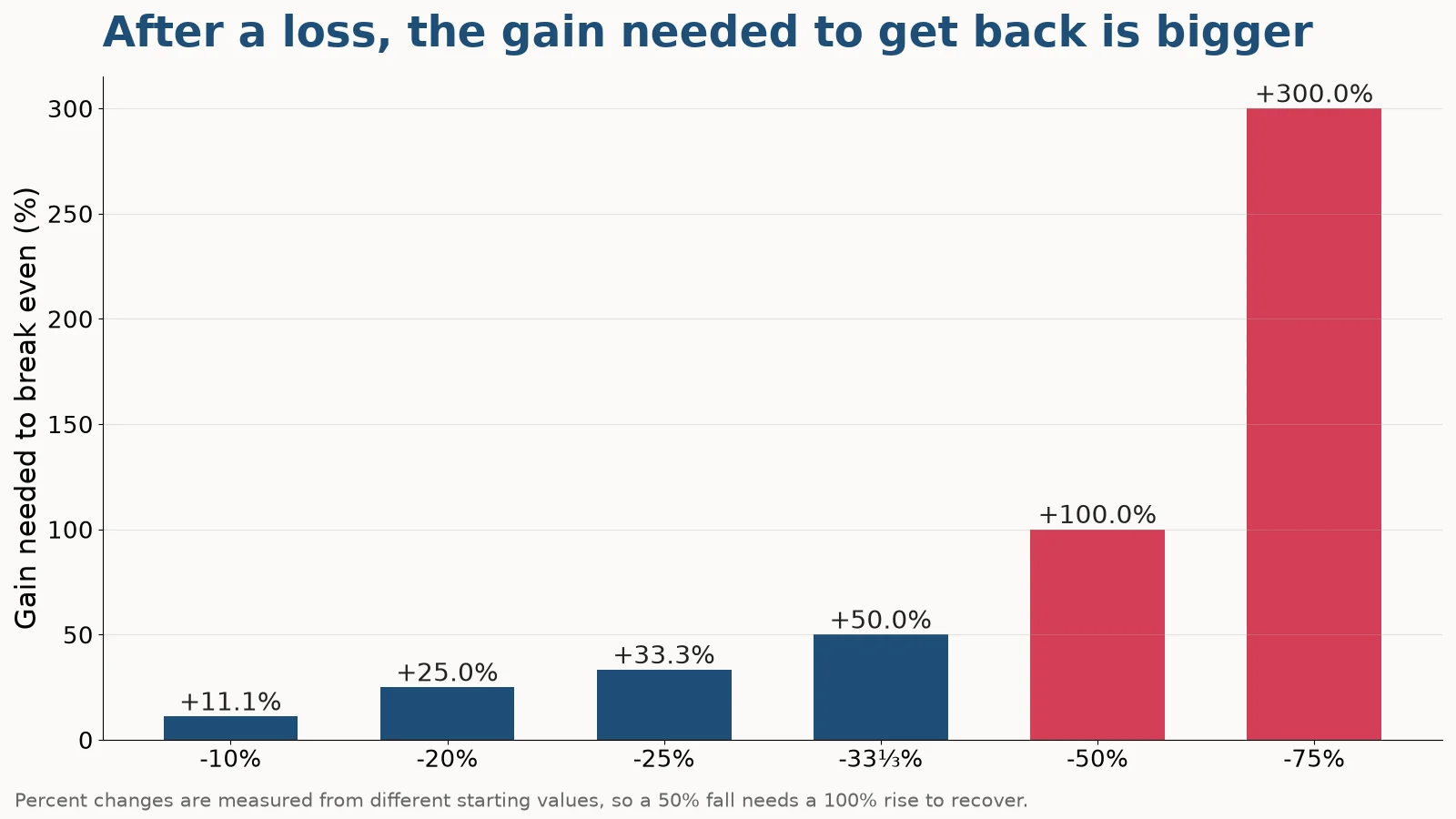
The same thing explains why losses are harder to recover from than they look. After a fall, you are starting from a smaller number, so you need a bigger percentage gain to get back to where you were:
| Fall | Rise needed to break even |
|---|---|
| 10% | 11.1% |
| 20% | 25.0% |
| 25% | 33.3% |
| 33.33% | 50.0% |
| 50% | 100.0% |
| 75% | 300.0% |
A 50% fall needs a 100% rise to recover. This is why investors talk about avoiding big drawdowns, and why a price that is “cut by 50% and then raised by 50%” ends up 25% below where it started (0.5 × 1.5 = 0.75).
Stacked discounts
Two discounts work the same way. “20% off, plus an extra 10% at the register” is not 30% off. You pay 0.80 × 0.90 = 0.72 of the price, which is a 28% discount. Always multiply successive percentage changes; never add them.
Percent vs percentage points (and percent difference)
When the thing that is changing is itself a percentage, such as an interest rate, a tax rate or an unemployment rate, there are two ways to describe the change, and they give very different numbers.
- Percentage points are the simple difference between two percentages. A mortgage rate that goes from 4% to 5% has risen by 1 percentage point.
- Percent change treats the rate as a number and measures the relative change: (5 − 4) ÷ 4 × 100 = 25%.
Both are correct, but they answer different questions, and mixing them up can make a change sound much bigger or smaller than it is. The UK Office for National Statistics style guide gives a neat example: a value of 10% that falls by 1 percentage point becomes 9%, while a value of 10% that falls by 1% becomes 9.9%.
Percent difference
Sometimes there is no “old” and “new”, just two values to compare, such as two shops’ prices. Percent change gives a different answer depending on which you start from: going from 40 to 50 is +25%, but from 50 to 40 is -20%. To get one symmetric number, a common convention divides the gap by the average of the two values:
|A − B| ÷ ((A + B) ÷ 2) × 100 = 10 ÷ 45 × 100 = 22.2%
Conventions vary between fields, so say which method you used. Our percentage difference calculator uses the average method.
Common fractions as percentages
Many percentage problems are easier if you recognise the common fractions behind them. These are worth memorising:
| Fraction | Decimal | Percent |
|---|---|---|
| 1/2 | 0.5 | 50% |
| 1/3 | 0.333… | 33.33% |
| 1/4 | 0.25 | 25% |
| 1/5 | 0.2 | 20% |
| 1/8 | 0.125 | 12.5% |
| 1/10 | 0.1 | 10% |
| 2/3 | 0.667… | 66.67% |
| 3/4 | 0.75 | 75% |
| 3/8 | 0.375 | 37.5% |
| 5/8 | 0.625 | 62.5% |
To convert any fraction to a percentage, divide the top by the bottom and multiply by 100: 7/16 = 0.4375 = 43.75%. To go the other way, write the percentage over 100 and simplify: 35% = 35/100 = 7/20.
Recognising these makes some problems instant. 37.5% of 64 is 3/8 of 64, which is 24. And 66.7% off is really “two thirds off”, so you pay one third of the price. If you work with fractions often, our fraction calculator and decimal to fraction calculator save time.
Frequently asked questions
How do I calculate a percentage of a number?
Divide the percentage by 100 and multiply by the number. For example, 15% of 80 is 0.15 × 80 = 12.
How do I work out what percentage one number is of another?
Divide the part by the whole and multiply by 100. 42 out of 50 is 42 ÷ 50 × 100 = 84%.
What is the formula for percent change?
(new value − old value) ÷ old value × 100. A positive result is an increase, a negative result a decrease.
How do I find the original price before a discount?
Divide the sale price by (1 − discount as a decimal). $64 after 20% off came from $64 ÷ 0.80 = $80.
How do I remove sales tax from a total?
Divide the total by (1 + tax rate as a decimal). $54 including 8% tax is $54 ÷ 1.08 = $50 before tax.
Are two discounts of 20% and 10% the same as 30% off?
No. You pay 0.80 × 0.90 = 72% of the price, so the combined discount is 28%.
What is the difference between percent and percentage points?
Percentage points are the plain difference between two percentages (4% to 5% is 1 point). Percent change is relative (4% to 5% is a 25% increase).
How do I calculate 15% quickly?
Take 10% by moving the decimal point one place left, then add half of that. For $40: 10% is $4, 5% is $2, so 15% is $6.
Related calculators
Sources
- Calculating percent changes, U.S. Bureau of Labor Statistics. The percent change method and why percent changes are preferred to point changes.
- Percentages and percentage points (content style guide), Office for National Statistics. The distinction between a percent change and a percentage point change.