
Updated 13 November 2026 · Written by the Digital Calculators team
Key takeaways
- There are 16 tablespoons in a cup, 48 teaspoons in a cup and 3 teaspoons in a tablespoon. These are exact US definitions.
- A cup holds 8 fluid ounces. 2 cups make a pint, 4 cups a quart and 16 cups a gallon.
- A US cup is 236.6 mL exactly; nutrition labels and NIST’s kitchen table round it to 240 mL. The difference is under 1.5%.
- Fluid ounces measure volume, ounces measure weight: a cup of flour is 8 fl oz but weighs only about 4.4 oz (125 g).
- For baking, weigh dry ingredients. A packed cup of brown sugar weighs about half as much again as a loose one (220 g vs 145 g, USDA).
How many tablespoons in a cup? Sixteen. A US cup is exactly 16 tablespoons, a tablespoon is exactly 3 teaspoons, and so a cup is 48 teaspoons. Those three numbers are fixed by the official US definitions that the National Institute of Standards and Technology (NIST) publishes in Handbook 44, so they work for any ingredient, wet or dry.
The harder questions start when a recipe mixes systems. How many ounces in a cup depends on whether you mean fluid ounces or weight. A cup of flour and a cup of honey take up the same space, but the honey weighs 2.7 times as much. And a recipe from a scale-using baker gives grams, while your recipe card says cups. This guide puts every common kitchen conversion in one place: spoons and cups, fluid ounces, pints, quarts and gallons, milliliters, and grams per cup for 15 everyday baking ingredients taken from USDA data. Worked examples show how to halve, scale and convert a real recipe, and our tablespoons to cups converter is built into the page for anything the charts do not cover.
- Tablespoons, teaspoons and fluid ounces in a cup
- Cups, pints, quarts and gallons
- How many milliliters in a cup: 236.6 or 240?
- How many ounces in a cup? Fluid ounces vs weight
- Cups to grams for common baking ingredients
- Why the same cup weighs different amounts
- Worked examples: halving, scaling and converting a recipe
- A kitchen conversion cheat sheet
- Frequently asked questions
- Sources
Tablespoons, teaspoons and fluid ounces in a cup
Here is the full ladder for the cup sizes you will meet in recipes. The tablespoon and teaspoon columns are exact. The milliliter column uses the exact US cup of 236.6 mL and is rounded to the nearest milliliter.
| Cup | Tablespoons | Spoons to measure | Teaspoons | Fluid ounces | Milliliters |
|---|---|---|---|---|---|
| 1 cup | 16 tbsp | 16 tbsp | 48 tsp | 8 fl oz | 237 mL |
| 3/4 cup | 12 tbsp | 12 tbsp | 36 tsp | 6 fl oz | 177 mL |
| 2/3 cup | 10⅔ tbsp | 10 tbsp + 2 tsp | 32 tsp | 5⅓ fl oz | 158 mL |
| 1/2 cup | 8 tbsp | 8 tbsp | 24 tsp | 4 fl oz | 118 mL |
| 1/3 cup | 5⅓ tbsp | 5 tbsp + 1 tsp | 16 tsp | 2⅔ fl oz | 79 mL |
| 1/4 cup | 4 tbsp | 4 tbsp | 12 tsp | 2 fl oz | 59 mL |
| 1/8 cup | 2 tbsp | 2 tbsp | 6 tsp | 1 fl oz | 30 mL |
| 1/16 cup | 1 tbsp | 1 tbsp | 3 tsp | ½ fl oz | 15 mL |
The “spoons to measure” column is the one to use at the counter. A third of a cup is 5⅓ tablespoons, which no spoon set can measure, so you use 5 tablespoons plus 1 teaspoon instead. Two thirds of a cup is 10 tablespoons plus 2 teaspoons. Every value comes from the same two exact rules: 1 cup = 16 tablespoons and 1 tablespoon = 3 teaspoons.
If you only remember one line, make it the quarter cup: ¼ cup = 4 tablespoons. Half a cup is 8 tablespoons, three quarters is 12, and you can build most other amounts from there.
Need an amount that is not in the table, such as 7 tablespoons in cups? Type it into the converter below and it will give you the decimal and the nearest measuring-cup combination.
Prefer a full page? Open the Tablespoons to Cups Converter.
Cups, pints, quarts and gallons
Liquid recipes, punch bowls and stock pots move up to bigger units. NIST Handbook 44 defines the US gallon as 231 cubic inches, split into 4 quarts, each quart into 2 pints, and each pint into 2 cups. That gives this table:
| Unit | Cups | Fluid ounces | Tablespoons | Milliliters (exact) |
|---|---|---|---|---|
| 1 cup | 1 | 8 | 16 | 237 mL |
| 1 pint | 2 | 16 | 32 | 473 mL |
| 1 quart | 4 | 32 | 64 | 946 mL |
| 1/2 gallon | 8 | 64 | 128 | 1,893 mL |
| 1 gallon | 16 | 128 | 256 | 3,785 mL |
So the answer to “how many cups in a quart” is 4, and there are 16 cups in a gallon. A quick check from the table: a gallon of milk is 128 fluid ounces, or about 3.79 liters.
These are US liquid measures. NIST notes that the British Imperial gallon is about 20% larger than the US gallon (1 Imperial gallon is 1.201 US gallons), and its pints and quarts are larger in the same proportion. So an older British recipe that says “pint” means about a fifth more than a US pint. If a recipe comes from the UK and the amount looks off, check which pint the author meant, or work from milliliters or grams instead.
Our quarts to cups converter and gallons to quarts converter handle any amount if you are scaling a big batch.
How many milliliters in a cup: 236.6 or 240?
You will see two numbers for a cup in milliliters, and both are correct for their purpose.
- 236.6 mL is the exact US customary cup. It follows from the gallon of 231 cubic inches: divide a gallon (3,785.4 mL) by 16. NIST Handbook 44 rounds this to 237 mL.
- 240 mL is the rounded cup used on Nutrition Facts labels. The FDA’s labeling rule (21 CFR 101.9) says that for nutrition labeling a teaspoon means 5 mL, a tablespoon 15 mL, a cup 240 mL and a fluid ounce 30 mL. NIST’s own home-cooking table uses the same rounded figures.
The difference is 1.4%. Even over 4 cups it adds up to only 13.6 mL, which is less than one tablespoon. In a home kitchen you can use whichever is easier. The exact figures matter only if you are converting large batches, writing nutrition labels, or checking a measuring jug for accuracy.
The spoons work the same way. An exact US tablespoon is 14.79 mL and a teaspoon 4.93 mL; Handbook 44 rounds them to 15 mL and 5 mL, calling them “imprecise units”. That is why a metric 15 mL spoon set works fine for American recipes.
For any other amount, our cups to mL converter uses the exact value.
How many ounces in a cup? Fluid ounces vs weight
A cup is 8 fluid ounces. That part is exact. The confusion comes from the word “ounce”, which in American kitchens means two different things:
- A fluid ounce (fl oz) is a volume: 29.57 mL. It tells you how much space something takes up.
- An ounce (oz) is a weight: 28.35 g, or 1/16 of a pound. It tells you how heavy something is.
For water and drinks like milk the two are close, which is how the mix-up survives. USDA data put 1 cup of whole milk at 244 g, which is 8.6 oz by weight, near enough to its 8 fl oz. For everything else they drift far apart:
| 1 cup of | Volume | Weight (USDA) | Weight in ounces |
|---|---|---|---|
| All-purpose flour | 8 fl oz | 125 g | 4.4 oz |
| Whole milk | 8 fl oz | 244 g | 8.6 oz |
| Honey | 8 fl oz | 339 g | 12.0 oz |
So if a recipe asks for “8 ounces of flour” it means weight, and that is almost two cups, not one. A good rule: if the ingredient is a liquid and the recipe says ounces, it usually means fluid ounces; if it is solid or powdery, it means weight. When in doubt, a kitchen scale settles it.
And the related question, how many grams in an ounce: 28.35 g. The pound is defined as exactly 453.59237 g, and an ounce is a sixteenth of that. Labels round it to 28 g. Our grams to ounces converter and ounces to cups converter do the arithmetic for you.
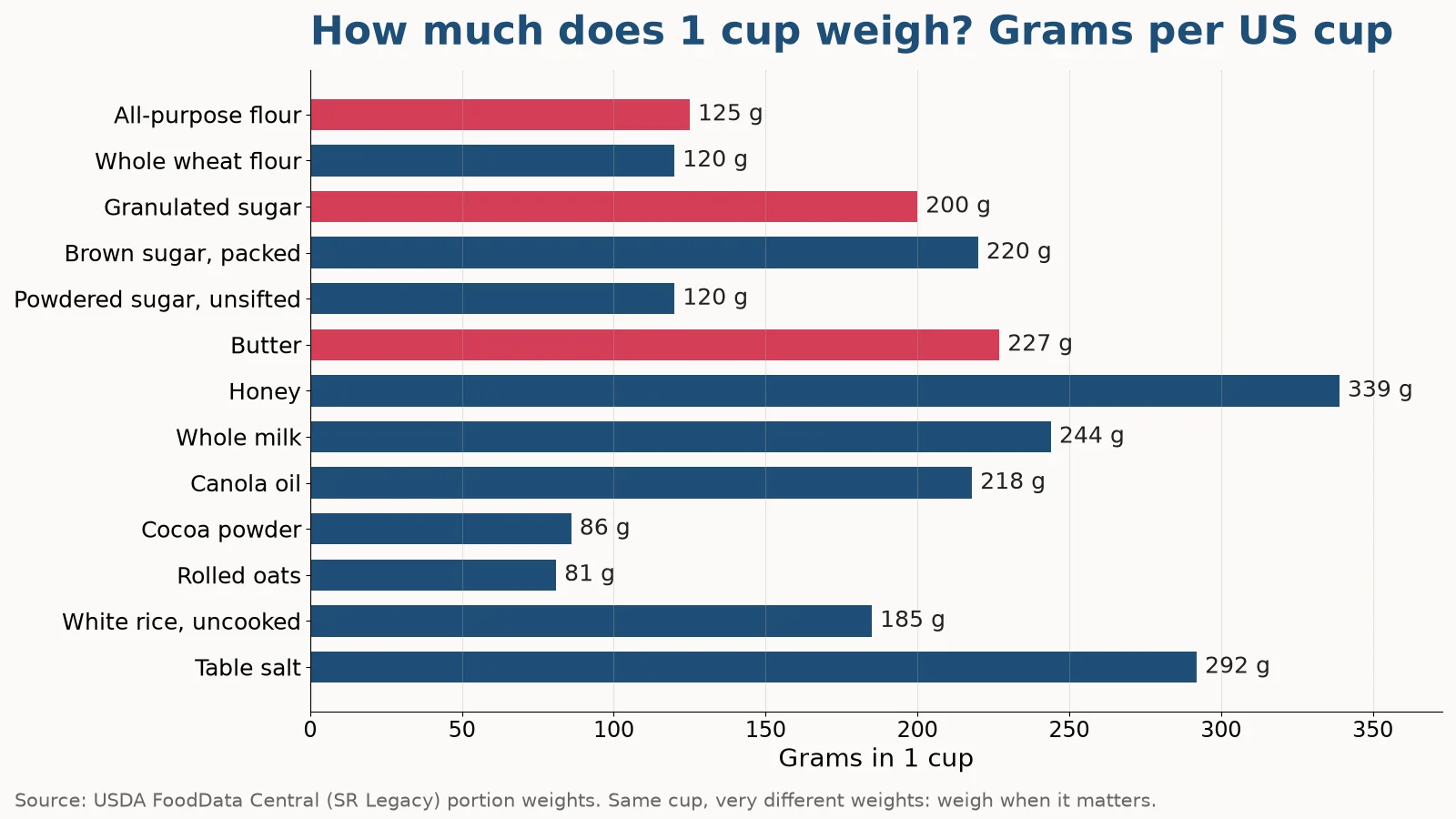
Cups to grams for common baking ingredients
Because a cup measures space, not weight, every ingredient has its own grams-per-cup figure. The table below uses the portion weights in USDA FoodData Central, the government’s food composition database. The half-cup, quarter-cup and tablespoon columns are simply the cup weight divided by 2, 4 and 16.
| Ingredient | 1 cup | ½ cup | ¼ cup | 1 tbsp | 1 cup in oz |
|---|---|---|---|---|---|
| All-purpose flour | 125 g | 62 g | 31 g | 7.8 g | 4.4 oz |
| Whole wheat flour | 120 g | 60 g | 30 g | 7.5 g | 4.2 oz |
| Granulated sugar | 200 g | 100 g | 50 g | 12.5 g | 7.1 oz |
| Brown sugar, packed | 220 g | 110 g | 55 g | 13.8 g | 7.8 oz |
| Brown sugar, loose | 145 g | 72 g | 36 g | 9.1 g | 5.1 oz |
| Powdered sugar, unsifted | 120 g | 60 g | 30 g | 7.5 g | 4.2 oz |
| Powdered sugar, sifted | 100 g | 50 g | 25 g | 6.2 g | 3.5 oz |
| Butter | 227 g | 114 g | 57 g | 14.2 g | 8.0 oz |
| Honey | 339 g | 170 g | 85 g | 21.2 g | 12.0 oz |
| Whole milk | 244 g | 122 g | 61 g | 15.2 g | 8.6 oz |
| Canola oil | 218 g | 109 g | 54 g | 13.6 g | 7.7 oz |
| Cocoa powder | 86 g | 43 g | 22 g | 5.4 g | 3.0 oz |
| Rolled oats | 81 g | 40 g | 20 g | 5.1 g | 2.9 oz |
| White rice, uncooked | 185 g | 92 g | 46 g | 11.6 g | 6.5 oz |
| Table salt | 292 g | 146 g | 73 g | 18.2 g | 10.3 oz |
Some patterns are worth knowing. Flour is light: a cup weighs around 125 g. White sugar is denser at 200 g. Liquids sweetened with sugar, such as honey, are much heavier than water. And powders full of air, like cocoa and rolled oats, weigh well under 100 g a cup.
USDA also lists a few handy portions directly. A tablespoon of butter is 14.2 g and a stick of butter is 113 g, which is 8 tablespoons or half a cup. A teaspoon of granulated sugar is 4.2 g and a teaspoon of table salt is 6 g.
Your own cup of flour may not weigh exactly 125 g; the next section explains why. For the most common conversion, try our grams to cups converter or the grams to tablespoons converter.
Why the same cup weighs different amounts
Look again at the USDA figures for sugars. A cup of brown sugar weighs 220 g when packed and 145 g when loose, a difference of 52%. Powdered sugar is 120 g a cup unsifted and 100 g sifted, 20% apart. Same cup, same ingredient, very different amounts, purely because of how it went into the cup.
Flour behaves the same way. Scooping the cup straight into the bag can press flour in, while spooning it in lightly leaves more air. Neither is wrong, but a recipe written one way and measured the other can end up with noticeably more or less flour, which is the usual reason for dry cookies or a dense cake.
NIST’s culinary measurement tips give three practical rules:
- Weigh when you can. NIST calls measuring by mass with a kitchen scale “a best practice to improve recipe accuracy” compared with measuring by volume.
- Use the right cup. Dry measuring cups are designed for dry ingredients and fluid measuring cups for liquids. Using one for the other is, in NIST’s words, a common way of introducing measurement errors.
- Measure carefully. Strike off excess dry ingredients level with the rim. For liquids, set the measuring cup on a level surface and read the meniscus at eye level, not from above.
If a recipe says “1 cup packed brown sugar”, press it in firmly until it holds the cup’s shape when turned out. If the recipe gives grams, use them: the author has done the hard part for you, and the packed-or-loose question disappears.
Worked examples: halving, scaling and converting a recipe
Here are the conversions that come up most often, worked through with the exact rules above.
1. Halving a recipe
A cake calls for ¾ cup sugar and ⅓ cup oil and you want half. Half of ¾ cup is ⅜ cup, which no cup set has, so convert to spoons: ⅜ cup = 6 tbsp. Half of ⅓ cup is ⅙ cup = 8 teaspoons = 2 tbsp + 2 tsp.
2. Scaling from 4 servings to 10
The scale factor is 10 ÷ 4 = 2.5. A sauce that uses ⅓ cup milk now needs ⅚ cup. That is 40 teaspoons, or 13 tbsp + 1 tsp; in practice, ¾ cup plus 1 tablespoon and 1 teaspoon. A quarter cup of butter becomes ⅝ cup = 10 tbsp, which is a stick (8 tablespoons) plus 2 tablespoons.
3. Converting a metric recipe to cups
A European recipe lists 250 g flour, 150 g sugar, 120 mL milk and 100 g butter. Using the USDA weights:
| Ingredient | Metric | Calculation | US measure |
|---|---|---|---|
| All-purpose flour | 250 g | 250 ÷ 125 g per cup | 2 cups |
| Granulated sugar | 150 g | 150 ÷ 200 g per cup | ¾ cup |
| Milk | 120 mL | 120 ÷ 236.6 mL per cup | 0.51 cup, so ½ cup |
| Butter | 100 g | 100 ÷ 14.2 g per tablespoon | 7.0 tbsp, so 7 tbsp |
The butter works out a little under one 113 g stick. For a cake this close is fine; for pastry, where butter ratios matter more, a scale is the safer choice.
4. Converting cups to grams
An American recipe asks for 2¼ cups all-purpose flour and you want to weigh it. At 125 g a cup that is 281 g. If the result seems dry, your flour may be packing more densely than USDA’s sample, and weighing to the gram removes that variable next time.
5. How many tablespoons in a stick of butter?
Eight. A stick is half a cup, and half of 16 tablespoons is 8. USDA’s weights agree: a stick is 113 g and a tablespoon 14.2 g, and 8 × 14.2 g = 113.6 g. Two sticks make a cup (227 g).
A kitchen conversion cheat sheet
The essentials on one card. Print this page or screenshot this table for the fridge door.
| Measure | Equals |
|---|---|
| 1 tablespoon | 3 teaspoons, ½ fl oz, about 15 mL |
| 1 fluid ounce | 2 tablespoons, about 30 mL |
| ¼ cup | 4 tablespoons, 2 fl oz |
| ⅓ cup | 5 tablespoons + 1 teaspoon |
| ½ cup | 8 tablespoons, 4 fl oz |
| 1 cup | 16 tablespoons, 48 teaspoons, 8 fl oz, 236.6 mL (240 mL on labels) |
| 1 pint | 2 cups, 16 fl oz |
| 1 quart | 4 cups, 2 pints, 32 fl oz |
| 1 gallon | 16 cups, 4 quarts, 128 fl oz, about 3.79 L |
| 1 ounce (weight) | 28.35 g |
| 1 pound | 16 oz, 453.6 g |
| 1 stick of butter | 8 tablespoons, ½ cup, 113 g |
| 1 cup all-purpose flour | about 125 g |
| 1 cup granulated sugar | about 200 g |
Everything in the top part of the card is an exact definition, so it is true for any ingredient. The bottom rows are USDA averages for specific ingredients, so treat them as good starting points rather than laws.
Frequently asked questions
How many tablespoons in a cup?
16 tablespoons. A cup is also 48 teaspoons and 8 fluid ounces.
How many tablespoons in 1/4 cup?
4 tablespoons. Half a cup is 8 tablespoons and three quarters of a cup is 12.
How many tablespoons in 1/3 cup?
5⅓ tablespoons, which you measure as 5 tablespoons plus 1 teaspoon.
How many teaspoons in a tablespoon?
3 teaspoons. This is an exact definition, so it holds for every ingredient.
How many ounces in a cup?
8 fluid ounces. By weight it depends on the ingredient: a cup of all-purpose flour weighs about 4.4 oz and a cup of honey about 12 oz (USDA).
How many cups in a quart?
4 cups. There are 2 cups in a pint and 16 cups in a gallon.
How many grams in an ounce?
28.35 grams, because a pound is exactly 453.59237 g and an ounce is 1/16 of a pound. Food labels round it to 28 g.
How many mL in a cup?
An exact US cup is 236.6 mL. Nutrition labels and NIST’s home-cooking table round it to 240 mL.
How many grams is a cup of flour?
About 125 g of all-purpose flour according to USDA FoodData Central. Packing the flour into the cup can add noticeably more, so weigh it for baking.
How many tablespoons in a stick of butter?
8 tablespoons. A stick is half a cup and weighs about 113 g.
Related calculators
Sources
- Handbook 44 (2026), Appendix C: General Tables of Units of Measurement, National Institute of Standards and Technology. Exact definitions of the gallon, quart, pint, cup, fluid ounce, tablespoon, teaspoon, pound and ounce.
- Metric Kitchen: Cooking Measurement Equivalencies, National Institute of Standards and Technology. Rounded metric equivalents for home cooking (240 mL cup, 15 mL tablespoon).
- Metric Kitchen: Culinary Measurement Tips, National Institute of Standards and Technology. Weighing versus measuring by volume, dry versus fluid cups, reading a meniscus.
- 21 CFR 101.9, Nutrition labeling of food, U.S. Food and Drug Administration (eCFR). Metric equivalents used on Nutrition Facts labels: 5 mL teaspoon, 15 mL tablespoon, 240 mL cup, 30 mL fluid ounce, 28 g ounce.
- FoodData Central (SR Legacy portion weights), U.S. Department of Agriculture, Agricultural Research Service. Grams per cup, tablespoon, teaspoon and stick for the 15 ingredients in our tables (food ids 168833, 168877, 168893, 168936, 169593, 169640, 169655, 169656, 171265, 172336, 173430, 173468, 173904).