
Updated 13 November 2026 · Written by the Digital Calculators team
Key takeaways
- A common year has 52 weeks and 1 day (365 ÷ 7 = 52.14); a leap year has 52 weeks and 2 days.
- 2027 starts and ends on a Friday, so it has 261 weekdays, 104 weekend days and 53 Fridays.
- After the 11 federal holidays, 2027 has 250 working days for federal employees.
- At 8 hours a day, 2027 has 2,088 weekday hours, 8 more than the usual 2,080.
- Three 2027 holidays fall on a weekend and are observed on a weekday: Juneteenth, Independence Day and Christmas.
How many weeks in a year? 52, plus a little extra. A common year has 365 days, which is 52 weeks and 1 day; a leap year has 366 days, 52 weeks and 2 days. That extra day or two is why the calendar shifts each year, and why some years have more working days, more paydays or more Fridays than others.
2027 is one of those years. It starts on a Friday and, because it is not a leap year, it also ends on a Friday. That gives it 261 weekdays and 53 Fridays. This guide counts everything you might need for planning 2027: weeks, weekdays and weekends, the 11 federal holidays and their observed dates from the U.S. Office of Personnel Management, working days month by month and quarter by quarter, total work hours and the number of paydays. Our date calculator is built into the page for counting any other span of days.
How many weeks are in a year?
Divide the days in the year by 7:
- Common year: 365 ÷ 7 = 52.143 weeks, which is 52 weeks and 1 day.
- Leap year: 366 ÷ 7 = 52.286 weeks, which is 52 weeks and 2 days.
2027 is a common year (2028 will be the next leap year), so it has 52 weeks and 1 day. The extra day is a Friday, which is why 2027 has 53 Fridays and 52 of every other day of the week:
| Day | Times in 2027 |
|---|---|
| Monday | 52 |
| Tuesday | 52 |
| Wednesday | 52 |
| Thursday | 52 |
| Friday | 53 |
| Saturday | 52 |
| Sunday | 52 |
On average, a month has 365 ÷ 12 ÷ 7 = 4.35 weeks. That figure is useful for converting weekly amounts into monthly ones: a $300 weekly expense is about $1,304 a month, not $1,200.
Week numbers
Many workplaces number the weeks of the year. Under the ISO week-date system that Python’s calendar functions follow, 2027 has 52 numbered weeks. 1 January 2027 actually falls in week 53 of 2026, because 2026 has 53 ISO weeks. Week 1 of 2027 starts on Monday 4 January.
The calculator below counts the days, weeks or working days between any two dates.
Prefer a full page? Open the Date Calculator.
Federal holidays in 2027
The U.S. Office of Personnel Management (OPM) publishes the federal holiday schedule. These are the 2027 dates, using the days on which each holiday is observed:
| Date (observed) | Holiday | Note |
|---|---|---|
| Friday, 1 January | New Year’s Day | |
| Monday, 18 January | Birthday of Martin Luther King, Jr. | |
| Monday, 15 February | Washington’s Birthday (Presidents’ Day) | |
| Monday, 31 May | Memorial Day | |
| Friday, 18 June | Juneteenth National Independence Day | observed; 19 June is a Saturday |
| Monday, 5 July | Independence Day | observed; 4 July is a Sunday |
| Monday, 6 September | Labor Day | |
| Monday, 11 October | Columbus Day | |
| Thursday, 11 November | Veterans Day | |
| Thursday, 25 November | Thanksgiving Day | |
| Friday, 24 December | Christmas Day | observed; 25 December is a Saturday |
OPM explains the weekend rule: if a holiday falls on a Saturday, for most federal employees the preceding Friday is treated as the holiday for pay and leave purposes, and a Sunday holiday moves to the following Monday. In 2027 that applies three times: Juneteenth (Saturday 19 June, observed Friday 18 June), Independence Day (Sunday 4 July, observed Monday 5 July) and Christmas (Saturday 25 December, observed Friday 24 December).
The same rule reaches into the new year. New Year’s Day 2028 falls on a Saturday, so under it most federal employees would also have Friday 31 December 2027 off. That day belongs to OPM’s 2028 schedule, so it is not counted in our 2027 totals; if your employer follows it, subtract one more working day.
Private employers are not required to give these days off, and many observe only some of them. Check your own employer’s holiday list and adjust the counts below.
Working days in 2027, month by month
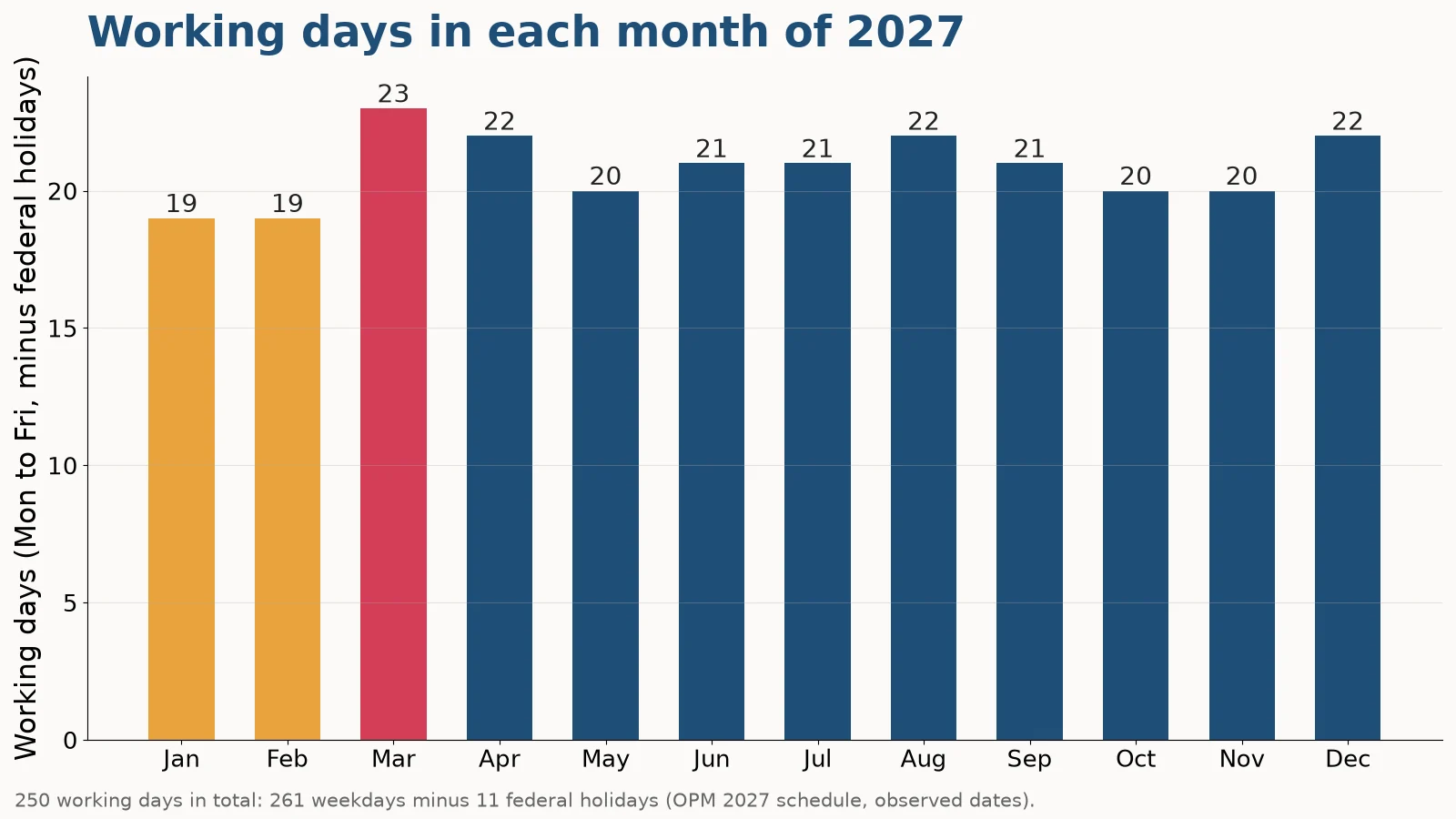
Working days here means Monday to Friday, minus the 11 federal holidays above. The year has 261 weekdays, so that leaves 250 working days.
| Month | Days | Weekdays | Federal holidays | Working days |
|---|---|---|---|---|
| January | 31 | 21 | 2 | 19 |
| February | 28 | 20 | 1 | 19 |
| March | 31 | 23 | 0 | 23 |
| April | 30 | 22 | 0 | 22 |
| May | 31 | 21 | 1 | 20 |
| June | 30 | 22 | 1 | 21 |
| July | 31 | 22 | 1 | 21 |
| August | 31 | 22 | 0 | 22 |
| September | 30 | 22 | 1 | 21 |
| October | 31 | 21 | 1 | 20 |
| November | 30 | 22 | 2 | 20 |
| December | 31 | 23 | 1 | 22 |
| Total | 365 | 261 | 11 | 250 |
March has the most working days (23), and January and February have the fewest (19 each). By quarter, 2027 has 61 working days in Q1, 63 in Q2, 64 in Q3 and 62 in Q4.
These counts matter for anything paid or planned by the working day: daily-rate contracts, project timelines, leave planning and service-level deadlines. If you work a different pattern, such as four 10-hour days, count the days you actually work instead.
Work hours in 2027
Payroll and salary conversions usually assume 2,080 hours a year: 40 hours × 52 weeks. But the real number of weekday hours depends on the calendar.
- 261 weekdays × 8 hours = 2,088 hours in 2027.
- Excluding the 11 federal holidays: 250 × 8 = 2,000 hours actually worked, if holidays are days off.
For an hourly worker who is paid for holidays, 2027 is worth 8 more paid hours than the standard formula. For a salaried worker, the salary is the same, so each hour is worth very slightly less. Our guide to converting hourly pay to salary works through the numbers, and the time card calculator totals weekly hours.
Here is how 2027 compares with nearby years:
| Year | Starts on | Leap year | Weekdays | Weekday hours |
|---|---|---|---|---|
| 2024 | Monday | Yes | 262 | 2,096 |
| 2025 | Wednesday | No | 261 | 2,088 |
| 2026 | Thursday | No | 261 | 2,088 |
| 2027 | Friday | No | 261 | 2,088 |
| 2028 | Saturday | Yes | 260 | 2,080 |
| 2029 | Monday | No | 261 | 2,088 |
| 2030 | Tuesday | No | 261 | 2,088 |
The pattern follows from the extra day or two. A common year has 261 weekdays unless it starts on a Saturday or Sunday, when it has 260. A leap year has 262 when it starts on Monday to Thursday, 261 when it starts on a Friday or Sunday, and 260 when it starts on a Saturday, as 2028 does. So 2027’s 261 is the normal figure; 2024 had 262, and 2028 drops to 260.
Leap years and the calendar shift
Each year starts one weekday later than the year before, because 365 days is 52 weeks plus one day. 2026 started on a Thursday, 2027 on a Friday. After a leap year the jump is two days: 2028 is a leap year starting on a Saturday, so 2029 starts on a Monday.
The Gregorian calendar, used in the US and most of the world, adds a leap day (29 February) in every year divisible by 4, except years divisible by 100, unless they are also divisible by 400. So 2000 was a leap year but 2100 will not be. The leap years between 2024 and 2040 are 2024, 2028, 2032, 2036, 2040.
This is why year-to-year comparisons need care. A business that compares sales in February 2028 with February 2027 is comparing 29 days with 28, and a month that gains an extra Friday or loses a weekday can look stronger or weaker for reasons that have nothing to do with performance. Comparing per working day, rather than per month, removes the calendar effect.
It also explains why the same date falls on a different weekday each year. Your birthday, an anniversary or a recurring bill due on the 15th will move forward one weekday in 2027 compared with 2026. Our age calculator and date calculator show the exact weekday for any date.
Paydays in 2027
How many paychecks you get in 2027 depends on how often you are paid and which day the schedule started on.
- Weekly on Fridays: 53 paychecks, because 2027 has 53 Fridays.
- Biweekly on Fridays: 27 paychecks if a payday falls on Friday 1 January, or 26 if the cycle starts on Friday 8 January.
- Semimonthly (twice a month, such as the 15th and the last day): always 24.
- Monthly: always 12.
A 27-paycheck year matters for budgeting. If your monthly bills are planned around two biweekly checks a month, a 27-payday schedule starting on 1 January brings a third check in three months: January, July and December. For salaried employees, some employers divide the annual salary by 27 in such a year, making each check a little smaller, while others keep the per-check amount and pay slightly more in total. Ask your payroll team which approach your employer uses.
A semimonthly schedule avoids this entirely, but its paydays move around the week, sometimes landing on a weekend, in which case most employers pay on the business day before.
Weekends, long weekends and planning tips
2027 has 104 weekend days: 52 Saturdays and 52 Sundays. Because nine of the federal holidays fall on a Monday or Friday, many of them create three-day weekends:
- Friday 1 January: New Year’s Day
- Monday 18 January: Birthday of Martin Luther King, Jr.
- Monday 15 February: Washington’s Birthday (Presidents’ Day)
- Monday 31 May: Memorial Day
- Friday 18 June: Juneteenth National Independence Day
- Monday 5 July: Independence Day
- Monday 6 September: Labor Day
- Monday 11 October: Columbus Day
- Friday 24 December: Christmas Day
Veterans Day and Thanksgiving fall on Thursdays (11 and 25 November). Taking the following Friday off turns each into a four-day weekend for the price of one day of leave.
Planning tips
- Book leave around holidays. One day of leave next to a Monday or Friday holiday gives you four days off; four days of leave around the Independence Day holiday (Monday 5 July) gives you nine days in a row, from Saturday 3 July to Sunday 11 July.
- Use working days, not calendar days, for deadlines. “10 working days” from Monday 20 December 2027 does not end in December at all: skipping the weekends and the observed Christmas holiday on Friday 24 December, it lands on Tuesday 4 January 2028, or a day later if your employer also observes Friday 31 December. A date calculator avoids mistakes like this.
- Check your employer’s list. Some employers add days such as the Friday after Thanksgiving, and some do not observe Columbus Day or Veterans Day.
For countdowns to a specific date, our countdown timer and time duration calculator help.
Frequently asked questions
How many weeks are in a year?
52 weeks and 1 day in a common year (365 ÷ 7 = 52.14), and 52 weeks and 2 days in a leap year.
How many weeks are in 2027?
52 weeks and 1 day. 2027 is not a leap year. It starts and ends on a Friday.
How many working days are in 2027?
250, counting Monday to Friday (261 weekdays) and taking off the 11 federal holidays.
How many weekdays are in 2027?
261: 52 of each weekday plus one extra Friday.
How many federal holidays are in 2027?
11. Three of them are observed on a different day because they fall on a weekend: Juneteenth (Fri 18 June), Independence Day (Mon 5 July) and Christmas (Fri 24 December).
How many work hours are in 2027?
2,088 weekday hours at 8 hours a day, or 2,000 hours if you exclude the 11 federal holidays.
How many Fridays are in 2027?
53, because the year starts and ends on a Friday.
How many paychecks will I get in 2027?
53 if paid weekly on Fridays, 26 or 27 if paid biweekly depending on your schedule, 24 if semimonthly and 12 if monthly.
Related calculators
Sources
- Federal Holidays (2027 schedule), U.S. Office of Personnel Management. Observed dates of the 11 federal holidays in 2027 and the Saturday/Sunday rule.
- 5 U.S.C. 6103, Holidays, Office of the Law Revision Counsel, U.S. House of Representatives. The law that lists federal holidays and sets the weekend observance rule, as cited by OPM.