
Updated 13 November 2026 · Written by the Digital Calculators team
Key takeaways
- Full-time pay is usually based on 40 hours × 52 weeks = 2,080 hours a year.
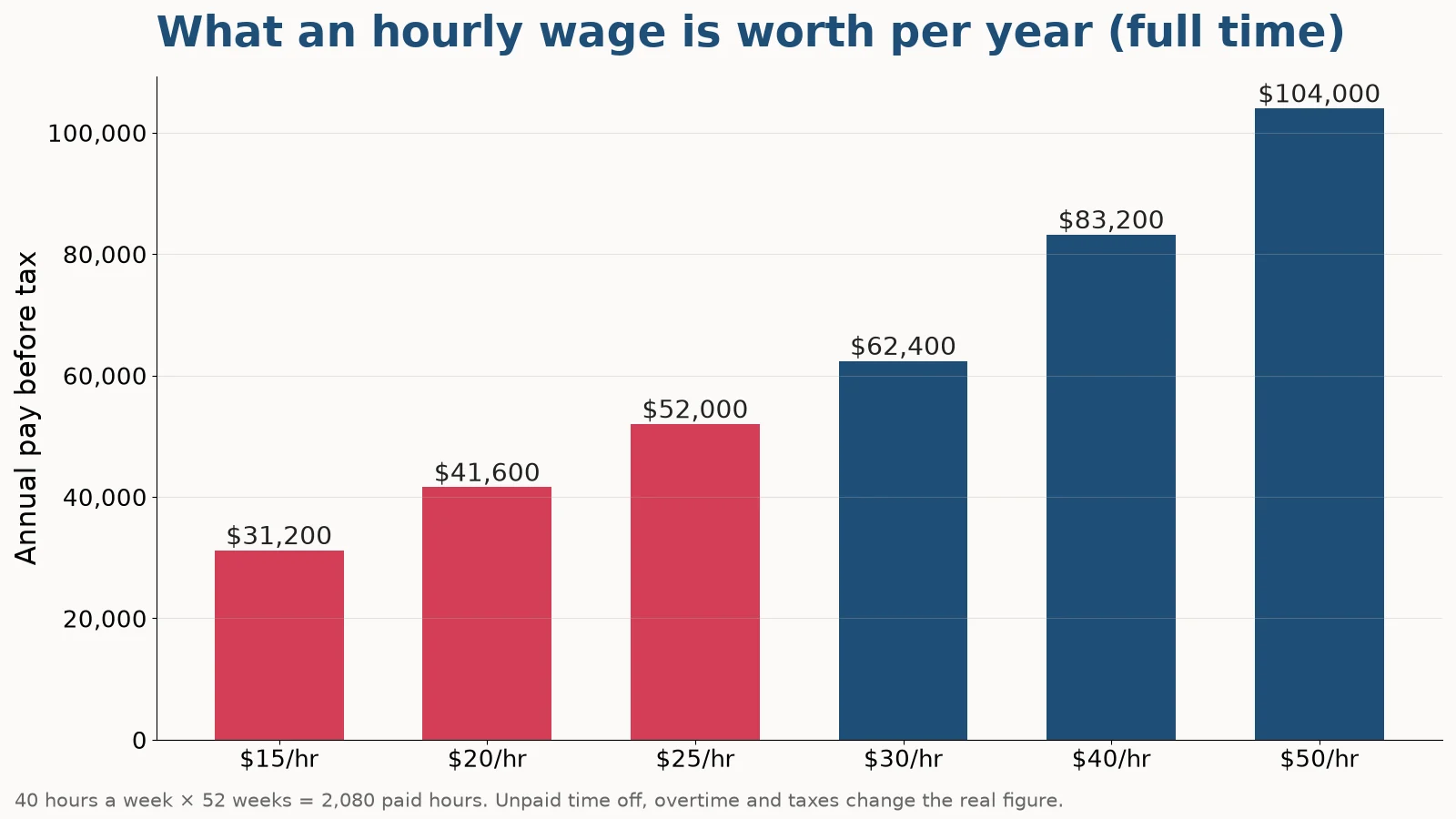
- $15 an hour is $31,200 a year, $20 an hour is $41,600 and $25 an hour is $52,000, before tax.
- The quick rule “double it and add three zeros” uses 2,000 hours, which is what you get with two weeks of unpaid time off.
- Federal law does not require paid vacation or holidays, so unpaid time off lowers an hourly worker’s yearly pay.
- Covered workers get at least 1.5× their regular rate for hours over 40 in a workweek (Fair Labor Standards Act).
To convert hourly to salary, multiply your hourly rate by the number of hours you are paid for in a year. For a full-time job that is normally 40 hours a week for 52 weeks, or 2,080 hours. So $20 an hour works out at 20 × 2,080 = $41,600 a year before tax, and $25 an hour at $52,000.
That headline number is a good starting point, but real pay depends on more than the rate. Unpaid holidays and vacation, part-time hours, overtime and even the calendar year itself all change what an hourly job actually pays. This guide gives you the full conversion tables, works through the most-searched rates in detail, explains how the federal overtime and leave rules affect the numbers, and shows how to compare an hourly job with a salaried offer. Our hourly to salary calculator is built into the page for your exact rate and hours.
- The formula: hourly rate × 2,080
- Hourly to salary conversion table
- $15, $20 and $25 an hour in detail
- Paid and unpaid time off
- Overtime: how it changes the numbers
- If your hours change from week to week
- Salary to hourly: going the other way
- Comparing an hourly job with a salaried offer
- Frequently asked questions
- Sources
The formula: hourly rate × 2,080
The basic conversion is:
Annual pay = hourly rate × hours per week × weeks paid per year
For a standard full-time job, that is rate × 40 × 52 = rate × 2,080. From the annual figure you can get every other pay period:
- Monthly: annual ÷ 12
- Biweekly (every two weeks): rate × 80
- Weekly: rate × 40
The mental shortcut
A quick estimate is to double the hourly rate and add three zeros: $25 an hour becomes “about $50,000”. That multiplies by 2,000 instead of 2,080, so it comes out $2,000 (3.8%) low at $25 an hour. As we will see, 2,000 hours is actually the right number if you take two weeks of unpaid time off, so the shortcut is a sensible, slightly cautious estimate.
Use the calculator below to enter your own rate, hours per week and weeks worked.
Prefer a full page? Open the Hourly to Salary Calculator.
Hourly to salary conversion table
Here is what common hourly rates are worth at 40 hours a week, before taxes and deductions. The first row is the federal minimum wage, which the Department of Labor confirms has been $7.25 an hour since 24 July 2009; many states set a higher minimum.
| Hourly | Yearly (2,080 h) | Monthly | Biweekly (80 h) | Weekly (40 h) |
|---|---|---|---|---|
| $7.25 | $15,080 | $1,257 | $580 | $290 |
| $10 | $20,800 | $1,733 | $800 | $400 |
| $12 | $24,960 | $2,080 | $960 | $480 |
| $15 | $31,200 | $2,600 | $1,200 | $600 |
| $17 | $35,360 | $2,947 | $1,360 | $680 |
| $18 | $37,440 | $3,120 | $1,440 | $720 |
| $20 | $41,600 | $3,467 | $1,600 | $800 |
| $22 | $45,760 | $3,813 | $1,760 | $880 |
| $25 | $52,000 | $4,333 | $2,000 | $1,000 |
| $28 | $58,240 | $4,853 | $2,240 | $1,120 |
| $30 | $62,400 | $5,200 | $2,400 | $1,200 |
| $35 | $72,800 | $6,067 | $2,800 | $1,400 |
| $40 | $83,200 | $6,933 | $3,200 | $1,600 |
| $45 | $93,600 | $7,800 | $3,600 | $1,800 |
| $50 | $104,000 | $8,667 | $4,000 | $2,000 |
| $60 | $124,800 | $10,400 | $4,800 | $2,400 |
| $75 | $156,000 | $13,000 | $6,000 | $3,000 |
The monthly column is the yearly figure divided by 12. Because months have different numbers of working days, an hourly worker’s actual monthly pay varies from month to month; the figure here is the average.
$15, $20 and $25 an hour in detail
These three are the most searched rates, so here they are with the variations that matter.
| $15/hour | $20/hour | $25/hour | |
|---|---|---|---|
| Full time, every week paid (2,080 h) | $31,200 | $41,600 | $52,000 |
| Monthly average | $2,600 | $3,467 | $4,333 |
| Biweekly paycheck (gross) | $1,200 | $1,600 | $2,000 |
| With 2 weeks unpaid (2,000 h) | $30,000 | $40,000 | $50,000 |
| Part time, 25 h/week, 52 weeks | $19,500 | $26,000 | $32,500 |
A few things stand out. Each $5 an hour adds $10,400 a year at full time. Two weeks of unpaid time off costs a $20-an-hour worker $1,600 of gross pay. And moving from 40 to 25 hours a week cuts pay by more than a third, which is worth knowing if you are weighing a part-time role.
These are all gross figures. Federal and state income tax, Social Security and Medicare, and any benefit deductions come off before you are paid. Our paycheck calculator estimates take-home pay, and our guide to 2027 federal tax brackets explains how income tax is worked out.
Paid and unpaid time off
The 2,080-hour figure assumes you are paid for all 52 weeks. Whether that is true depends on your employer, not the law. The Department of Labor is clear that the Fair Labor Standards Act does not require payment for time not worked, such as vacations, sick leave or federal or other holidays. Those benefits are a matter of agreement between employer and employee, although some states and cities have their own leave laws.
So for an hourly worker:
- If holidays and vacation are paid, you are paid for 2,080 hours (or more, in some years).
- If you take two weeks unpaid, you are paid for 2,000 hours, which is where the “× 2,000” shortcut comes from.
- If holidays are unpaid too, subtract 8 hours for each one you do not work.
Salaried employees are usually paid the same amount each period regardless, which is one of the biggest practical differences between the two kinds of job.
Why 2027 has extra working hours
A year is 52 weeks plus one day (two in a leap year), so the number of weekdays changes from year to year. 2027 starts on a Friday, which gives it 261 weekdays and 53 Fridays. At 8 hours a day that is 2,088 hours, not 2,080. An hourly worker paid for every weekday in 2027 earns 8 hours more than the standard formula, worth $160 at $20 an hour.
It can also affect paychecks. With 53 Fridays in 2027, a biweekly payroll that falls on Friday 1 January has 27 paydays in the year, while one that starts on 8 January has 26. If you are salaried and paid biweekly, a 27-paycheck year usually means each check is slightly smaller or one check is “extra”, depending on how your employer divides the salary.
Overtime: how it changes the numbers
Under the Fair Labor Standards Act, covered employees who are not exempt must receive overtime pay for hours worked over 40 in a workweek, at a rate not less than one and a half times their regular rate of pay. A few details from the Department of Labor’s guidance are worth knowing:
- Overtime is calculated per workweek, a fixed and recurring period of 168 hours. Hours are not averaged across two weeks.
- The FLSA does not require extra pay just because you work on a Saturday, Sunday or holiday, unless those hours take you over 40 for the week.
- Some states have additional rules, such as daily overtime.
Example
At $20 an hour, a 45-hour week pays 40 × $20 = $800 plus 5 × $30 = $150 of overtime, a total of $950 for the week. If that pattern held all year, annual pay would be $49,400, compared with $41,600 at a straight 40 hours. Our overtime calculator handles different overtime hours and rates.
If your hours change from week to week
Many hourly jobs, especially in retail, hospitality and healthcare, do not have a fixed 40-hour week. In that case, base your yearly estimate on the hours you actually work, not the hours you hope for.
- Add up your hours for the last 12 weeks from your pay stubs. Twelve weeks is long enough to smooth out one unusually busy or quiet week.
- Divide by 12 to get your average week.
- Multiply by your hourly rate and by 52.
For example, someone earning $18 an hour who worked 38, 42, 35, 40, 44, 31, 40, 39, 36, 45, 40 and 37 hours over 12 weeks averaged 38.9 hours a week. That gives $18 × 38.9 × 52 = $36,426 a year, about $3,036 a month.
For budgeting, it is safer to plan around a low month than an average one. If every week were as short as the shortest week in that sample (31 hours), monthly pay would be about $2,418. Building your fixed costs around that lower figure, and treating anything above it as a bonus for savings, protects you when the schedule thins out. Our time card calculator adds up weekly hours from start and finish times.
Salary to hourly: going the other way
To turn a salary into an hourly rate, divide by the number of hours worked in a year. Using 2,080 hours gives the standard figure; using 2,000 shows what the hours are worth if you would otherwise take two weeks unpaid.
| Salary | Hourly (2,080 h) | Hourly (2,000 h) |
|---|---|---|
| $30,000 | $14.42 | $15.00 |
| $40,000 | $19.23 | $20.00 |
| $50,000 | $24.04 | $25.00 |
| $60,000 | $28.85 | $30.00 |
| $75,000 | $36.06 | $37.50 |
| $100,000 | $48.08 | $50.00 |
This is a useful check on salaried jobs that come with long hours. A $60,000 salary is $28.85 an hour at 40 hours a week, but if the job really takes 50 hours a week, the effective rate drops to $23.08. Our salary calculator converts between all pay periods.
Comparing an hourly job with a salaried offer
Suppose you are choosing between $27 an hour and a $54,000 salary. On the headline numbers, $27 × 2,080 = $56,160, which beats the salary. But if the hourly job does not pay for two weeks of holidays and vacation, its real figure is $27 × 2,000 = $54,000, and the salary is worth $25.96 an hour at 2,080 hours. Once unpaid time is counted, the two offers pay exactly the same, and the decision comes down to everything else.
To compare fairly, line up:
- Paid hours: how many hours a year each job actually pays for, including paid time off.
- Overtime: whether you are eligible, and how often overtime is available. Salaried roles are often exempt from overtime.
- Benefits: health insurance, retirement matching and other benefits can be worth thousands of dollars a year.
- Stability: hourly schedules can vary; a salary is usually the same each period.
If you are expecting a raise, our pay raise calculator shows the new hourly and annual figures side by side.
Frequently asked questions
How do I convert hourly pay to an annual salary?
Multiply the hourly rate by the hours you are paid for in a year. Full time is usually 40 × 52 = 2,080 hours, so $20 an hour is $41,600.
How much is $15 an hour per year?
$31,200 a year at 40 hours a week for 52 weeks, or $30,000 if two weeks are unpaid.
How much is $20 an hour per year?
$41,600 a year full time, about $3,467 a month on average, before tax.
How much is $25 an hour per year?
$52,000 a year full time, or $50,000 with two weeks unpaid.
How many work hours are in a year?
The standard is 2,080 (40 hours × 52 weeks). 2027 has 261 weekdays, which is 2,088 hours at 8 hours a day.
Do hourly workers get paid holidays?
Not by federal law. The Department of Labor says the FLSA does not require payment for time not worked, such as vacations or holidays; it depends on the employer and any state or local law.
How is overtime calculated?
Under the FLSA, covered non-exempt employees get at least 1.5 times their regular rate for hours over 40 in a workweek.
How do I convert a salary to an hourly rate?
Divide the salary by 2,080. A $60,000 salary is about $28.85 an hour.
Related calculators
Sources
- Overtime Pay, U.S. Department of Labor, Wage and Hour Division. Overtime at 1.5 times the regular rate for hours over 40 in a workweek; workweek definition.
- Minimum Wage, U.S. Department of Labor, Wage and Hour Division. The $7.25 federal minimum wage and the existence of state minimum wage laws.
- Vacation Leave, U.S. Department of Labor. The FLSA does not require payment for vacations, sick leave or holidays.