
Updated 13 November 2026 · Written by the Digital Calculators team
Key takeaways
- For 2027, the 401(k)/403(b)/457/TSP employee limit is $25,500 (up from $24,500); the IRA limit (traditional and Roth combined) stays at $7,500 (IRS Notice 2026-66).
- Traditional accounts are funded pre-tax (or get a deduction) and taxed on withdrawal. Roth accounts are funded after-tax and withdrawals are tax-free.
- If your tax rate is the same now and in retirement, Traditional and Roth produce the exact same after-tax result.
- Roth wins if your tax rate will be higher later; Traditional wins if it will be lower later.
- A 401(k) is offered through an employer and often includes a match; an IRA is opened individually and has a much lower contribution cap.
A Roth IRA vs 401k comparison, and traditional vs Roth within each, comes down to two separate questions: which account type (employer 401(k) or individual IRA) can you use and how much can you put in, and which tax treatment (traditional or Roth) suits your situation. This guide covers the 2027 contribution limits from the IRS, the tax math behind traditional vs Roth, and how to decide. Our Roth IRA calculator and 401(k) contribution calculator run the numbers for your own contributions.
Why the account type matters as much as the tax choice
It is easy to focus only on “Roth or traditional” and skip past the more basic question of which account you can actually use. Not everyone has access to a workplace plan, and not every IRA contribution is fully deductible, so the practical order of operations usually looks like this: first check what your employer offers and whether there is a match, then decide between traditional and Roth within whichever accounts are available to you, and only then consider an IRA on top if you have more to save than your 401(k) alone can hold, or if you want investment options your workplace plan does not offer.
Prefer a full page? Open the Roth IRA Calculator.
401(k) vs IRA: the account types
A 401(k) (or 403(b), governmental 457, or Thrift Savings Plan) is a workplace retirement account offered by an employer. A traditional or Roth IRA is opened individually at a bank or brokerage, available to anyone with taxable compensation, whether or not their employer offers a plan.
The IRS announced the 2027 limits in Notice 2026-66 (IRS release IR-2026-136): the 401(k)-type employee deferral limit rises to $25,500, up from $24,500 in 2026. The IRA limit, covering traditional and Roth contributions combined, stays at $7,500. Both limits allow a further catch-up contribution for savers 50 and older.
Because the 401(k) limit is more than three times the IRA limit, workplace plans are usually where the bulk of retirement saving happens for people with access to one. Many employers also match a portion of 401(k) contributions, which is money added on top of the limit above and usually worth contributing enough to capture in full before putting extra money elsewhere.
Traditional vs Roth: the tax tradeoff
Within either a 401(k) or an IRA, you usually choose between a traditional and a Roth version. The difference is entirely about when you pay income tax:
- Traditional: contributions reduce your taxable income now (pre-tax in a 401(k), or deductible in an IRA subject to income and workplace-coverage limits). The IRS notes the traditional IRA deduction “may be limited if you or your spouse is covered by a retirement plan at work and your income exceeds certain levels.” Growth is tax-deferred, and withdrawals in retirement are taxed as ordinary income.
- Roth: contributions are made with after-tax money, so there is no deduction now. Growth and qualified withdrawals in retirement are entirely tax-free. The IRS notes Roth IRA contributions “might be limited if your income exceeds a certain level,” and many 401(k) plans separately offer a Roth option with no income limit.
Both account types cap contributions at your taxable compensation for the year if your income is below the stated dollar limit.
The tax math, worked out
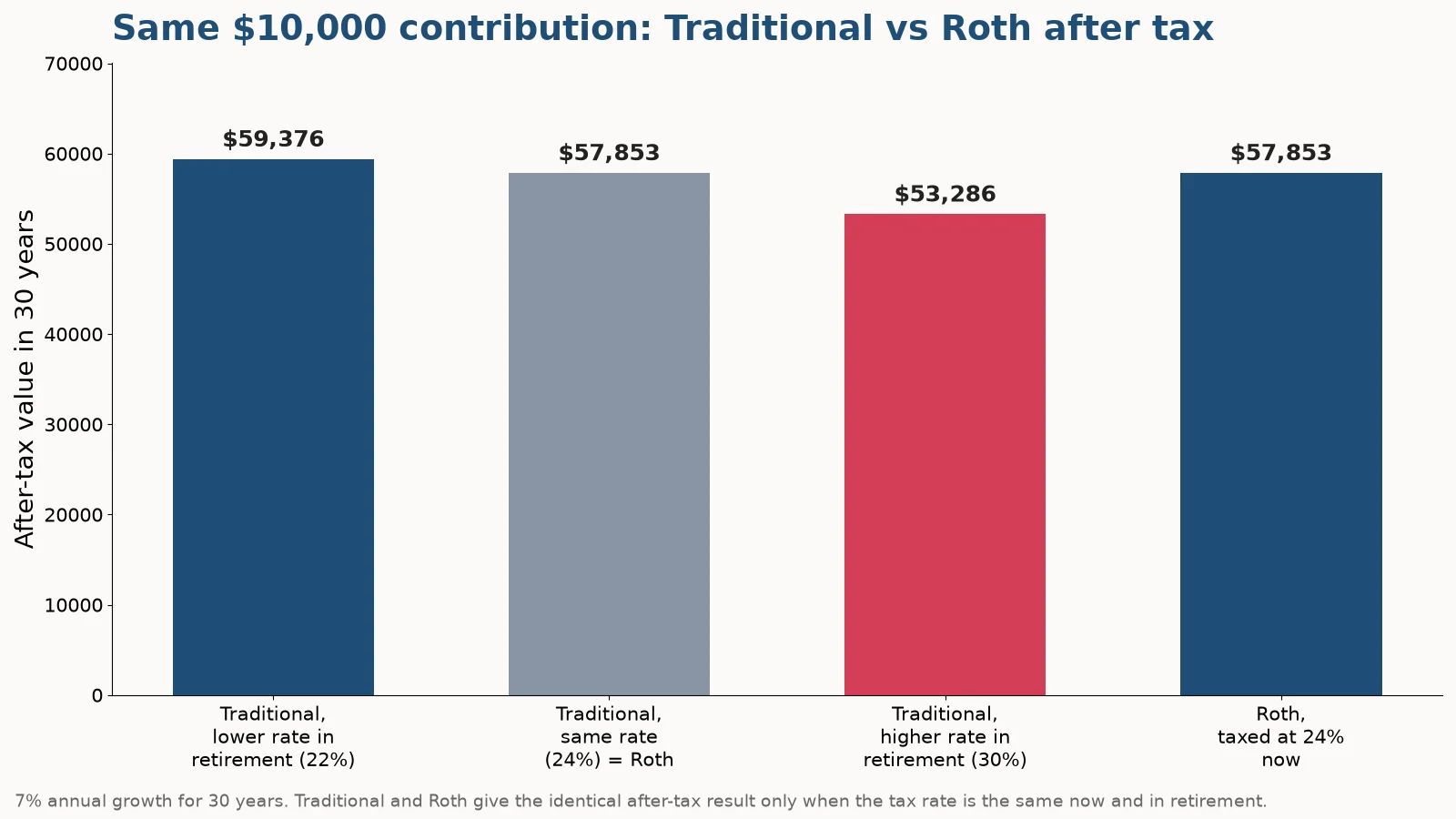
Suppose you can set aside $10,000 of pre-tax income this year, taxed at a 24% rate if taken as income today, and it grows at 7% a year for 30 years (a 7.61× multiple). Compare putting the full $10,000 into a traditional account against paying the tax now and putting the $7,600 that is left into a Roth account:
| Your tax rate in retirement | Traditional account, after-tax value |
|---|---|
| lower in retirement (22%) | $59,376 |
| same (24%) | $57,853 |
| higher in retirement (30%) | $53,286 |
The Roth account, taxed once up front at 24%, grows to $57,853 tax-free. Compare that to the middle row of the table: when the tax rate is the same (24%) both now and in retirement, Traditional and Roth produce exactly the same after-tax result, $57,853. That is not a coincidence; multiplying by (1 − tax rate) at the start or at the end gives the same answer, as long as the rate does not change.
What actually separates them is whether your tax rate changes. If you expect a lower tax rate in retirement than today, as in the top row, Traditional comes out ahead. If you expect a higher rate later, Roth comes out ahead, because you locked in today’s lower rate. Required minimum distributions, Social Security becoming taxable, or future tax law changes can all push your retirement-year rate higher than you expect.
Other practical differences
The tax math is not the only difference worth weighing:
- Required withdrawals: traditional 401(k)s and IRAs generally require you to start taking distributions at a certain age. Roth IRAs have no such requirement during the original owner’s lifetime, which matters for leaving money invested longer or for estate planning.
- Early access to contributions: Roth IRA contributions (not earnings) can generally be withdrawn at any time without tax or penalty, since they were already taxed, which traditional accounts do not allow without a tax hit and often a penalty.
- Employer match: only available through a 401(k), and it is added on top of your own contribution limit, not counted against it.
- Catch-up contributions: both the 401(k)-type limit and the IRA limit allow an extra catch-up amount starting at age 50, on top of the regular limit, which is unchanged by the traditional/Roth choice.
Our 401(k) contribution calculator and IRA calculator project balances under either account type, and the retirement calculator and our how much do I need to retire guide cover the savings target itself.
Contribution limits and the catch-up amounts also apply per person, not per account type across a household. A married couple can each use their own 401(k) at a separate employer and their own IRA, meaning the combined family limit is roughly double the individual numbers above, which matters for households trying to maximize tax-advantaged saving on one higher income.
A simple way to decide
Three rules of thumb cover most situations:
- If your employer offers a 401(k) match, contribute enough to get the full match first. It is an immediate return before any tax consideration.
- If you expect to be in a lower tax bracket in retirement than you are now (a common assumption for high earners near their peak income), lean Traditional.
- If you expect to be in a similar or higher bracket later, are early in your career, or want to avoid required withdrawals and keep flexible access to your contributions, lean Roth.
Many savers split contributions between both types, since nobody can predict future tax rates with certainty, and having both taxable and tax-free money available in retirement gives more flexibility over which account to draw from each year.
Age also matters more than it first appears. Someone decades from retirement has more years for Roth’s tax-free growth to compound, and is often in a lower tax bracket early in their career than they will be later, which both point toward Roth. Someone closer to retirement, already in a high bracket, more often leans traditional, especially if a large pre-tax balance built up over a career means required withdrawals will land in a lower bracket than the person’s working-years income did.
A note on account types, not just tax treatment
It helps to keep the two choices separate in your head: 401(k) vs IRA is a question of where the money sits and how much you can contribute, while traditional vs Roth is a question of when you pay tax. A workplace 401(k) plan may offer only a traditional option, only Roth, or both; an IRA you open yourself can be opened as either type, or both, at a brokerage of your choosing.
This also means the “best” choice is not fixed for life. It is common to use a traditional 401(k) in high-earning years to reduce current taxable income, then contribute more to a Roth IRA once income drops, such as during a career break, a lower-paying job, or early retirement years before Social Security and required withdrawals begin. Revisiting the choice every few years, rather than setting it once, captures more of the benefit either account type offers.
Frequently asked questions
What is the 2027 401(k) contribution limit?
$25,500 for employee deferrals into a 401(k), 403(b), governmental 457 plan or the Thrift Savings Plan, up from $24,500 in 2026, per IRS Notice 2026-66.
What is the 2027 IRA contribution limit?
$7,500, unchanged from 2026, covering traditional and Roth IRA contributions combined across all your IRAs.
What is the main difference between a Roth and a traditional account?
Traditional contributions are pre-tax or deductible now and taxed on withdrawal; Roth contributions are made with after-tax money and qualified withdrawals are tax-free.
Is a Roth or traditional account better?
If your tax rate is the same now and in retirement, the after-tax result is identical. Roth tends to win if your rate will be higher later; traditional tends to win if it will be lower later.
What is the difference between a 401(k) and an IRA?
A 401(k) is offered through an employer and has a much higher contribution limit, often with a matching contribution. An IRA is opened individually and has a lower limit, but is available to anyone with taxable compensation.
Can I contribute to both a 401(k) and an IRA?
Yes. The two limits are separate, though an employer plan can affect whether a traditional IRA contribution is tax-deductible.
Is there an income limit for Roth contributions?
Yes. The IRS reduces or eliminates how much you can contribute to a Roth IRA once your income passes certain thresholds, which change each year; check the current IRS figures before contributing.
Do catch-up contributions work the same for Roth and traditional accounts?
The extra amount allowed from age 50 is set by account type (401(k)-type plans or IRAs), not by whether the money goes into a traditional or Roth version within that account.
What happens if I withdraw traditional retirement money early?
It is generally added to your taxable income for that year and, with limited exceptions, hit with an additional early-withdrawal penalty if you are under the plan’s minimum age.
Can I change my mind later?
Future contributions can switch between traditional and Roth at any time your plan allows. Moving existing traditional balances into a Roth account (a Roth conversion) is possible but triggers income tax on the converted amount in the year of the conversion.
Related calculators
Sources
- 401(k) limit increases to $25,500 for 2027; IRA limit remains $7,500, IRS news release IR-2026-136. The 2027 contribution limits for 401(k)-type plans and IRAs, citing Notice 2026-66.
- Retirement Topics – IRA Contribution Limits, Internal Revenue Service. Deductibility rules for traditional IRA contributions and the existence of Roth IRA income limits.