
Updated 13 November 2026 · Written by the Digital Calculators team
Key takeaways
- The 4% rule (Bengen, 1994) says a diversified portfolio can support a first-year withdrawal of about 4% of its value, adjusted for inflation each year, without running out over a 30-year retirement in every historical period tested.
- That means a rough target is 25 times your yearly spending: $60,000/year of spending points to a $1,500,000 target.
- The Rule of 72 estimates how long money takes to double: divide 72 by the annual return. At 7%, that is about 10.3 years.
- Coast FIRE is the amount you need invested today so growth alone, with no further contributions, reaches your target by a normal retirement age.
- Social Security lowers the amount you must personally fund: the average 2027 benefit is about $26,040 a year per person.
If you are asking how much do I need to retire, the most widely used starting point is the “4% rule,” a guideline that came from a 1994 study of how retirement portfolios held up through the worst historical US market conditions. This guide walks through where that number comes from, how to turn it into your own savings target, how the “Rule of 72” estimates growth, what “Coast FIRE” means, and how Social Security changes the target. Our retirement calculator runs these numbers for your own income and timeline.
Where the 4% rule comes from
In 1994, financial planner William Bengen published “Determining Withdrawal Rates Using Historical Data” in the Journal of Financial Planning. He tested a portfolio split 50/50 between stocks and bonds against real, historical US market returns for every 30-year retirement starting between 1926 and 1976, including retirements that began right before the 1929 crash and during the inflation of the 1970s.
He found that a first-year withdrawal of around 4% of the portfolio’s value, with the dollar amount then adjusted for inflation every year after, did not exhaust the portfolio in any of those historical 30-year periods, even the worst ones, such as a retirement that began right before the 1929 crash or during the high inflation of the early 1970s. Bengen later said the figure his data actually supported was closer to 4.15%, which got rounded down and popularized as “the 4% rule.”
It is a historical guideline built on US market data, not a guarantee of future results. Researcher Wade Pfau later ran the same method against other developed countries’ market histories and found a 4% withdrawal rate held up in only a handful of them, since other countries’ 20th-century stock markets did not perform as well as the US market over the same decades. Bengen himself has since revisited his own research and, in a later book, raised his personal estimate of a safe starting rate for a 30-year retirement to about 4.7% under different assumptions. This guide uses the original, widely cited 4% figure because it is still the most common starting point, but treat it as one reasonable estimate among several, not a fixed law.
Prefer a full page? Open the Retirement Calculator.
Turning 4% into a savings target
Flip the 4% withdrawal rate around and it becomes a savings target: if 4% of your portfolio should cover a year of spending, your portfolio needs to be about 25 times your annual spending (1 ÷ 0.04 = 25).
Example: someone planning to spend $60,000 a year in retirement would target:
$60,000 ÷ 0.04 = $1,500,000
Spending $80,000 a year instead points to a $2,000,000 target. The relationship is a straight multiple, so halving your planned spending halves the target. This is why cutting recurring costs, not just earning more, moves the number a lot. Our 50/30/20 budget guide and compound interest calculator help work out how fast contributions can get you there.
The Rule of 72: how fast your money grows
The Rule of 72 is a quick mental-math estimate for how many years it takes an investment to double at a steady annual return: divide 72 by the return percentage.
| Annual return | Years to double (72 ÷ rate) |
|---|---|
| 4% | 18.0 years |
| 5% | 14.4 years |
| 6% | 12.0 years |
| 7% | 10.3 years |
| 8% | 9.0 years |
| 10% | 7.2 years |
At a 7% average annual return, money roughly doubles every 10.3 years. That means money invested in your 30s can double two or three times before a typical retirement age, which is why starting early matters more than the dollar amount of any single contribution. The Rule of 72 is an approximation (it is most accurate for returns in the 6-10% range); use our compound interest calculator for an exact year-by-year figure.
Coast FIRE: when you can stop adding new money
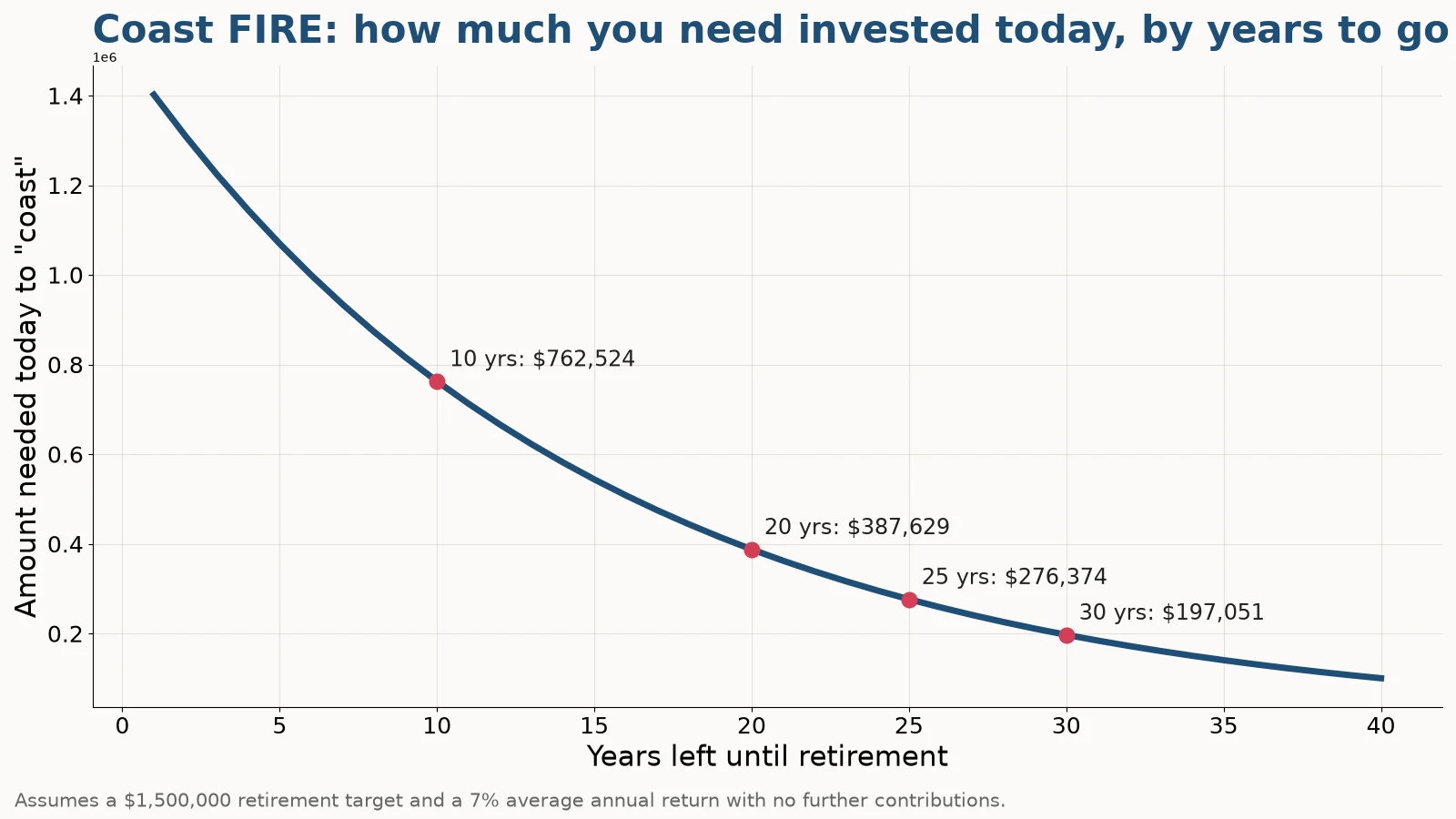
“Coast FIRE” is a term used in the financial-independence community for a specific milestone: the point where you have enough invested that, left alone to grow with no further contributions, it will reach your retirement target by a normal retirement age on its own. Once you hit your Coast FIRE number, you do not need to keep saving at the same rate; income just needs to cover current spending.
The math is the 25x target run backward through compound growth: divide your target by (1 + return) raised to the number of years left, assuming a 7% average annual return and a $1,500,000 target:
| Years until retirement | Coast FIRE number needed today |
|---|---|
| 5 | $1,069,479 |
| 10 | $762,524 |
| 15 | $543,669 |
| 20 | $387,629 |
| 25 | $276,374 |
| 30 | $197,051 |
So someone 25 years from retirement who has already invested about $276,374, and keeps it invested without touching it, is on track to reach $1,500,000 on growth alone at a 7% return. Fewer years left means a bigger number is needed today, since there is less time for growth to do the work.
What people actually have saved
The Federal Reserve’s 2022 Survey of Consumer Finances found that 54.3% of US families held a retirement account of some kind (IRAs, 401(k), 403(b) or similar employer plans), up from 50.5% in 2019. Among families that had one, the median balance was $86,900 and the mean was $334,000, both well short of a $1,500,000 target built on $60,000 of planned spending.
The same survey breaks mean retirement balances down by income for families with a working-age head of household (35 to 64): families in roughly the bottom half of earners averaged $54,700, those in the 50th-to-90th percentile averaged $226,700, and the top 10% of earners averaged $913,300. The gap between those groups is far wider than the gap in income alone, because higher earners both save more in dollar terms and are more likely to have access to an employer retirement plan in the first place.
That gap is normal this far from retirement; the 4% rule describes the target at the point you stop working, not where you should already be at 35 or 45. It does mean most households depend on decades of continued contributions and growth, plus Social Security, to close the gap, rather than relying on savings alone. Our compound interest calculator shows how much a given monthly contribution grows to by retirement age at different return assumptions.
How Social Security changes the target
The 4% rule target assumes your portfolio funds 100% of your spending, but most retirees also get a Social Security check. The Social Security Administration’s 2027 COLA fact sheet puts the average retired-worker benefit at about $2,170 a month ($26,040 a year) starting in 2027, after a 3.6% cost-of-living increase.
Subtracting that from planned spending lowers the amount your own savings need to cover. For the $60,000-a-year example:
($60,000 − $26,040) × 25 = $849,000
That is $651,000 less than the $1,500,000 target that ignored Social Security. For the $80,000-a-year example, the self-funded target drops from $2,000,000 to $1,349,000. Two working spouses, each getting their own benefit, would lower the self-funded target further. Our Social Security calculator estimates your own benefit from your own earnings record, which can be higher or lower than the average used here.
Putting the numbers together
Here is the full picture for the $60,000-a-year example, combining every step above:
| Step | Amount |
|---|---|
| Planned annual spending | $60,000 |
| 4% rule target, ignoring Social Security (spending × 25) | $1,500,000 |
| Expected Social Security (2027 average, per person) | $26,040/year |
| Spending your own savings must cover | $33,960/year |
| Realistic 4% rule target, after Social Security | $849,000 |
| Coast FIRE number, 25 years out, 7% return, against the full $1,500,000 target | $276,374 |
Two things move this target a lot: how much you plan to spend, and whether you count Social Security. Someone who plans to spend less, or who has a spouse also earning a Social Security benefit, reaches a realistic number much sooner than the simple spending × 25 calculation suggests. Someone retiring early, before Social Security starts, needs to fund more years from savings alone and should not subtract a benefit they will not receive yet.
None of this accounts for taxes, healthcare before Medicare eligibility, or a pension, all of which change the real number. Treat the 4% rule as a starting estimate to refine, not a fixed answer, and revisit it every few years as your own spending, savings and Social Security estimate change.
Frequently asked questions
How much money do I need to retire?
A common starting point is the 4% rule: multiply your expected annual spending by 25. Planning to spend $60,000 a year points to a $1,500,000 target, before counting Social Security.
What is the 4% rule?
A guideline from a 1994 study by William Bengen showing that withdrawing about 4% of a 50/50 stock/bond portfolio in the first year of retirement, then adjusting the dollar amount for inflation each year, did not exhaust the portfolio in any historical 30-year US retirement period tested.
Is the 4% rule guaranteed?
No. It is based on historical US market returns from 1926 onward. Later research applying the same method to other countries’ markets found it held up less well, and future returns could differ from the past.
What is the Rule of 72?
A quick estimate for how long an investment takes to double: divide 72 by the annual return percentage. At 7% a year, that is about 10.3 years.
What does Coast FIRE mean?
The point where your current investments, left to grow with no further contributions, are projected to reach your retirement target by a normal retirement age, so you no longer need to keep saving at the same rate.
Does Social Security reduce how much I need to save?
Yes. Subtract your expected annual Social Security benefit from your planned spending before multiplying by 25. The average 2027 retired-worker benefit is about $26,040 a year.
How much do most people have saved for retirement?
The Federal Reserve’s 2022 Survey of Consumer Finances found 54.3% of families had a retirement account; among those that did, the median balance was $86,900 and the mean was $334,000.
Does the 4% rule account for taxes?
No. It is based on the portfolio’s pre-tax value. Withdrawals from a traditional 401(k) or IRA are taxed as income when you take them, so your after-tax spending power is lower than the raw withdrawal amount; a Roth account’s qualified withdrawals are not taxed again.
Related calculators
Sources
- Determining Withdrawal Rates Using Historical Data, Bengen, W.P. (1994), Journal of Financial Planning (FPA reprint). The original 4% rule study: methodology, historical test periods and findings.
- Changes in U.S. Family Finances from 2019 to 2022, Federal Reserve Bulletin, October 2023. Table 3: percentage of families holding retirement accounts and the conditional median/mean values.
- 2027 Cost-of-Living Adjustment (COLA) Fact Sheet, Social Security Administration. The 3.6% COLA for 2027 and the resulting average retired-worker benefit.