
Updated 13 November 2026 · Written by the Digital Calculators team
Key takeaways
- A calorie deficit means taking in fewer calories than your body uses. It is the basis of every weight-loss approach.
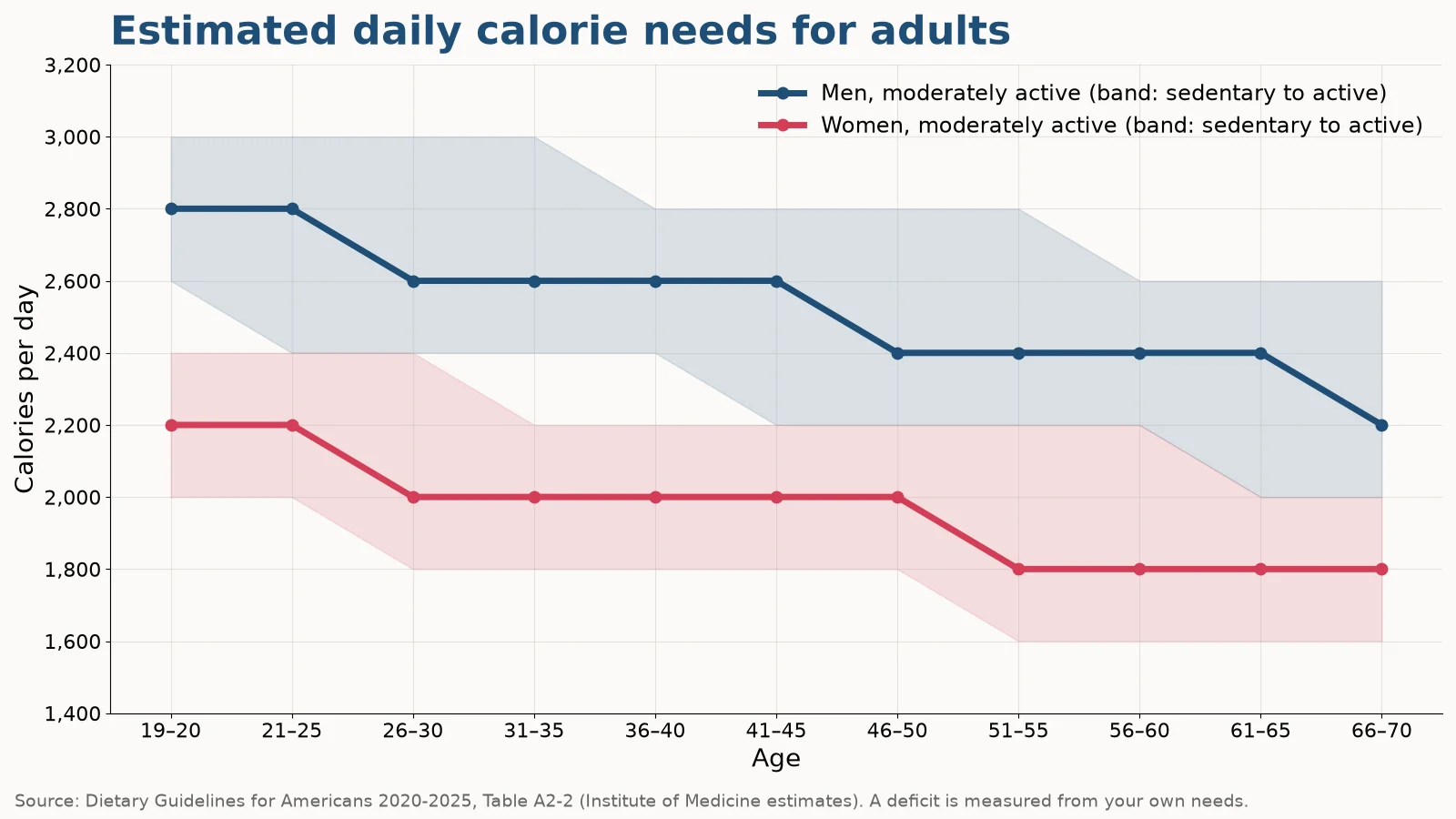
- The Dietary Guidelines estimate most adult women need about 1,600 to 2,400 calories a day and men about 2,000 to 3,000, depending on age and activity.
- CDC notes that losing about 1 to 2 pounds a week makes people more likely to keep the weight off.
- By the traditional rule of thumb, a deficit of about 500 calories a day is roughly 1 pound a week; real results slow over time.
- Even modest loss helps: CDC says 5% of body weight (10 lb for a 200 lb person) can improve blood pressure, cholesterol and blood sugar.
A calorie deficit is simply eating and drinking fewer calories than your body burns. When that happens, the body makes up the difference from stored energy, and over time weight comes down. Every diet, from low-carb to intermittent fasting, works by creating a deficit in one way or another.
The hard parts are knowing how many calories you actually need and how big a deficit is sensible. This guide uses the estimated calorie needs published in the Dietary Guidelines for Americans to show typical requirements by age, sex and activity level, explains how activity changes the numbers, sets out what different deficits mean per week, works through two examples, and covers why weight loss slows and what CDC says about a healthy pace. Our calorie deficit calculator is built into the page. This is general information, not medical advice; if you have a health condition, are pregnant or take medicines that affect weight, talk with a health care provider first.
Step 1: estimate how many calories you use
Your deficit is measured from your own daily needs, so start there. The Dietary Guidelines for Americans 2020–2025 include a table of estimated calorie needs, based on Institute of Medicine equations, for a reference person of each age and sex at three activity levels:
| Age | Men, sedentary | Men, moderately active | Men, active | Women, sedentary | Women, moderately active | Women, active |
|---|---|---|---|---|---|---|
| 19–20 | 2,600 | 2,800 | 3,000 | 2,000 | 2,200 | 2,400 |
| 21–25 | 2,400 | 2,800 | 3,000 | 2,000 | 2,200 | 2,400 |
| 26–30 | 2,400 | 2,600 | 3,000 | 1,800 | 2,000 | 2,400 |
| 31–35 | 2,400 | 2,600 | 3,000 | 1,800 | 2,000 | 2,200 |
| 36–40 | 2,400 | 2,600 | 2,800 | 1,800 | 2,000 | 2,200 |
| 41–45 | 2,200 | 2,600 | 2,800 | 1,800 | 2,000 | 2,200 |
| 46–50 | 2,200 | 2,400 | 2,800 | 1,800 | 2,000 | 2,200 |
| 51–55 | 2,200 | 2,400 | 2,800 | 1,600 | 1,800 | 2,200 |
| 56–60 | 2,200 | 2,400 | 2,600 | 1,600 | 1,800 | 2,200 |
| 61–65 | 2,000 | 2,400 | 2,600 | 1,600 | 1,800 | 2,000 |
| 66–70 | 2,000 | 2,200 | 2,600 | 1,600 | 1,800 | 2,000 |
The guidelines define the activity levels like this:
- Sedentary: only the physical activity of independent daily living.
- Moderately active: the equivalent of walking about 1.5 to 3 miles a day at 3 to 4 miles per hour, on top of daily living.
- Active: the equivalent of walking more than 3 miles a day at that pace.
These are estimates for an average-sized person; your own needs depend on your height, weight and body composition too. The calculator below personalizes the estimate from your details.
Prefer a full page? Open the Calorie Deficit Calculator.
How activity changes your calorie needs
Activity makes a big difference. For a woman aged 26 to 30, the table puts needs at 1,800 calories a day if sedentary and 2,400 if active, a gap of 600 calories. For a man the same age the gap is 600 calories.
The National Institute of Diabetes and Digestive and Kidney Diseases (NIDDK) expresses activity as a physical activity level (PAL), a multiplier on the energy your body uses at rest. Its Body Weight Planner notes that typical PAL values range from 1.4 (sedentary) to 2.5 (very active), with a default of 1.6 for someone who mostly sits at work or school and does moderate activity such as walking or cycling at least once a week.
For someone whose body uses 1,500 calories a day at rest, that range looks like this:
| PAL | Description | Calories a day |
|---|---|---|
| 1.4 | Sedentary | 2,100 |
| 1.6 | Default: mostly sitting, some weekly activity | 2,400 |
| 1.8 | Between the default and very active | 2,700 |
| 2.0 | Between the default and very active | 3,000 |
| 2.5 | Very active | 3,750 |
Most people overestimate how active they are. If you are not sure, start with a lower level, track your weight for a few weeks and adjust. Our TDEE calculator and BMR calculator estimate both numbers from your own details.
Step 2: choose the size of your deficit
CDC’s guidance on losing weight notes that people who lose weight at a gradual, steady pace of about 1 to 2 pounds a week are more likely to keep it off than people who lose weight faster.
A long-standing rule of thumb says that about 3,500 calories equals a pound of body weight. By that rule, here is what different daily deficits would mean:
| Daily deficit | Weekly deficit | Rule-of-thumb weekly loss |
|---|---|---|
| 250 a day | 1,750 a week | about 0.5 lb |
| 500 a day | 3,500 a week | about 1.0 lb |
| 750 a day | 5,250 a week | about 1.5 lb |
| 1,000 a day | 7,000 a week | about 2.0 lb |
So a deficit of about 500 calories a day lines up with roughly 1 pound a week, and 1,000 a day with roughly 2 pounds, the range CDC describes. Treat these as starting estimates, not promises. The 3,500 figure is an approximation, early weight loss can include water, and, as the next section explains, the same deficit produces less loss over time.
Bigger is not better. A very large deficit is hard to sustain, may make it harder to get enough nutrients, and CDC notes that faster loss is less likely to be kept off. If your estimated needs are low, a smaller deficit such as 250 to 500 calories may be the realistic choice.
Two worked examples
A moderately active woman aged 33
The Dietary Guidelines estimate 2,000 calories a day for her age and activity level. A 500-calorie daily deficit gives a target of about 1,500 calories a day, which by the rule of thumb would be around 1 pound a week at first.
A sedentary man aged 44
The estimate is 2,200 calories a day. A 500-calorie deficit means about 1,700 calories a day. If he started walking about 2 miles a day, the table suggests his needs would rise toward the moderately active figure of 2,600, so the same 1,700 calories would become a deficit of about 900 a day. That is more than he needs, so he could eat a little more and still stay within the 1 to 2 pounds a week range.
Combining food and activity
You do not have to create the whole deficit through food. Eating 300 calories less and using about 200 more through activity also adds up to 500 a day. Many people find a mix easier to sustain than a large cut in food alone, and activity has health benefits of its own.
Why weight loss slows down
Almost everyone who keeps a steady deficit sees progress slow after the first weeks. There are a few reasons:
- A smaller body uses less energy. As you lose weight, the calories you need each day fall, so the gap between what you eat and what you use shrinks unless you adjust.
- Early losses can include water. The first week or two may show a bigger drop than the deficit alone would explain.
- Needs also change with age. The Dietary Guidelines table shows estimated needs falling by 400 calories a day for moderately active women and 600 for moderately active men between ages 19–20 and 66–70.
This is why simple calculations based on 3,500 calories per pound tend to overestimate long-term loss. NIDDK’s Body Weight Planner is designed to plan calorie and activity changes over time. A practical approach is to recalculate your needs after every 10 pounds or so, and to judge progress by the trend over several weeks rather than day-to-day changes on the scale.
CDC also notes that many other factors affect weight, including medicines, medical conditions, stress, genes, hormones, environment and age. If progress stops despite a careful deficit, that is worth discussing with a health care provider.
Small losses still count
You do not need to reach a particular number for a calorie deficit to be worthwhile. CDC points out that if you are not at a healthy weight, even modest weight loss can improve blood pressure, cholesterol and blood sugar. Its example: a 5% weight reduction for a person who weighs 200 pounds is 10 pounds, a change that could lower the risk of some chronic diseases, such as heart disease, prediabetes and type 2 diabetes.
At 1 to 2 pounds a week, that first 5% would take roughly 5 to 10 weeks. Seen that way, the goal is less daunting.
Making a deficit sustainable
CDC’s steps for losing weight start with understanding why you want to change and tracking where you are now, including what you eat and drink, your activity and your sleep. It describes healthy weight loss as part of a lifestyle that includes healthy eating patterns, regular physical activity, enough sleep and stress management. In practice:
- Track food honestly for a week or two before cutting, so the deficit is measured from what you really eat.
- Cut calories you will not miss first: sugary drinks, large portions, snacks eaten out of habit.
- Keep protein, fruit, vegetables and whole grains in the plan so you feel full and get enough nutrients.
- Plan for weekends and social events rather than treating them as failures.
During pregnancy and breastfeeding, calorie needs go up, not down: the Dietary Guidelines add about 340 calories a day in the second trimester and 452 in the third. Weight-loss diets are not appropriate then without medical advice. Our calorie calculator and weight loss percentage calculator help you plan and track.
Frequently asked questions
What is a calorie deficit?
Eating and drinking fewer calories than your body uses in a day. The difference comes from stored energy, which leads to weight loss over time.
How big should my calorie deficit be?
Many people aim for about 500 calories a day. By the traditional 3,500-calories-per-pound rule that is about 1 pound a week, within the 1 to 2 pounds a week that CDC describes as a pace people are more likely to maintain.
How many calories do I need a day?
The Dietary Guidelines estimate about 1,600 to 2,400 calories a day for adult women and 2,000 to 3,000 for adult men, depending on age and activity. Your own needs depend on your size too.
Is 1,200 calories a day a safe deficit?
It depends on your needs. For many adults it would be a large deficit. Talk with a health care provider before eating very few calories.
Why have I stopped losing weight in a calorie deficit?
As you lose weight your body uses fewer calories, so the deficit shrinks. Recalculate your needs and look at the trend over several weeks.
Does exercise count toward a calorie deficit?
Yes. Activity raises the calories you use. In the Dietary Guidelines table, an active woman aged 26 to 30 needs about 600 more calories a day than a sedentary one.
How much weight loss makes a difference?
CDC says even 5% of body weight, such as 10 pounds for a 200-pound person, can improve blood pressure, cholesterol and blood sugar.
Should I be in a calorie deficit while pregnant?
No, not without medical advice. Calorie needs rise in the second and third trimesters, by about 340 and 452 calories a day.
Related calculators
Sources
- Dietary Guidelines for Americans 2020–2025, Appendix 2 (Tables A2-2 and A2-3), U.S. Department of Agriculture and U.S. Department of Health and Human Services. Estimated calorie needs by age, sex and activity, activity definitions, and changes in pregnancy and lactation.
- Steps for Losing Weight, Centers for Disease Control and Prevention. The 1 to 2 pounds a week pace, the benefits of modest weight loss and factors that affect weight.
- Body Weight Planner, National Institute of Diabetes and Digestive and Kidney Diseases. Physical activity level range and default used to estimate calorie needs.