
Updated 13 November 2026 · Written by the Digital Calculators team
Key takeaways
- Compound interest is interest on your interest. The formula is A = P × (1 + r/n)n×t.
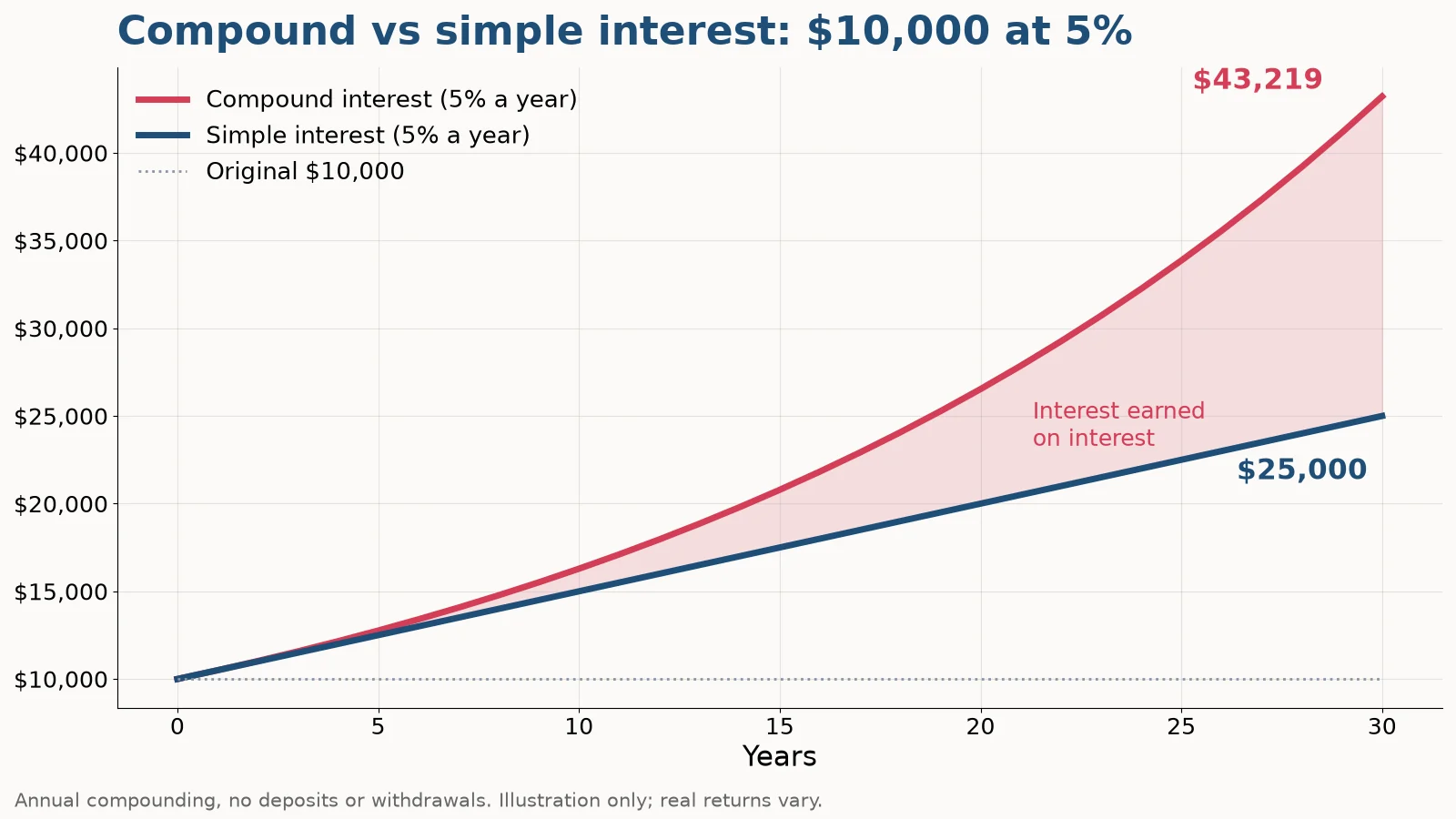
- $10,000 at 5% a year grows to $43,219 in 30 years with compounding, against $25,000 with simple interest.
- More frequent compounding helps a little: 5% compounded monthly is an APY of 5.116%.
- The Rule of 72 estimates doubling time: 72 ÷ 6% ≈ 12 years.
- FDIC’s October 2026 national average savings rate was 0.38%, so where you keep your savings matters more than the formula.
Knowing how to calculate compound interest lets you see exactly how savings grow, and how debt grows against you. The Securities and Exchange Commission’s investor site defines compound interest simply as interest paid on the principal and on the interest already earned. That second part is what makes it powerful: each year’s interest becomes part of the balance that earns interest the next year.
Investor.gov gives a tidy example. $100 earning 5% a year becomes $105 after one year and $110.25 after two, because in the second year you also earn 25 cents of interest on the first year’s $5. Left alone, it grows to more than $162 in 10 years and almost $340 in 25. This guide shows the formula behind those numbers and works through five real examples: simple versus compound interest, how often interest compounds, the Rule of 72, regular monthly deposits, and what today’s average bank rates actually earn. Our compound interest calculator is built into the page for your own figures.
The compound interest formula
The standard formula for a single deposit is:
A = P × (1 + r/n)n×t
- A is the final amount.
- P is the principal, the amount you start with.
- r is the annual interest rate as a decimal (5% = 0.05).
- n is how many times a year interest is added (1 for yearly, 12 for monthly).
- t is the number of years.
The interest earned is A − P.
Checking the Investor.gov example
For $100 at 5% compounded once a year: after 10 years, A = 100 × 1.0510 = $162.89; after 25 years, A = 100 × 1.0525 = $339. Those match the “more than $162” and “almost $340” figures on Investor.gov.
On a calculator, use the power key (often xy or ^). In a spreadsheet, the formula is =P*(1+r/n)^(n*t). Or use the calculator below, which also handles regular deposits.
Prefer a full page? Open the Compound Interest Calculator.
Example 1: compound vs simple interest
Simple interest is paid only on the original principal, so it grows by the same amount every year. Compound interest is paid on the growing balance. Here is $10,000 at 5% a year both ways:
| Years | Simple interest | Compound interest | Difference |
|---|---|---|---|
| 1 | $10,500 | $10,500 | $0 |
| 5 | $12,500 | $12,763 | $263 |
| 10 | $15,000 | $16,289 | $1,289 |
| 20 | $20,000 | $26,533 | $6,533 |
| 30 | $25,000 | $43,219 | $18,219 |
In the first year they are identical. By year 10 the gap is about $1,289, and by year 30 compound interest has produced $43,219 against $25,000, more than 1.7 times as much. The chart above shows the gap widening: the shaded area is interest earned on interest.
The lesson is that time does most of the work. The rate matters, but the number of years matters even more, because the exponent in the formula is n × t. Our simple interest calculator shows the non-compounding version for comparison.
Example 2: how often interest compounds
Banks can add interest yearly, quarterly, monthly or daily. The more often interest is added, the sooner it starts earning interest itself. For $10,000 at a 5% annual rate over 10 years:
| Compounding | Balance after 10 years | Effective annual rate (APY) |
|---|---|---|
| Annually | $16,289 | 5.000% |
| Quarterly | $16,436 | 5.095% |
| Monthly | $16,470 | 5.116% |
| Daily | $16,487 | 5.127% |
Continuous compounding, the mathematical limit, gives $16,487 (an APY of 5.127%). So going from yearly to daily compounding adds about $197.70 over 10 years: real, but small.
This is why savings accounts advertise an APY (annual percentage yield), which already includes the effect of compounding, so you can compare accounts directly. A higher APY always earns more, whatever the compounding schedule. Our APY calculator converts between a stated rate and its APY.
Example 3: the Rule of 72
Investor.gov describes the Rule of 72 as a quick way to estimate how long it takes money to double: divide 72 by the interest rate. At 6%, 72 ÷ 6 = 12 years. Here is how the shortcut compares with the exact answer, which is ln(2) ÷ ln(1 + r):
| Annual rate | Rule of 72 (years) | Exact (years) |
|---|---|---|
| 1% | 72.0 | 69.7 |
| 2% | 36.0 | 35.0 |
| 3% | 24.0 | 23.4 |
| 4% | 18.0 | 17.7 |
| 6% | 12.0 | 11.9 |
| 8% | 9.0 | 9.0 |
| 10% | 7.2 | 7.3 |
| 12% | 6.0 | 6.1 |
| 18% | 4.0 | 4.2 |
| 24% | 3.0 | 3.2 |
The rule is remarkably close between about 6% and 10%, and drifts at very low or very high rates. At 1% it says 72 years when the true figure is 69.7; at 24% it says 3 years against an exact 3.2. For a quick mental check, it is hard to beat.
It works for debt and inflation too. Debt growing at 18% a year doubles in about 4 years if nothing is paid. Prices rising 3% a year double in about 24 years, which means the same money buys half as much.
Example 4: adding money every month
Most people do not invest one lump sum; they add a little each month. For regular deposits, the future value uses a slightly different formula:
FV = PMT × ((1 + i)N − 1) ÷ i
where PMT is the monthly deposit, i the monthly rate (annual rate ÷ 12) and N the number of months.
Saving $200 a month at a 6% annual return, compounded monthly, for 30 years:
- You deposit $200 × 12 × 30 = $72,000.
- The account grows to $200,903.
- So $128,903, about 64% of the final balance, is interest.
Start 10 years later and save the same $200 a month for 20 years, and you deposit $48,000 but end with only $92,408. Waiting a decade costs $108,495 even though you only put in $24,000 less. A 6% return is used here as an illustration only; investment returns are not guaranteed and can be negative in any year.
Our investment calculator and the SEC’s own compound interest calculator on Investor.gov both model monthly contributions.
Example 5: what today's rates actually earn
The formula is only as good as the rate you put into it. The FDIC publishes national average deposit rates every month. Using the October 2026 figures, here is what $10,000 would earn over 5 years at each average rate (treated as an annual yield, with nothing added or withdrawn):
| Account (FDIC national rate) | Rate | Balance after 5 years | Interest earned |
|---|---|---|---|
| Interest checking | 0.07% | $10,035 | $35.05 |
| Savings | 0.38% | $10,191 | $191.45 |
| Money market | 0.63% | $10,319 | $319 |
| 60-month CD | 1.41% | $10,725 | $725 |
| 12-month CD, renewed at the same rate | 1.76% | $10,912 | $912 |
At the national average savings rate of 0.38%, five years of compounding adds less than $200 to $10,000. The FDIC weights its national rate by each institution’s share of domestic deposits, so it reflects where most money sits rather than the best rates on offer, and higher-yield savings accounts and CDs are available. As a comparison only, an account paying 4% would grow the same $10,000 to $12,167, about $1,975 more than the average savings rate. Shopping around for the rate matters far more than how often interest compounds.
Check that any bank or credit union is federally insured, and remember that a 12-month CD rate is only locked for 12 months. The table assumes it renews at the same rate each year, which is unlikely; in reality you accept whatever the rate is at each renewal. Our CD calculator handles specific terms.
Doing it in a spreadsheet
For anything beyond a single deposit, a spreadsheet is the easiest tool. Excel, Google Sheets and most other spreadsheets have a built-in future value function:
=FV(rate, periods, payment, present_value)
The rate and the number of periods must use the same time unit, so for monthly compounding divide the annual rate by 12 and multiply the years by 12. Money you pay in is entered as a negative number, because it leaves your pocket; the result comes back positive.
For example, starting with $5,000, adding $150 a month, at 5% a year compounded monthly for 15 years:
=FV(0.05/12, 15*12, -150, -5000) = $50,662
Of that, $32,000 is your own money and $18,662 is interest. Changing one cell at a time, such as the rate, the monthly amount or the number of years, is a quick way to see which lever matters most for your own plan. You will usually find it is the number of years.
The calculator at the top of this page does the same sum without any formulas, and shows a year-by-year table of the balance.
Compound interest on debt
Compounding works just as hard against you when you owe money. Credit cards typically quote an APR and charge interest monthly on the unpaid balance, so unpaid interest is added to the balance and starts accruing interest itself.
As an illustration, a $5,000 balance on a card charging 24% APR, compounded monthly, would grow to $6,341 after a year if no payments were made. The effective annual rate is 26.8%, higher than the 24% headline because of monthly compounding. In practice, minimum payments stop the balance growing this fast, but they also mean most of each payment goes to interest in the early months.
The same Rule of 72 applies: at 24%, an unpaid balance doubles in about 3 years. Paying off high-rate debt is effectively a guaranteed return at that rate, which is why it usually comes before investing. Our guide to calculating percentages explains why percentage changes compound rather than add.
Five habits that make compounding work for you
- Start early, even with small amounts; time is the biggest lever.
- Reinvest interest and dividends rather than withdrawing them.
- Compare APY, not the stated rate, when choosing a savings account.
- Keep fees low; a fee is negative compounding on your whole balance.
- Pay down high-interest debt, where compounding works against you.
Frequently asked questions
What is the formula for compound interest?
A = P × (1 + r/n)^(n×t), where P is the principal, r the annual rate as a decimal, n the number of compounding periods a year and t the number of years.
How much is $10,000 at 5% compound interest for 10 years?
With annual compounding, about $16,289. With monthly compounding, about $16,470.
What is the difference between simple and compound interest?
Simple interest is paid only on the original principal. Compound interest is also paid on interest already earned, so the balance grows faster each year.
What is the Rule of 72?
A shortcut to estimate how long money takes to double: divide 72 by the annual rate. At 6%, about 12 years.
Does compounding monthly make a big difference?
Only a small one. 5% compounded monthly is an APY of 5.116%, compared with 5% compounded yearly. The rate itself matters far more.
What is APY?
Annual percentage yield, the effective yearly return including compounding. It lets you compare accounts with different compounding schedules.
What is the average savings account rate?
The FDIC’s national average for savings accounts was 0.38% in its October 2026 update. Many accounts pay more, so it is worth comparing.
How does compound interest work on credit cards?
Unpaid interest is added to the balance and then charged interest itself. A 24% APR compounded monthly is an effective rate of about 26.8% a year.
Related calculators
Sources
- What is compound interest?, Investor.gov, U.S. Securities and Exchange Commission. The $100 at 5% example and the Rule of 72.
- Glossary: Compound Interest, Investor.gov, U.S. Securities and Exchange Commission. Definition of compound interest.
- National Rates and Rate Caps (October 2026), Federal Deposit Insurance Corporation. National average rates for savings, checking, money market and CD accounts.