
Updated 13 November 2026 · Written by the Digital Calculators team
Key takeaways
- The debt snowball pays off the smallest balance first; the avalanche pays off the highest interest rate first. Both keep minimums on everything else.
- In our example with $15,100 of debt, the avalanche saved $101 in interest; the snowball cleared its first debt sooner.
- Credit card interest averaged 22.36% in Q3 2026 for accounts charged interest (Federal Reserve), so high-rate cards are expensive to leave for last.
- A Kellogg study of 6,000 people found that paying off whole accounts predicted getting out of debt, which supports the snowball’s motivation effect.
- The CFPB says either method can work; choose the one you will stick with.
The debt snowball and the debt avalanche are the two best-known ways to pay off several debts at once. Both start the same way: you pay the minimum on every debt and put every extra dollar toward one target. They differ only in which debt you target first. The snowball goes after the smallest balance, for quick wins. The avalanche goes after the highest interest rate, to save the most money.
The Consumer Financial Protection Bureau describes both and does not insist on one. This guide runs both methods month by month on the same set of debts so you can see the real difference in time and interest, explains what a well-known study found about why small wins matter, uses the Federal Reserve’s latest interest rate data to show what high-rate debt costs, and finishes with a step-by-step plan. Our debt snowball calculator lets you try your own debts.
How the two methods work
Both methods use the same total monthly budget. Only the order changes.
Debt snowball
- List your debts from smallest balance to largest, ignoring interest rates.
- Pay the minimum on everything.
- Put all extra money on the smallest debt until it is gone.
- Add that debt’s payment to the next smallest, and repeat. The payment grows like a snowball.
Debt avalanche
- List your debts from highest interest rate to lowest.
- Pay the minimum on everything.
- Put all extra money on the highest-rate debt until it is gone.
- Move that payment to the next highest rate, and repeat.
The CFPB calls the avalanche the “highest interest rate method” and explains its logic simply: the highest-rate debt is costing you the most, so paying it off first saves money, even if it does not always feel like progress. Its worksheets add the key rule for both methods: when a debt is paid off, move its entire payment, the minimum plus the extra, to the next debt on the list.
Try the Debt Snowball Calculator
Enter your own numbers and get the result instantly.
A worked example: four debts, two methods
Here is a realistic set of debts. The credit card rate matches the Federal Reserve’s Q3 2026 average for accounts charged interest, and the car loan rate matches the Fed’s figure for a 60-month new car loan; the other rates and all the minimum payments are assumptions for the example.
| Debt | Balance | APR | Minimum payment |
|---|---|---|---|
| Medical payment plan | $800 | 9% | $40 |
| Store credit card | $1,800 | 26% | $55 |
| Credit card | $3,500 | 22.36% | $105 |
| Car loan | $9,000 | 7.54% | $260 |
That is $15,100 of debt with $460 a month of minimum payments. We add $300 a month extra, for a total of $760 a month, and run both methods month by month with interest charged monthly.
Snowball order (smallest balance first)
| # | Debt paid off | When |
|---|---|---|
| 1 | Medical payment plan | Month 3 |
| 2 | Store credit card | Month 8 |
| 3 | Credit card | Month 14 |
| 4 | Car loan | Month 23 |
Avalanche order (highest rate first)
| # | Debt paid off | When |
|---|---|---|
| 1 | Store credit card | Month 6 |
| 2 | Medical payment plan | Month 14 |
| 3 | Credit card | Month 14 |
| 4 | Car loan | Month 23 |
The result
- Snowball: debt-free in 23 months (1 year 11 months), paying $1,748 in interest.
- Avalanche: debt-free in 23 months (1 year 11 months), paying $1,646 in interest.
- The avalanche saves $101. The snowball clears its first debt in month 3, compared with month 6 for the avalanche.
For comparison, paying only the minimums would take 58 months (4 years 10 months) and cost $4,639 in interest. The extra $300 a month matters far more than which method you choose.
Why the extra payment matters most
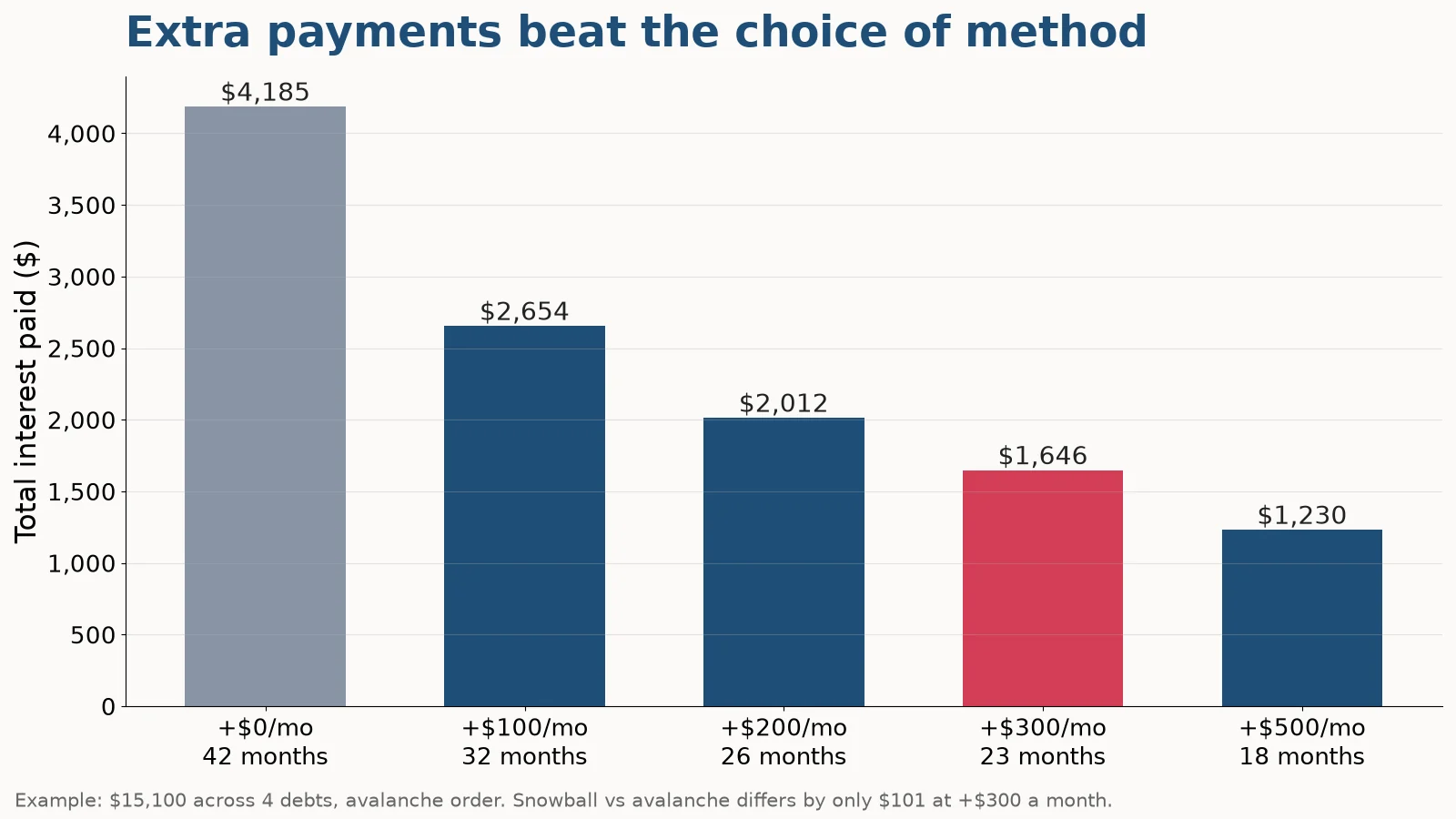
Arguing about snowball versus avalanche can hide a bigger point: the size of your extra payment changes the outcome far more than the order you pay in. Here is the same set of debts paid with the avalanche method at different extra amounts each month:
| Extra each month | Time to debt-free | Total interest |
|---|---|---|
| $0 | 42 months | $4,185 |
| $100 | 32 months | $2,654 |
| $200 | 26 months | $2,012 |
| $300 | 23 months | $1,646 |
| $500 | 18 months | $1,230 |
Two effects are at work. Simply rolling each paid-off debt’s payment into the next one, with no extra money at all (the $0 row), cuts the time from 58 months on minimums alone to 42 months. Adding $300 a month then brings it down to 23 months and saves a further $2,539 in interest. The gap between the snowball and the avalanche, by comparison, is $101. Every extra dollar shortens the plan, whichever order you choose.
That is why most plans start by finding money in the budget, then picking a method. Small, regular amounts add up: an extra $100 a month is $1,200 a year aimed straight at the debt. Windfalls such as a tax refund or a bonus can speed things up further if they go to the target debt rather than being spent.
Minimum payments also tend to fall as balances fall on many credit cards, which can quietly stretch repayment out for years. Keeping your total monthly payment fixed, even as minimums drop, is one of the simplest ways to make sure the snowball keeps rolling.
Why the avalanche saves money
Interest is charged on what you owe, at each debt’s own rate. Every dollar that pays down a 26% card stops costing 26% a year; the same dollar on a 9% plan only stops 9%. So the avalanche, which always aims extra money at the most expensive debt, keeps total interest as low as possible.
How much you save depends on how far apart your rates are. The Federal Reserve’s consumer credit data show how wide the gap can be: in Q3 2026, credit card plans charged an average of 22.36% on accounts assessed interest, against 11.90% for a 24-month personal loan and 7.54% for a 60-month new car loan at commercial banks. With rates that far apart, leaving a card for last is expensive. At 22.36%, a $5,000 card balance costs about $93 a month in interest.
If all your debts have similar rates, the two methods give almost the same result, and the snowball’s quicker wins cost very little.
Why the snowball can still win
The avalanche is cheaper on paper, but a plan only works if you finish it. That is where the snowball has an edge.
Researchers David Gal and Blakeley McShane, then at Northwestern University’s Kellogg School of Management, studied data from a debt settlement company on how 6,000 people eliminated their credit card debt. As Kellogg reported, they found that people who pursued the “small victories” strategy were more likely to eliminate their entire debt balance. In Gal’s words, closing debt accounts, independent of the dollar balances of the accounts closed, predicted successful debt elimination.
In other words, the number of debts you have actually crossed off seems to keep people going, even when it is not the cheapest route. The researchers suggested consumers should hear about both: the rationally optimal approach of paying higher-interest balances first, and the possible psychological benefits of closing accounts.
The CFPB takes a similar view. If saving money is your priority, use the highest-rate method; if seeing progress matters more to you, the snowball can keep you motivated.
Which method should you choose?
A simple way to decide:
- Choose the avalanche if your rates differ a lot, especially if you carry credit card balances, and you are confident you will stick with the plan without early wins.
- Choose the snowball if you have several small balances, you have tried and stopped before, or seeing debts disappear quickly will keep you going.
- Try a hybrid: knock out one or two very small balances first for momentum, then switch to the avalanche for the rest.
Run both on your own debts before deciding. If the avalanche saves only a small amount, the snowball’s motivation may be worth it. If it saves thousands, the avalanche is probably worth the patience. Our debt avalanche calculator and debt snowball calculator show the numbers side by side.
How to start this month
- List every debt. Write down each balance, interest rate and minimum payment from your latest statements.
- Find your extra amount. Work out how much you can add above the minimums each month. A budget helps; our guide to the 50/30/20 rule shows one way to find it.
- Build a small cushion first. A modest emergency fund stops one surprise bill from going straight back on a card.
- Pick your order and write it down.
- Automate the minimums so you never miss one, and pay the extra on the target debt right after payday.
- Roll payments forward. Each time a debt is paid off, add its whole payment to the next one.
- Avoid new debt on the cards you are paying off, or the plan cannot work.
If your rates are very high, it may also be worth checking whether a lower-rate consolidation loan or balance transfer would help, but compare all fees first. Our debt consolidation calculator and credit card payoff calculator can help you compare. If you are struggling to make even the minimum payments, contact your lenders early and consider a reputable nonprofit credit counselor.
Frequently asked questions
What is the debt snowball method?
Pay the minimum on all debts and put every extra dollar on the smallest balance. When it is gone, roll its payment into the next smallest, and repeat.
What is the debt avalanche method?
Pay the minimum on all debts and put every extra dollar on the debt with the highest interest rate, then move to the next highest.
Which saves more money, snowball or avalanche?
The avalanche, because it targets the most expensive debt first. In our example it saved about $101 in interest.
Is the debt snowball a good idea?
It can be. A Kellogg study of 6,000 people found that paying off whole accounts predicted getting out of debt, so the snowball’s quick wins can help people stick with the plan.
What does the CFPB recommend?
The CFPB describes both methods and suggests choosing the highest-rate method if saving money matters most, or the snowball if seeing quick progress keeps you motivated.
What is the average credit card interest rate?
The Federal Reserve reported 22.36% for credit card accounts assessed interest in Q3 2026 (preliminary), and 21.19% across all accounts.
Should I pay off debt or save first?
Many people build a small emergency fund first so a surprise expense does not add new debt, then focus extra money on paying debts down.
How do I roll over payments?
When a debt is paid off, add its full payment, the minimum plus any extra, to the payment on the next debt in your order.
Related calculators
Sources
- How to reduce your debt, Consumer Financial Protection Bureau. Description of the highest interest rate and snowball methods.
- Consumer Credit, G.19 (current release), Board of Governors of the Federal Reserve System. Average interest rates on credit cards, personal loans and new car loans.
- The 'snowball approach' to debt, Kellogg School of Management, Northwestern University. The Gal and McShane study of 6,000 people and the small-victories finding.