
Updated 13 November 2026 · Written by the Digital Calculators team
Key takeaways
- Profit margin = (price − cost) ÷ price. Markup = (price − cost) ÷ cost. Same profit, different base.
- Selling for $5,000 something that cost $3,000 is a 66.7% markup but a 40% margin (SCORE’s example).
- To hit a target margin, divide the cost by (1 − margin): a $24 item at a 40% margin sells for $40, not $33.60.
- A 20% discount on a 40%-margin product cuts the margin to 25% and halves the profit per unit.
- Break-even units = fixed costs ÷ (price − variable cost per unit), the formula the SBA uses.
If you are learning how to calculate profit margin, the first thing to know is that margin and markup are not the same thing, even though both describe the same dollars of profit. Margin measures profit as a share of the selling price. Markup measures it as a share of the cost. Mix them up and you will price too low, sometimes by a lot.
The small-business mentoring organization SCORE uses a simple example: a product that costs $3,000 and sells for $5,000 makes $2,000. That is a 40% margin but a 66.7% markup. This guide explains both formulas, gives a conversion table between them, shows how to set a price that hits a target margin, and works through what discounts do to your margin, the difference between gross and net margin, and how to find your break-even point. Our free profit margin calculator lets you run your own numbers as you go.
- Margin and markup: the two formulas
- Converting between margin and markup
- How to price for a target margin
- Margin across a product range
- Margins for services and freelancers
- What discounts do to your margin
- Gross, operating and net profit margin
- Break-even: how many sales cover your costs?
- Frequently asked questions
- Sources
Margin and markup: the two formulas
Both start with gross profit, the selling price minus the cost of the goods sold. They differ only in what you divide by.
| Formula | SCORE example ($5,000 price, $3,000 cost) | |
|---|---|---|
| Gross profit | price − cost | $5,000 − $3,000 = $2,000 |
| Margin | (price − cost) ÷ price × 100 | $2,000 ÷ $5,000 = 40% |
| Markup | (price − cost) ÷ cost × 100 | $2,000 ÷ $3,000 = 66.7% |
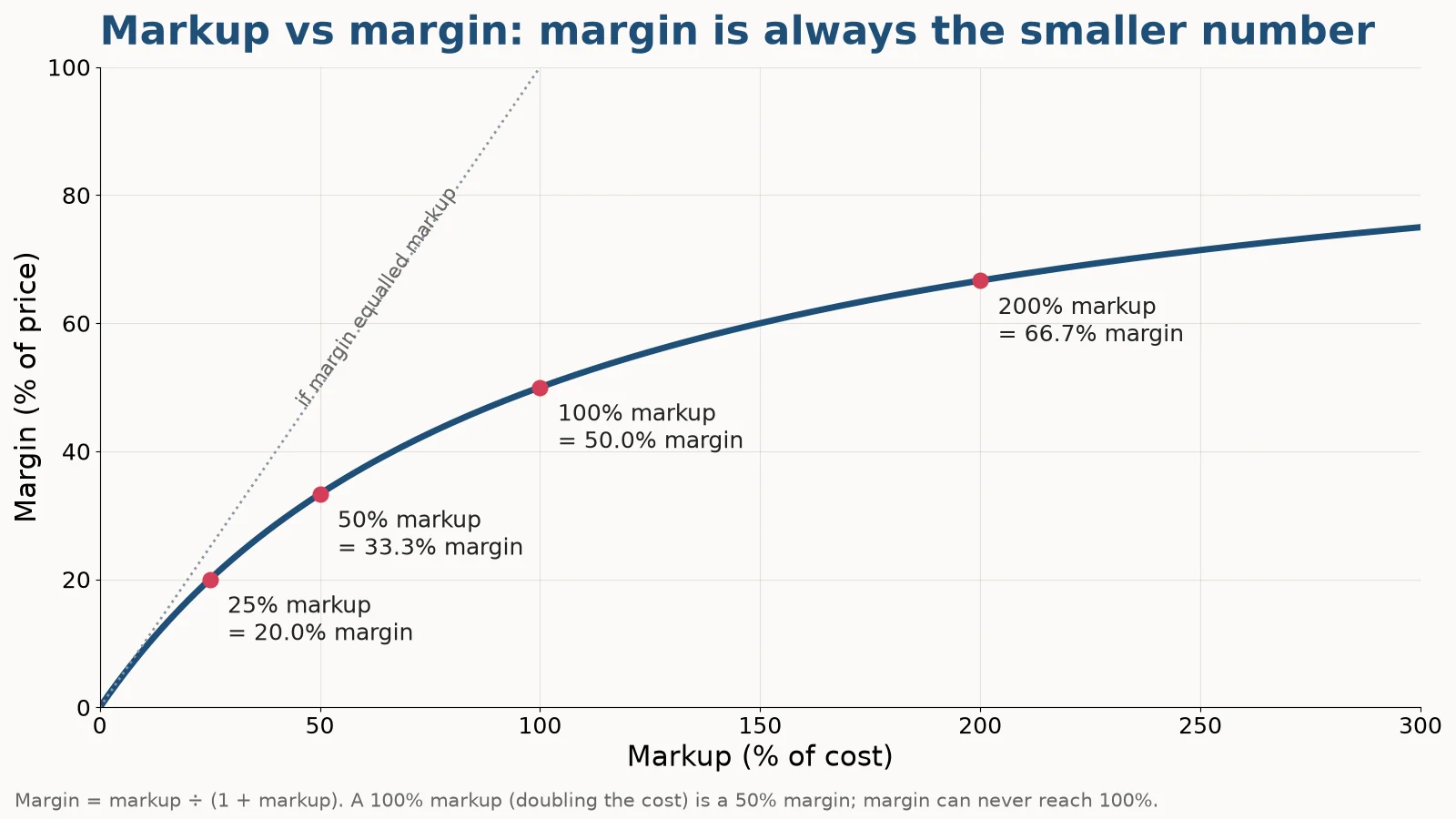
SCORE notes that gross margin, as a percentage, is always stated as a percentage of net sales, the seller’s price. Markup is stated as a percentage of cost. Because the price is always bigger than the cost when you make a profit, margin is always the smaller of the two numbers.
Which should you use? Markup is convenient for setting prices from a cost sheet. Margin is what tells you how much of every sales dollar you keep, so it is what lenders, investors and your own accounts care about. Most pricing mistakes come from targeting a margin but calculating a markup.
Use our profit margin calculator, linked below, to work out margin, markup and profit from any cost and price.
Try the Profit Margin Calculator
Enter your own numbers and get the result instantly.
Converting between margin and markup
You can turn one into the other without knowing the actual cost or price:
- Margin = markup ÷ (1 + markup), with both as decimals. A 50% markup is 0.5 ÷ 1.5 = 33.3% margin.
- Markup = margin ÷ (1 − margin). A 40% margin is 0.4 ÷ 0.6 = 66.7% markup.
Target margin to markup
The third column is the multiplier: cost × multiplier = selling price.
| Target margin | Markup needed | Price = cost × |
|---|---|---|
| 10% | 11.1% | 1.111 |
| 15% | 17.6% | 1.176 |
| 20% | 25.0% | 1.250 |
| 25% | 33.3% | 1.333 |
| 30% | 42.9% | 1.429 |
| 33.3% | 49.9% | 1.499 |
| 40% | 66.7% | 1.667 |
| 50% | 100.0% | 2.000 |
| 60% | 150.0% | 2.500 |
| 70% | 233.3% | 3.333 |
| 75% | 300.0% | 4.000 |
| 80% | 400.0% | 5.000 |
Markup to margin
| Markup | Margin |
|---|---|
| 10% | 9.1% |
| 20% | 16.7% |
| 25% | 20.0% |
| 30% | 23.1% |
| 50% | 33.3% |
| 75% | 42.9% |
| 100% | 50.0% |
| 150% | 60.0% |
| 200% | 66.7% |
Two landmarks are worth remembering. A 100% markup (doubling the cost) gives a 50% margin, a pricing rule many retailers know as keystone pricing. And while markup can be any size, margin can never reach 100%, because that would mean the cost was zero.
How to price for a target margin
Suppose an item costs you $24 and you want a 40% margin. The correct formula is:
Price = cost ÷ (1 − target margin) = $24 ÷ 0.60 = $40
Check it: profit is $40 − $24 = $16, and $16 ÷ $40 = 40%.
The common mistake is to add the margin to the cost: $24 × 1.40 = $33.60. That is a 40% markup, which only produces a 28.6% margin. On every sale you would keep $6.40 less than you planned. Across a whole product range, that gap can be the difference between a profitable year and a loss.
SCORE’s pricing guidance is a useful reminder of what the margin has to pay for: the price must cover the product’s purchase cost and other variable costs such as packaging and freight, a share of overhead, and a reasonable profit. Insurance, theft, changes in wholesale costs and discounts all eat into it, so the target margin should leave room for them.
Our markup calculator works from cost and markup if you prefer to price that way.
Margin across a product range
Most businesses sell more than one product, each with its own margin. Your overall margin is not the average of the percentages; it is total gross profit divided by total sales, so high-volume items count for more.
| Product | Cost | Price | Markup | Margin | Units sold |
|---|---|---|---|---|---|
| Candles | $6 | $14 | 133% | 57.1% | 300 |
| Mugs | $4.50 | $12 | 167% | 62.5% | 200 |
| Gift boxes | $18 | $30 | 67% | 40.0% | 80 |
Total sales are $9,000 and the total cost of goods is $4,140, so gross profit is $4,860 and the overall margin is 54.0%. The simple average of the three margins would be 53.2%, a little lower, because the candles, at a 57.1% margin, bring in 47% of all revenue, while the low-margin gift boxes bring in only 27%. Each product’s margin counts in proportion to its sales.
This is why the product mix matters. Selling more of the high-margin mugs lifts the overall margin even if no price changes, and a rush of sales on a low-margin line can lower it even though revenue grows.
Margins for services and freelancers
Margin works the same way for a service business, but the “cost of goods” is mostly time. To price a job, count the cost of the hours it takes, including your own time at a realistic rate, plus any materials.
Say a job needs 12 hours of labor that costs $35 an hour, plus $180 of materials. The direct cost is 12 × $35 + $180 = $600. A quote of $1,100 gives a margin of 45.5%. To reach a 40% margin instead, the quote would need to be $600 ÷ 0.60 = $1,000.
Two traps are common in service pricing. The first is leaving your own time out of the cost, which makes every job look more profitable than it is. The second is forgetting non-billable hours: quoting, travel, admin and invoicing all take time that no customer pays for directly, so the margin on billable work has to cover them. If a third of your working week is non-billable, your effective hourly cost is higher than the rate you pay yourself.
Our hourly to salary guide helps turn an hourly rate into a yearly figure if you are setting a rate from an income target.
What discounts do to your margin
Discounts come straight off the price, but the cost stays the same, so they cut margin much faster than the headline percentage suggests.
Take a product that costs $30 and sells for $50: a 40% margin and $20 of gross profit per unit. Offer 20% off and the price becomes $40. Profit per unit falls to $10, and the margin drops to 25%.
A 20% discount halved the profit per unit. To earn the same total gross profit as before, you would need to sell 2 times as many units. That is the question to ask before any promotion: will the discount really double sales?
The deeper the discount and the thinner the starting margin, the worse this gets. A 20% discount on a product with a 20% margin wipes out the profit entirely. Our discount calculator shows the sale price, and our guide to calculating percentages explains why stacked discounts are smaller than they look.
Gross, operating and net profit margin
“Profit margin” can mean three different things, depending on which costs you subtract. SCORE describes gross margin as the difference between sales and the cost of sales, which must then cover fixed costs and profit. Going further down the income statement gives the other two.
| Line | Amount | Margin |
|---|---|---|
| Revenue | $400,000 | |
| Cost of goods sold | −$240,000 | |
| Gross profit | $160,000 | 40.0% gross margin |
| Operating expenses (rent, wages, marketing) | −$110,000 | |
| Operating profit | $50,000 | 12.5% operating margin |
| Interest and taxes | −$18,000 | |
| Net profit | $32,000 | 8.0% net margin |
In this example, a healthy-looking 40% gross margin turns into an 8.0% net margin once the business has paid for its premises, staff, loans and taxes. When someone quotes a “profit margin”, ask which one they mean. Pricing decisions usually work with gross margin; the question “is this business profitable?” needs net margin.
Break-even: how many sales cover your costs?
The U.S. Small Business Administration defines the break-even point as the point at which total cost and total revenue are equal, meaning no loss or gain. It is a standard part of a business plan, because investors and lenders want to know when a business will start making money. The SBA’s break-even calculator uses this formula:
Break-even units = fixed costs ÷ (price per unit − variable cost per unit)
The bottom part, price minus variable cost, is the contribution each sale makes toward fixed costs. With monthly fixed costs of $6,000, a price of $40 and a variable cost of $24 per unit, each sale contributes $16, so you need $6,000 ÷ $16 = 375 units a month to break even. That is $15,000 of sales.
The same answer in sales dollars comes from dividing fixed costs by the contribution margin ratio: $16 ÷ $40 = 40%, and $6,000 ÷ 0.40 = $15,000.
Notice the link with margin: the higher the margin on each unit, the fewer sales you need to cover the same fixed costs. Raising the price from $40 to $44 would cut the break-even point to 300 units, provided sales held up. Our break-even calculator and ROI calculator handle the rest of the planning numbers.
Frequently asked questions
How do you calculate profit margin?
Subtract the cost from the selling price, divide by the selling price and multiply by 100. A $50 item that cost $30 has a ($50 − $30) ÷ $50 = 40% margin.
What is the difference between margin and markup?
Margin divides profit by the selling price; markup divides it by the cost. The same $20 profit on a $30 cost and $50 price is a 40% margin but a 66.7% markup.
How do I convert markup to margin?
Margin = markup ÷ (1 + markup). A 50% markup is 0.5 ÷ 1.5 = 33.3% margin; a 100% markup is a 50% margin.
How do I convert margin to markup?
Markup = margin ÷ (1 − margin). A 40% margin needs a 0.4 ÷ 0.6 = 66.7% markup.
How do I set a price for a 40% margin?
Divide the cost by 0.60. A $24 item needs a $40 price. Multiplying the cost by 1.40 gives only a 28.6% margin.
Can profit margin be more than 100%?
No. Margin is profit as a share of the price, so it can only approach 100% as the cost approaches zero. Markup, on the other hand, can be any size.
What is a good profit margin?
It depends heavily on the industry and on whether you mean gross or net margin. Compare with businesses like yours, and make sure your gross margin covers your overhead with room for profit.
How do I calculate my break-even point?
Divide fixed costs by the contribution per unit (price minus variable cost). $6,000 of fixed costs with a $16 contribution per unit needs 375 sales.
Related calculators
Sources
- Pricing Procedures for Retail (SCORE 7.00), SCORE. Definitions and formulas for markup and gross margin, the $5,000/$3,000 example and what a price must cover.
- Break-even point, U.S. Small Business Administration. Definition of the break-even point and its role in a business plan; the break-even formula used by the SBA calculator.