
Updated 16 November 2026 · Written by the Digital Calculators team
Key takeaways
- International Morse code is set by the ITU in Recommendation M.1677-1. It covers 26 letters, 10 numbers and 13 punctuation marks.
- The rhythm is fixed: a dash = 3 dots, the gap inside a letter = 1 dot, between letters = 3 dots and between words = 7 dots.
- SOS is
... --- .... E (.) and T (-) are the only one-symbol letters. - Every number has five symbols: 1 is
.----and 0 is-----. - Learn by sound, not by looking at dots and dashes: hear each letter as a rhythm.
The Morse code alphabet turns each letter and number into a short pattern of dots and dashes. The version used around the world today is International Morse code, defined by the International Telecommunication Union (ITU) in Recommendation M.1677-1. It covers the 26 letters, the digits 0 to 9, common punctuation and a handful of service signals that operators use to start, pause and end a message.
This guide has the complete charts taken from the ITU standard, the exact timing rules, worked examples such as SOS and HELLO, and practical tips for learning Morse code. Type anything into the translator below to see it in Morse code, or paste dots and dashes to decode them.
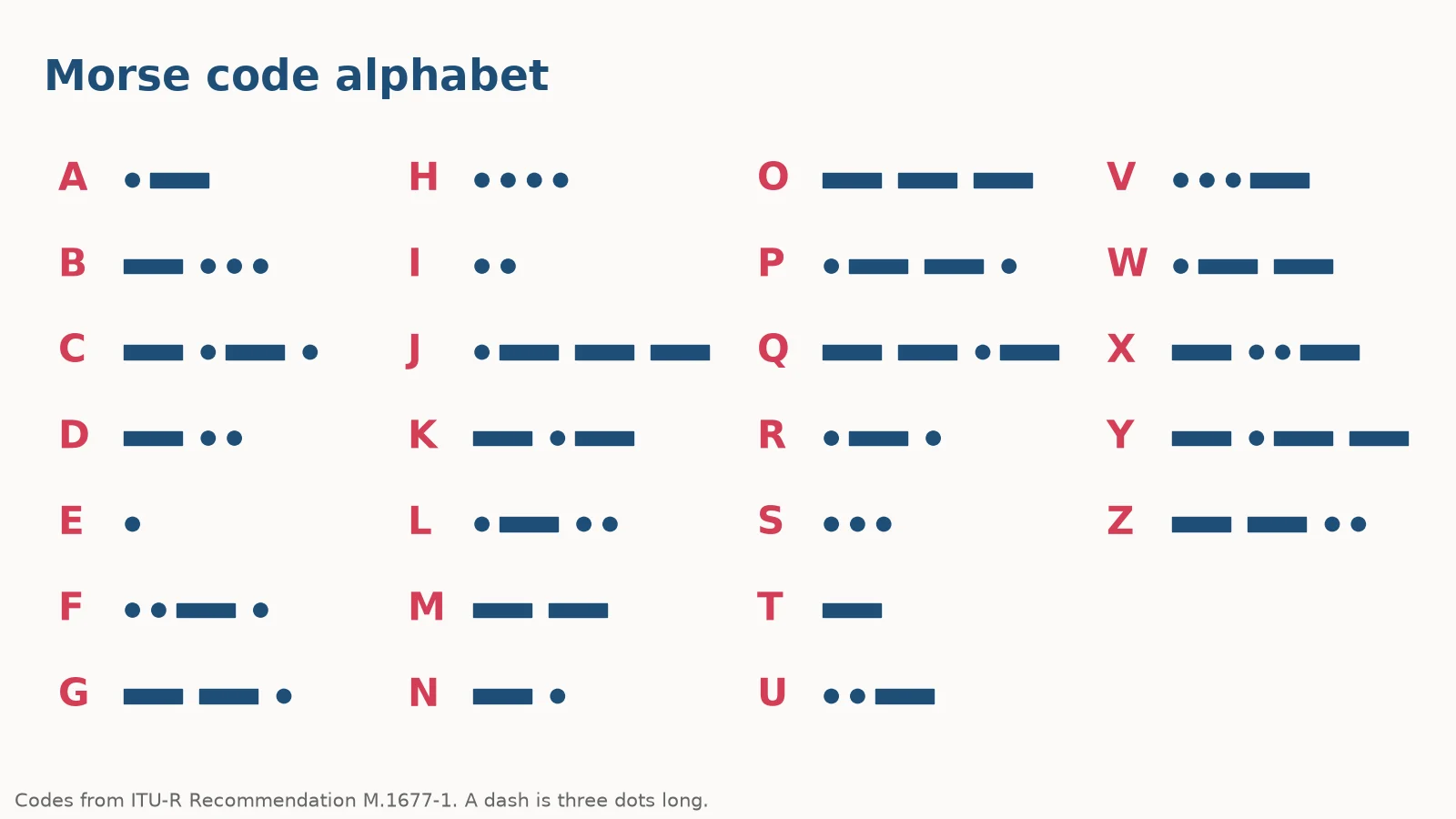
Morse code alphabet A to Z
These are the 26 letter codes from ITU-R M.1677-1. The last column shows how long each letter is in “dot units”, counting a dot as 1, a dash as 3 and the gap between symbols as 1.
| Letter | Morse code | Length (dot units) |
|---|---|---|
| A | .- | 5 |
| B | -... | 9 |
| C | -.-. | 11 |
| D | -.. | 7 |
| E | . | 1 |
| F | ..-. | 9 |
| G | --. | 9 |
| H | .... | 7 |
| I | .. | 3 |
| J | .--- | 13 |
| K | -.- | 9 |
| L | .-.. | 9 |
| M | -- | 7 |
| N | -. | 5 |
| O | --- | 11 |
| P | .--. | 11 |
| Q | --.- | 13 |
| R | .-. | 7 |
| S | ... | 5 |
| T | - | 3 |
| U | ..- | 7 |
| V | ...- | 9 |
| W | .-- | 9 |
| X | -..- | 11 |
| Y | -.-- | 13 |
| Z | --.. | 11 |
The shortest letters are E (1 unit), I (3 units), T (3 units), A (5 units). The longest are J (13 units), Q (13 units), Y (13 units).
Some letters are mirror images, with dots and dashes swapped: A (.-) and N (-.), B (-…) and J (.—), D (-..) and W (.–), E (.) and T (-), F (..-.) and Q (–.-), G (–.) and U (..-), I (..) and M (–), K (-.-) and R (.-.), L (.-..) and Y (-.–), O (—) and S (…), P (.–.) and X (-..-). Spotting pairs like these is a good way to remember them.
Morse code numbers 0 to 9
Numbers are the easiest part of Morse code, because every number has exactly five symbols and follows a pattern:
| Number | Morse code |
|---|---|
| 1 | .---- |
| 2 | ..--- |
| 3 | ...-- |
| 4 | ....- |
| 5 | ..... |
| 6 | -.... |
| 7 | --... |
| 8 | ---.. |
| 9 | ----. |
| 0 | ----- |
- 1 to 5: start with dots. The number of dots equals the number, and the rest are dashes. 3 is
...--(three dots, two dashes). - 6 to 9: start with dashes. The number of dashes is the number minus 5, and the rest are dots. 7 is
--...(two dashes, three dots). - 0: five dashes,
-----.
So if you know the pattern, you never need to memorize the numbers one by one.
Punctuation and special signs
The ITU standard also defines these punctuation marks and signs:
| Sign | Symbol | Morse code |
|---|---|---|
| Full stop (period) | . | .-.-.- |
| Comma | , | --..-- |
| Colon | : | ---... |
| Question mark | ? | ..--.. |
| Apostrophe | ' | .----. |
| Hyphen or dash | - | -....- |
| Fraction bar (slash) | / | -..-. |
| Left bracket | ( | -.--. |
| Right bracket | ) | -.--.- |
| Inverted commas (quotes) | " | .-..-. |
| Double hyphen (equals) | = | -...- |
| Cross (plus) | + | .-.-. |
| Commercial at | @ | .--.-. |
The commercial at (@), used in email addresses, is the last sign in the ITU list. Some signs have no code of their own, so the standard says how to send them instead:
- Multiplication sign (×): send the letter X (
-..-). - Percent (%): send zero, fraction bar, zero, so 0/0. For 2%, send 2-0/0, joining the number with a hyphen.
Accented E (É) also has its own code, ..-.., but other accented letters are not part of the international standard.
Prefer a full page? Open the Morse Code Translator.
Service signals: start, wait, error and end
Operators use a few special signals to manage a conversation. The ITU lists these:
| Meaning | Morse code |
|---|---|
| Starting signal (before every transmission) | -.-.- |
| Invitation to transmit | -.- |
| Wait | .-... |
| Understood | ...-. |
| Error (eight dots) | ........ |
| End of work | ...-.- |
The error signal is easy to recognize: eight dots in a row, which does not match any letter or number, so a listener cannot mistake it for part of the message.
The invitation to transmit, -.-, is the same pattern as the letter K, and the multiplication sign uses the letter X, so context tells the listener which is meant.
Morse code timing rules
Morse code is a rhythm, not just a pattern of symbols. Section 2 of the ITU recommendation fixes the timing, measured in the length of one dot:
- A dash is equal to three dots.
- The space between the signals that form the same letter is one dot.
- The space between two letters is three dots.
- The space between two words is seven dots.
So speed comes from the length of the dot, and everything else scales with it. Here is how long common messages take at three dot lengths, the same speeds offered by our translator:
| Dot length | Dash | Word gap | SOS (27 units) | HELLO WORLD (111 units) |
|---|---|---|---|---|
| 60 ms | 180 ms | 420 ms | 1.62 s | 6.66 s |
| 80 ms | 240 ms | 560 ms | 2.16 s | 8.88 s |
| 120 ms | 360 ms | 840 ms | 3.24 s | 13.32 s |
Worked example: HELLO
HELLO is .... . .-.. .-.. ---. Counting the units: H (7) + E (1) + L (9) + L (9) + O (11) = 37 units of signals and inner gaps, plus 4 gaps of 3 units between the letters = 49 units. At an 80 ms dot that takes 3.92 seconds.
Getting the gaps right matters as much as the dots and dashes. Run two letters together and they become a different letter: E (.) followed too closely by T (-) sounds like A (.-).
SOS and other famous examples
Some Morse code sequences are worth knowing by heart:
- SOS:
... --- ..., three dots, three dashes, three dots. It is 27 dot units long including the gaps between the letters. - HELLO:
.... . .-.. .-.. --- - I LOVE YOU:
.. / .-.. --- ...- . / -.-- --- ..- - OK:
--- -.- - YES:
-.-- . ...and NO:-. ---
In writing, letters are usually separated by a space and words by a slash (/), as above. That is a written convention; when sent as sound or light, the gaps are the 3-dot and 7-dot pauses from the timing rules.
You can also send Morse code with a flashlight, a whistle or taps: anything with a short and a long signal works, as long as you keep the 1 to 3 to 7 rhythm.
How to decode Morse code by hand
Reading Morse code means splitting the signal into letters at the 3-dot gaps, then matching each group to a letter. It helps to sort the alphabet by how many symbols each letter has:
| Symbols | Letters | How many |
|---|---|---|
| 1 | E, T | 2 |
| 2 | A, I, M, N | 4 |
| 3 | D, G, K, O, R, S, U, W | 8 |
| 4 | B, C, F, H, J, L, P, Q, V, X, Y, Z | 12 |
With one symbol there are only two possible letters (dot or dash), with two symbols four, with three symbols eight, and with four symbols up to sixteen, of which the alphabet uses twelve. So when you hear a short group, there are only a few letters it can be.
Worked example: decoding a message
Decode -- . . - / .- - / - . -.:
- Split at the slashes into words: three words.
- Split each word at the spaces into letters:
--..-, then.--, then-.-. - Look up each letter: M E E T, A T, T E N.
- Read it out: MEET AT TEN.
Practice
| Morse code | Answer |
|---|---|
-.-. .- - | CAT |
.... . .-.. .--. | HELP |
.-. .- -.. .. --- | RADIO |
--. --- --- -.. / -. .. --. .... - | GOOD NIGHT |
-.-. --- -.. . / ..--- ----- ..--- -.... | CODE 2026 |
Paste any of these into the translator above, choose Morse code to text, and check your answers.
How to learn Morse code
Morse code is a skill you learn with your ears. These steps work for most people:
- Learn by sound. Say each letter as a rhythm, “di-dah” for A and “dah-di-di-dit” for B, instead of picturing dots and dashes. Counting dots on paper becomes too slow later.
- Start with a few letters. E, T, A, N, I and M are all short. Once you can recognize them instantly, add two more letters at a time.
- Use the patterns. Mirror pairs such as A and N, and the regular numbers, cut the work.
- Listen at a fast letter speed. Play letters quickly but leave long gaps between them, so you learn each letter’s sound as a whole.
- Practice little and often. Ten minutes a day beats one long session a week.
- Decode real words. Use the translator above: type short words, press Play sound and try to write them down before you look.
For more code games, try the Caesar cipher, the binary translator or the letters to numbers converter.
Frequently asked questions
What is SOS in Morse code?
… — … (three dots, three dashes, three dots).
Who sets the Morse code alphabet?
The International Telecommunication Union (ITU), in Recommendation ITU-R M.1677-1, International Morse code.
How long is a dash in Morse code?
Three times as long as a dot.
How do you separate words in Morse code?
With a pause equal to seven dots. In writing, a slash (/) or a wide space is used.
What is the shortest letter in Morse code?
E, a single dot. T, a single dash, is the only other letter with one symbol.
How are numbers written in Morse code?
Every number has five symbols. 1 to 5 start with that many dots, 6 to 9 start with dashes, and 0 is five dashes.
What is the Morse code for error?
Eight dots in a row (……..). It does not match any letter or number.
Does Morse code have lowercase letters?
No. Morse code has no capital or lowercase letters; each letter has one code.
How do you write a year like 2026 in Morse code?
Send each digit in turn with a letter gap between them: 2026 is ..— —– ..— -…. (2, 0, 2, 6). Every digit has five symbols, so a four-digit number is always 20 symbols long.
Can you send Morse code with a flashlight or by tapping?
Yes. Any short and long signal works, such as a short and long flash or a light and heavy tap, as long as you keep the timing: a dash three times as long as a dot, a 3-dot pause between letters and a 7-dot pause between words.
What does the slash mean in written Morse code?
It marks the gap between words. When Morse code is sent as sound or light, that gap is a silence seven dots long.
Related calculators
Sources
- Recommendation ITU-R M.1677-1, International Morse code, International Telecommunication Union. Codes for letters, numbers, punctuation and service signals; the timing rules; how to send signs that have no Morse code.
- International Morse code (PDF of the recommendation), International Telecommunication Union. Full text read for this guide, including section 2 on spacing and length of signals.