
Updated 16 November 2026 · Written by the Digital Calculators team
Key takeaways
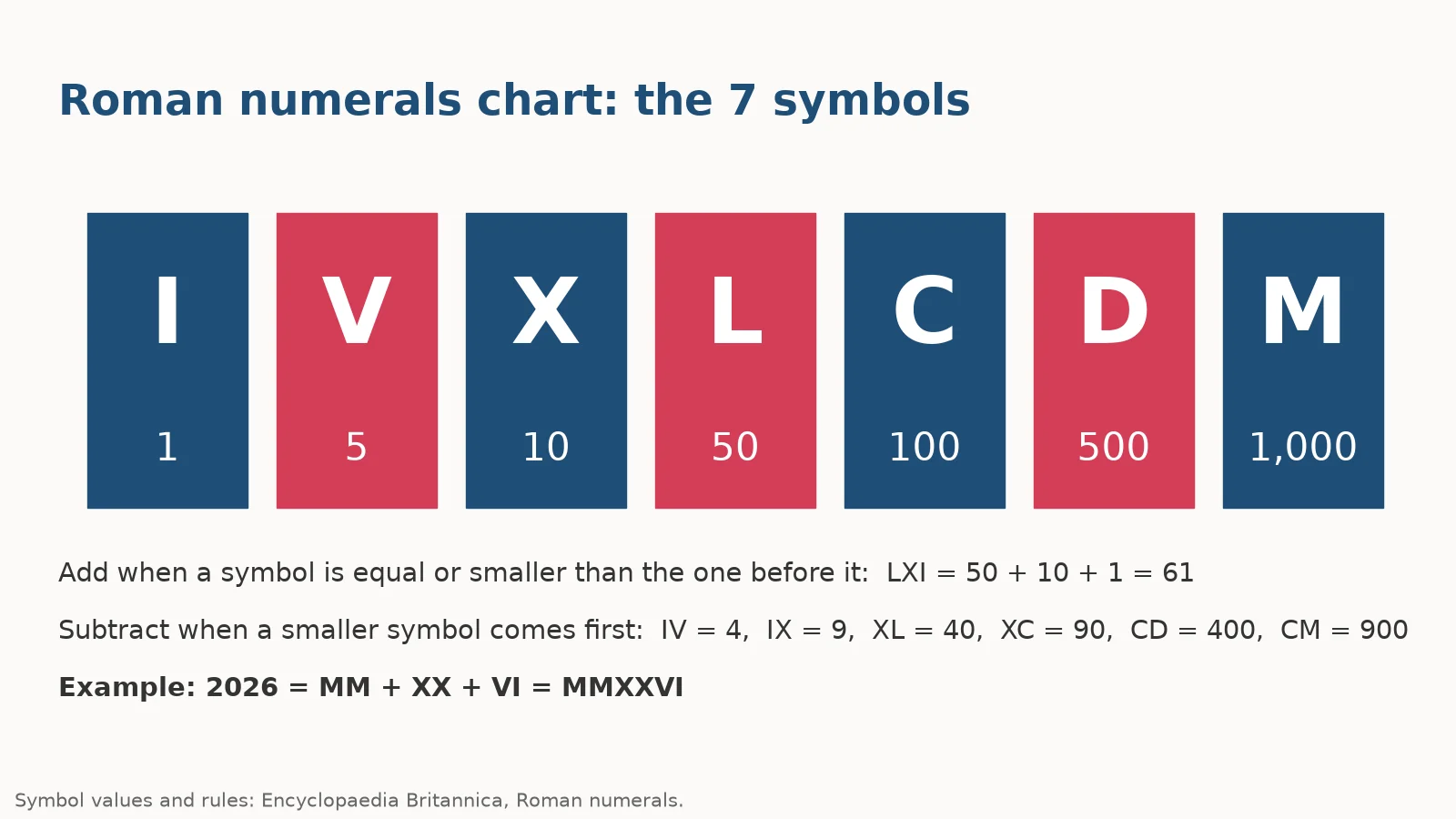
- Roman numerals use seven letters: I = 1, V = 5, X = 10, L = 50, C = 100, D = 500, M = 1,000.
- Symbols of equal or lower value add (VI = 6). A smaller symbol before a larger one subtracts (IV = 4).
- Usually no symbol appears more than three times in a row, which is why 4 is IV and 40 is XL.
- The year 2026 is MMXXVI. 1999 is MCMXCIX and 2000 is MM.
- There is no zero. In the standard form the largest number is 3,999 (MMMCMXCIX).
This Roman numerals chart shows every number from 1 to 100, the tens, hundreds and thousands, and the years you are most likely to need, such as MMXXVI for 2026. Roman numerals use just seven letters, combined by adding and subtracting. Once you know the seven values and two rules, you can read any Roman numeral on a clock, a movie copyright line, a cornerstone or a Super Bowl logo.
Below the charts, we explain the rules with worked examples, show how to convert in both directions step by step, and list the mistakes people make most often. The converter below changes any number from 1 to 3,999 into Roman numerals and back.
- The seven Roman numeral symbols
- Roman numerals chart 1 to 100
- Tens, hundreds and thousands
- The rules for reading Roman numerals
- How to convert a number to Roman numerals
- Roman numerals for years
- Where Roman numerals are still used
- Practice: test yourself
- Big numbers, zero and common mistakes
- Frequently asked questions
- Sources
The seven Roman numeral symbols
According to Encyclopaedia Britannica, the system has seven symbols:
| Symbol | Value |
|---|---|
| I | 1 |
| V | 5 |
| X | 10 |
| L | 50 |
| C | 100 |
| D | 500 |
| M | 1,000 |
Notice the pattern: each step alternates between a “one” (I, X, C, M) and a “five” (V, L, D). Every number is built from these seven letters. Unicode, the standard for text on computers, even has separate Roman numeral characters in its Number Forms block, but in everyday writing ordinary capital letters are used.
Roman numerals chart 1 to 100
Here is every number from 1 to 100. Read across each row:
| 1 = I | 2 = II | 3 = III | 4 = IV | 5 = V |
| 6 = VI | 7 = VII | 8 = VIII | 9 = IX | 10 = X |
| 11 = XI | 12 = XII | 13 = XIII | 14 = XIV | 15 = XV |
| 16 = XVI | 17 = XVII | 18 = XVIII | 19 = XIX | 20 = XX |
| 21 = XXI | 22 = XXII | 23 = XXIII | 24 = XXIV | 25 = XXV |
| 26 = XXVI | 27 = XXVII | 28 = XXVIII | 29 = XXIX | 30 = XXX |
| 31 = XXXI | 32 = XXXII | 33 = XXXIII | 34 = XXXIV | 35 = XXXV |
| 36 = XXXVI | 37 = XXXVII | 38 = XXXVIII | 39 = XXXIX | 40 = XL |
| 41 = XLI | 42 = XLII | 43 = XLIII | 44 = XLIV | 45 = XLV |
| 46 = XLVI | 47 = XLVII | 48 = XLVIII | 49 = XLIX | 50 = L |
| 51 = LI | 52 = LII | 53 = LIII | 54 = LIV | 55 = LV |
| 56 = LVI | 57 = LVII | 58 = LVIII | 59 = LIX | 60 = LX |
| 61 = LXI | 62 = LXII | 63 = LXIII | 64 = LXIV | 65 = LXV |
| 66 = LXVI | 67 = LXVII | 68 = LXVIII | 69 = LXIX | 70 = LXX |
| 71 = LXXI | 72 = LXXII | 73 = LXXIII | 74 = LXXIV | 75 = LXXV |
| 76 = LXXVI | 77 = LXXVII | 78 = LXXVIII | 79 = LXXIX | 80 = LXXX |
| 81 = LXXXI | 82 = LXXXII | 83 = LXXXIII | 84 = LXXXIV | 85 = LXXXV |
| 86 = LXXXVI | 87 = LXXXVII | 88 = LXXXVIII | 89 = LXXXIX | 90 = XC |
| 91 = XCI | 92 = XCII | 93 = XCIII | 94 = XCIV | 95 = XCV |
| 96 = XCVI | 97 = XCVII | 98 = XCVIII | 99 = XCIX | 100 = C |
Look at how 4, 9, 14, 19, 40 and 90 are written. Those are the numbers that use subtraction. Everything else is just adding symbols from left to right.
Prefer a full page? Open the Roman Numeral Converter.
Tens, hundreds and thousands
Larger numbers follow the same pattern with bigger symbols. The tens use X, L and C; the hundreds use C, D and M:
| Number | Roman numeral |
|---|---|
| 10 | X |
| 20 | XX |
| 30 | XXX |
| 40 | XL |
| 50 | L |
| 60 | LX |
| 70 | LXX |
| 80 | LXXX |
| 90 | XC |
| 100 | C |
| 200 | CC |
| 300 | CCC |
| 400 | CD |
| 500 | D |
| 600 | DC |
| 700 | DCC |
| 800 | DCCC |
| 900 | CM |
| 1,000 | M |
| 2,000 | MM |
| 3,000 | MMM |
Compare the rows: 4 is IV, 40 is XL and 400 is CD. 9 is IX, 90 is XC and 900 is CM. The same shape repeats at each level, just with the next pair of letters. That makes long numbers easy once you split them into thousands, hundreds, tens and ones.
The rules for reading Roman numerals
Britannica sums up the rules:
- Add when a symbol is followed by one of equal or smaller value. II = 1 + 1 = 2. LXI = 50 + 10 + 1 = 61.
- Subtract when a smaller symbol comes before a larger one. IV = 5 − 1 = 4. LIX = 50 + (10 − 1) = 59.
- Usually no more than three of the same symbol in a row. 3 is III, but 4 is IV rather than IIII.
In the standard modern form, subtraction is only used in six pairs: IV (4), IX (9), XL (40), XC (90), CD (400) and CM (900). A smaller symbol only goes in front of the next two larger ones. So 99 is XCIX (90 + 9), not IC, and 49 is XLIX, not IL.
Worked example: reading MCMXCIV
- M = 1,000
- CM = 1,000 − 100 = 900
- XC = 100 − 10 = 90
- IV = 5 − 1 = 4
- Total: 1,000 + 900 + 90 + 4 = 1,994
The trick is to scan from left to right and look for any symbol that is smaller than the one after it. Group those pairs first, then add everything up.
How to convert a number to Roman numerals
Work from the largest place value down. For 1987:
- Split the number: 1,000 + 900 + 80 + 7.
- Write each part using the chart: M + CM + LXXX + VII.
- Join them: MCMLXXXVII.
Another way that never fails is to keep taking away the largest value you can from this list: 1,000 (M), 900 (CM), 500 (D), 400 (CD), 100 (C), 90 (XC), 50 (L), 40 (XL), 10 (X), 9 (IX), 5 (V), 4 (IV), 1 (I). For 1987 that gives M (1000) + CM (900) + L (50) + X (10) + X (10) + X (10) + V (5) + I (1) + I (1).
The longest standard Roman numeral below 4,000 is 3,888: MMMDCCCLXXXVIII, which uses 15 letters to write a four-digit number. That shows why Hindu-Arabic numerals replaced Roman numerals for calculation, which Britannica says had largely happened in Europe by the 17th century.
Roman numerals for years
Years are the most common place to see Roman numerals today, in film credits, on buildings and on diplomas. Here are some useful ones:
| Year | Roman numeral |
|---|---|
| 1900 | MCM |
| 1950 | MCML |
| 1975 | MCMLXXV |
| 1980 | MCMLXXX |
| 1990 | MCMXC |
| 1999 | MCMXCIX |
| 2000 | MM |
| 2010 | MMX |
| 2020 | MMXX |
| 2024 | MMXXIV |
| 2025 | MMXXV |
| 2026 | MMXXVI |
| 2027 | MMXXVII |
| 2030 | MMXXX |
Most 20th-century years start with MCM (1900) and most 21st-century years start with MM (2000). So for any year from 2000 to 2099, write MM and then the last two digits: 2026 is MM + XXVI = MMXXVI.
For birth years, the same method works: 1987 is MCMLXXXVII and 1995 is MCMXCV. Use the converter above to check any year before you engrave it or get it tattooed, where a mistake is hard to fix.
Where Roman numerals are still used
Britannica lists several modern uses:
- Names of popes and monarchs: Leo XIV (14) and Charles III (3).
- Book front matter: prefaces and introductions are often numbered i, ii, iii so they do not clash with the main page numbers.
- The Super Bowl: the 2026 to 2027 NFL season ends with Super Bowl LXI (61) on February 14, 2027.
- The Olympics: the 2028 Summer Games in Los Angeles are the Games of the XXXIV (34) Olympiad, and the 2030 Winter Games in the French Alps are the XXVI (26) Olympic Winter Games.
- Clocks: clock faces usually show 4 as IIII rather than IV, one of the exceptions Britannica notes.
You will also see them in outlines and lists (I, II, III), in chapter and act numbers, and in the names of sequels and events.
A short history
Britannica explains that Roman numerals evolved from the numerals of the Etruscans, who ruled Italy before the Romans. The Romans adopted the system from the 5th century BCE. The Romans themselves were not consistent: both IIII and IV were used for 4, and inscriptions preferred the additive forms. Hindu-Arabic numerals reached Europe in the Middle Ages and spread after Fibonacci’s book Liber abaci (1202).
Practice: test yourself
Cover the right-hand column and try these. They include every subtraction pair at least once:
| Question | Answer | How |
|---|---|---|
| Write 44 | XLIV | 40 (XL) + 4 (IV) |
| Write 99 | XCIX | 90 (XC) + 9 (IX) |
| Write 444 | CDXLIV | 400 (CD) + 40 (XL) + 4 (IV) |
| Write 1,666 | MDCLXVI | One of each symbol, largest first |
| Write 3,999 | MMMCMXCIX | 3,000 + 900 + 90 + 9 |
| Read XLII | 42 | 40 + 2 |
| Read CDXC | 490 | 400 + 90 |
| Read MMXXVII | 2027 | 2,000 + 20 + 7 |
1,666 is a nice one to remember: it is the number you get by writing all seven symbols once, from largest to smallest (MDCLXVI). If your answers matched, you can read any Roman numeral you are likely to meet.
Big numbers, zero and common mistakes
Numbers above 3,999
Because M can only be repeated three times in the standard form, the largest number you can write is 3,999 (MMMCMXCIX). Britannica notes two older ways of going higher: 4,000 was sometimes written MMMM, and a bar over a numeral, called a vinculum, multiplies it by 1,000. So V with a bar over it means 5,000.
Is there a zero?
No. The Roman system has no symbol for zero, and it does not need one, because it is not a place-value system: the position of a symbol does not multiply its value by 10. That is the biggest difference from the digits we use today.
Common mistakes
- IC for 99. The standard form is XCIX (90 + 9).
- IIII for 4. Fine on a clock face, but IV is standard elsewhere.
- VV or LL. The “fives” (V, L, D) are never repeated: 10 is X, not VV.
- MIM for 1999. The standard form is MCMXCIX (1,000 + 900 + 90 + 9).
- Reading left to right without grouping. In XIX, read X + IX = 19, not X + I + X.
Frequently asked questions
What are the 7 Roman numerals?
I = 1, V = 5, X = 10, L = 50, C = 100, D = 500 and M = 1,000.
What is 2026 in Roman numerals?
MMXXVI: MM (2,000) + XX (20) + VI (6).
How do you write 4 in Roman numerals?
IV, which is 5 minus 1. Clock faces often use IIII instead.
What is 100 in Roman numerals?
C.
What is 50 in Roman numerals?
L.
How do you write 1999 in Roman numerals?
MCMXCIX: M (1,000) + CM (900) + XC (90) + IX (9).
Is there a zero in Roman numerals?
No. The Roman system has no symbol for zero.
What is the largest Roman numeral?
In the standard form, 3,999 (MMMCMXCIX). Older forms used MMMM for 4,000 or a bar over a numeral to multiply it by 1,000.
Related calculators
Sources
- Roman numerals, Encyclopaedia Britannica. The seven symbols, the add and subtract rules, exceptions (IIII on clocks, MMMM, the vinculum), history and modern uses.
- Number Forms (U+2150 to U+218F) code chart, The Unicode Consortium. Separate Roman numeral characters in the Unicode standard.